MQM founder Altaf Hussain calls on Pak Army to engage with Baloch people on their own terms
MQM supremo Altaf Hussain has called on Pakistan's military establishment to engage with the Baloch people on their own terms, urging the military to listen to their demands. In a significant statement made during the launch of his book,
ANI
Feb 24, 2025 12:49 IST

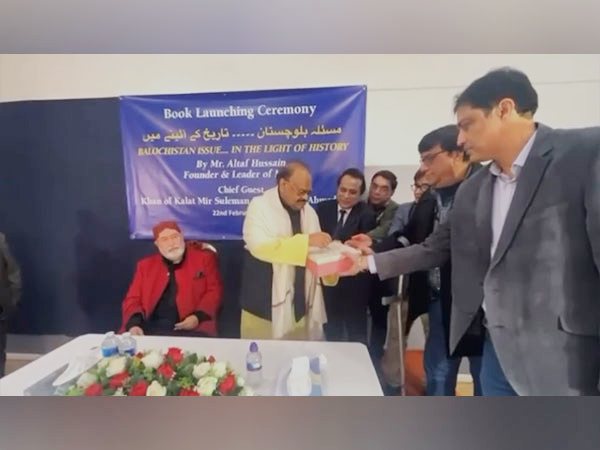
London [UK], February 24 (ANI): MQM supremo Altaf Hussain has called on Pakistan's military establishment to engage with the Baloch people on their own terms, urging the military to listen to their demands. In a significant statement made during the launch of his book, The Balochistan Issue: A Historical Perspective, Hussain extended an offer to Pakistan's Chief of Army Staff, General Asim Munir, expressing his willingness to engage in dialogue with the Baloch.
However, Hussain stressed that these talks should be held on the Baloch people's terms, not the army's. The event, held in a local hall in Edgware, London, saw a diverse audience, including representatives from Baloch and Sindhi organisations. The chief guest at the launch was Khan of Kalat, Mir Agha Suleman Dawood Jan Ahmedzai.
During his address, Altaf Hussain stated, "I have put the ball in General Asim Munir's court; now it is up to him to make a firm decision to resolve the conflicts once and for good. Just as he values his own children, he should also give importance to the Baloch people and all oppressed nations of Pakistan."
Hussain reiterated that MQM is not against any ethnic group, including Punjabis. "We are not against Punjabis, but the fact remains that the majority of the oppressive army is Punjabi," he remarked. He highlighted how the military's oppression against various ethnic groups, including Baloch, Muhajirs, Sindhis, and Pashtuns, has been met with silence from many, but he chose to speak out. "Instead of staying silent, I wrote a book to inform them about the causes and realities of the Balochistan issue," he said. "Historically, Balochistan was never a part of Pakistan; it was forcefully annexed on gunpoint instead." He added.
He thanked the Khan of Kalat for attending the event and pledged his unconditional support for the Baloch people's struggle for justice and recognition. Khan of Kalat, Mir Agha Suleman Dawood Jan Ahmedzai, the chief guest at the event, spoke about the insecurity faced by oppressed nations in Pakistan, particularly Muhajirs, who, like the Baloch, are victims of extrajudicial killings and enforced disappearances. "Muhajirs, Baloch, Pashtuns, Sindhis, Seraikis, Kashmiris, Baltistanis, and Gilgitis are all protesting against state oppression," he said.
Referring to the role of the military, he remarked, "An army is supposed to be a guardian, but our guardian has become the owner of our land. First, they became property dealers, then industrialists, and now they are feuds."
Khan of Kalat also raised concerns about global scrutiny of Pakistan's nuclear technology. "Libya has already revealed that Pakistan sold them nuclear technology," he noted, underscoring the ongoing investigations into the issue.
He expressed deep gratitude to Altaf Hussain for his book, which sheds light on the historical realities of Balochistan. He urged Hussain to mobilize the Muhajir and Baloch communities. "Muhajirs and Baloch must unite to reclaim their usurped rights. We own 64 per cent of the land. Baloch and Muhajirs are brothers, and together, we must stand against the oppressors and take what is rightfully ours," he declared.
He emphasised that "Rights are not granted upon request; they must be taken. Asking only gets you charity." Khan of Kalat also answered questions from the audience, elaborating on the historical, political, and geographical aspects of Balochistan's struggle.
Mir Agha Suleman Dawood Jan Ahmedzai is the 35th Khan (or Sultan) of the Kalat State. He has lived in the UK since 2006 and addressed a public gathering for the first time in 19 years during this event. This event marked a significant moment for both Altaf Hussain and Khan of Kalat as they jointly raised their voices for the oppressed nations within Pakistan, emphasising the need for unity and justice. (ANI)
Tags:
Get the App