 हिंदी खबर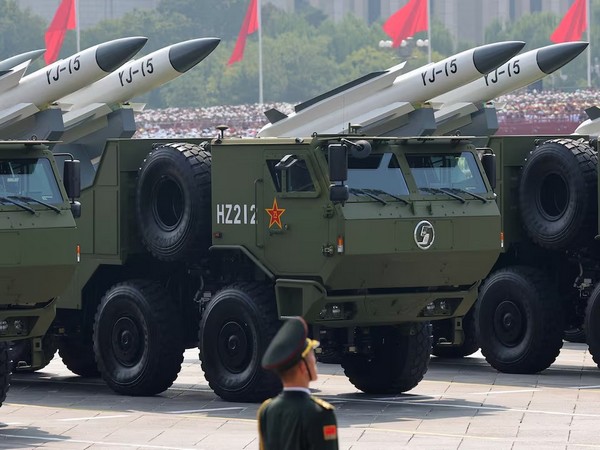

Hong Kong, September 9 (ANI): With Vladimir Putin and Kim Jong-un on his right and left hands respectively, Chairman Xi Jinping exulted in an extravagant military parade in Tiananmen Square in the heart of Beijing on 3 September.
Much of the equipment was officially unveiled for the first time, and real surprises were among them. Perhaps overall, the greatest impact - figuratively speaking - was achieved by the People's Liberation Army's (PLA) plethora of missile types.
The parade celebrated the 80th anniversary of the defeat of Japan in World War II, as the Chinese Communist Party (CCP) continues to hold the Japanese people responsible for war crimes committed nearly a century ago.
Attending the parade, Singapore's Deputy Prime Minister Gan Kim Yong later remarked, "We must never forget the price that comes with violence and war, nor take peace and prosperity for granted. However, we must also look ahead and not be trapped by history."
However, it suits the CCP to demonize Japan for this war that wreaked havoc across China. Of course, it is worth noting that it was Chinese nationalists and not the CCP that principally fought against the Japanese invaders.
In his speech before the parade kicked off, Xi remarked, "Comrades and friends, the Chinese nation is the great nation that is never intimidated by any bullies and always values independence and forges ahead. In the past, when faced with critical struggles between good and evil, light and darkness, progress and reaction, the Chinese people rallied together to defy the enemy."
Based on the sheer amount of advanced weaponry displayed by the PLA on 3 September, China obviously feels there is an enemy out there it must defy still.
China exhibited new types of anti-ship, surface-to-air, cruise, hypersonic and ballistic missiles, but one of the big surprises was a new intercontinental ballistic missile (ICBM) labeled the DF-61 of the PLA Rocket Force (PLARF). Little has been revealed about this new missile, especially when the similar-looking DF-41 ICBM was unveiled at a Beijing parade just six years ago.
It could be a modified version of the DF-41, but it must be different enough to warrant a new nomenclature. The DF-61's range is thousands of kilometers, permitting it to strike multiple targets over vast distances. It gives Beijing a more robust second-strike capability, and while it is unclear how many multiple independently targetable re-entry vehicles (MIRV) it has, some have suggested three 5Mt warheads.
The arrival of the DF-61 carried by a 16x16 launcher truck means the PLARF currently has nine types of land-based ICBM in service - five road-mobile and four silo-based.
The DF-61 was not the only new ICBM in the parade. Another was the DF-5C, a liquid-fueled missile launched from silos. The DF-5C was paraded in three parts, and the US Pentagon claims the DF-5C has a multi-megaton warhead. Its range is said to reach anywhere in the world, which means it can attack from any direction. It carries an unknown number of MIRVs, perhaps ten, some of which could be decoys or conventionally armed.
China might proclaim a "no first use" policy relating to nuclear weapons, but it sure has created a powerful and far-reaching nuclear arsenal. It is somewhat ironic that China says it is not engaging in a nuclear arms race with any country, even as it works hard to close the gap with Russia and the USA.
Also debuting was the DF-31BJ, which is an ICBM launched from underground silos. It was carried on a 16x16 transporter that presumably can load the DF-31BJ into underground silos. China has developed three large missile silo fields deep inside China, and the Pentagon reported last year that the PLARF had begun loading solid-fueled DF-31-class missiles into these silos. The DF-31BJ is designed for such a launch method, and its range is likely similar to the DF-31AG's estimated 11,200-13,000km reach.
In fact, Beijing showed its complete nuclear triad, as it also paraded the JL-1 air-launched nuclear-tipped missile, as well as the JL-3 submarine-launched ballistic missile. The latter has been arming the PLA Navy's (PLAN) Type 094A ballistic missile submarines since at least 2022. The JL-3 looks similar to the JL-2 paraded in 2019, although it does have a longer range of around 10,000km and it can thus reach the continental USA from launch positions within Chinese coastal waters. The JL-3 is said to carry an unspecified number of MIRVs, perhaps three.
This was the first time China had displayed an air-launched nuclear missile, and the JL-1, whose name translates to "sudden thunder", would be carried by H-6N strategic bombers. Its range could be in excess of 9,000km, and such an air-launched nuclear capability gives China greater flexibility and mobility.
This was the first time that a Chinese parade has featured a complete nuclear triad. China is clearly investing heavily in its stockpile of nuclear warheads, the most intensive expansion the world has ever seen. A commentator explained that the triad "is a strategic trump card for safeguarding national sovereignty and defending national dignity".
Turning to hypersonic missiles, three types appeared for roles such as breaking through island chains and for striking aircraft carriers. Hypersonic is defined as speeds exceeding Mach 5. One type was the DF-17 hypersonic glide vehicle that debuted in 2019, but a brand new one was the DF-26D intermediate-range ballistic missile (IRBM).
Again, China was coy in revealing the characteristics of this DF-26D, but given that it appeared within a hypersonic missile formation, it can be assumed that it adopts some form of hypersonic configuration like the DF-17 does. It is designed to fly beyond the Second Island Chain.
Conventional and nuclear-armed versions of the DF-26 "Guam killer", as it has been christened, already exist. The dual role of the DF-26 is particularly problematic, since an enemy would not know whether an incoming missile is carrying a conventional or nuclear warhead. Additionally, the YJ-21 is a hypersonic ballistic missile launched from H-6K bombers against either naval or land targets. This two-stage missile has a range of perhaps 1,500km, and it can strike high-value targets such as aircraft carriers.
Next up, the parade's cruise missile phalanx featured three weapons. One was the PLARF's CJ-1000 scramjet-powered land attack cruise missile. As China's first hypersonic cruise missile, the land-based CJ-1000 carried on a 10x10 truck improves upon the CJ-100 exhibited in 2019. It flies faster, is more maneuverable and can penetrate defenses better.
The second cruise missile was the air-launched, long-range CJ-20A designed to hit ground targets such as command nodes and underground hangars like those in Taiwan. Launched from an H-6K bomber, a missile like the CJ-20A can approach from unexpected directions.
Thirdly, the long-range YJ-18C is a land attack missile whose chiseled shape hints at signature reduction. It is probably subsonic but with a supersonic dash capability as it performs "surgical strikes" with its estimated 500kg warhead. Its launch platform is also unclear, whether submarine or surface combatants, but its range is said to reach beyond the First Island Chain.
Moving on to other missile types, there was a preponderance of PLAN naval missiles, with the parade announcer describing them as "vanguard weapons" thanks to their long range, high speed and destructive power. The relatively compact, supersonic YJ-15 is powered by a ducted ramjet, and it may succeed older designs like the YJ-12. This stealthy missile is estimated to be around 6.7m long and can be carried by J-15 fighters. It is optimized for high-speed, low-altitude flight for sea-skimming profiles. Its range may be in the order of 200km.
There were reportedly three hypersonic anti-ship missiles. Judging by the shape of its nose, the highly maneuverable YJ-17 is a boost-glide vehicle mounted on a first-stage booster and is capable of hypersonic speeds. This "waverider" missile skips off the shockwaves produced during high-speed flight, and it can make trajectory changes. It is probably fired from universal vertical launch systems (UVLS) such as those installed on Type 052D and Type 055 destroyers.
Similarly, the YJ-19 is believed to be a hypersonic cruise missile for use against ships or land targets. It has an air intake under its nose, indicating a scramjet. Its slender body suggests it can be launched from submarine torpedo tubes. It is likely intended for rapid strikes against high-value or time-sensitive targets, and if the above is correctly surmised, the YJ-19 would give any Chinese submarine the ability to launch hypersonic anti-ship missiles.
There was also a YJ-20 hypersonic glide missile with a biconical shape present in the parade. This multistage anti-ship missile was known to have been fired from a Type 055 several years ago. It combines the speed of a ballistic missile, but its terminal stage can maneuver so it could hit a target such as an aircraft carrier near vertically. It is launched from a UVLS on larger warships, though some Chinese media claim it can be launched from H-6K bomber aircraft or a submarine too.
Such a range of missile configurations and launch platforms make Chinese attacks on naval vessels unpredictable and difficult to defeat. These different weapons could also be used simultaneously, multiplying the complexity of defending a warship.
Air defense was also well represented in Xi's parade. As well as the short-range HQ-11, the longer-ranged HQ-20 and the HQ-22A long-range systems, the most notable surface-to-air missile was the HQ-29. Two such anti-ballistic missile and anti-satellite weapons are mounted on each 12x12 launcher truck.
The HQ-29 can target either incoming missiles at very high altitudes, or it can reach out to strike enemy satellites operating in low-Earth orbit. Indeed, Chinese media describe it as a "double-barreled satellite hunter," and this road-mobile HQ-29 becomes an important element in China's strategic air defense network.
Also unveiled was the HQ-9C, whose missile diameter is smaller than the preceding HQ-9B, but it still likely has a range in excess of 250km.
The equivalent of an American PAC-3 MSE missile, the HQ-9C can assume a point defense role in anti- ballistic missile engagements. Moving on, the HQ-19 is an anti-ballistic missile weapon too, the Chinese facsimile of the American THAAD for high-atmospheric and low exo-atmospheric interceptions of ballistic missiles. It can likely reach an altitude of 200km. The HQ-19 is the backbone of the PLA's anti-missile capability.
Elsewhere, the shipboard, medium-range HQ-16C is also an air defense missile. It likely arms Type 054A/B frigates. The HQ-16 is the Chinese equivalent of the ESSM, with the HQ-16C introducing larger control surfaces and possibly a new motor. Some sources attribute it with a 100-120km range and 15-40km intercept altitude. It is designed to intercept both subsonic and supersonic anti-ship cruise missiles.
Also on parade was the HHQ-9C long-range air defense missile, which is larger than the HQ-16C. More slender than its predecessors, the missile has a larger booster and employs attitude control thrusters instead of flight control surfaces. It is speculated that it might be able to perform high-altitude, endo-atmospheric intercepts against ballistic missiles. Its compact size may enable dual-packing in a UVLS.
There were thus missiles galore at Xi's grand gala in Tiananmen Square. Approximately 26 international heads of state attended the event, including those from democracy-resistant bastions like Belarus, Cambodia, Cuba, Iran, Lao, Myanmar, Pakistan, Vietnam and, of course, North Korea and Russia. This rogue's gallery of authoritarian states illustrated the type of company China likes to keep.
Xi said in his speech, "We should stay firmly on the path of socialism with Chinese characteristics and carry forward the great spirit of the war of resistance. We should press ahead with enterprise and resolve and advance the unity for the cause of building China into a great country on all fronts and realizing great national rejuvenation through Chinese modernization. The great rejuvenation of the Chinese nation is irresistible, the noble cause of peace and development of humanity will prevail."
It was therefore quite incongruous that 71-year-old Xi, who would like to live to 150 with the assistance of medical technology, was using a military parade and a procession of nuclear weapons to advance the "noble cause of peace and development". (ANI)




