MEA denies Bloomberg report on 'secret' letter from Chinese President Xi to President Murmu
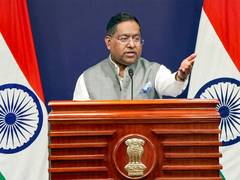
"We have seen the report and can confirm that the story of the letter is incorrect," MEA spokesperson Randhir Jaiswal said while addressing the press conference.
ANI
Sep 06, 2025 10:32 IST

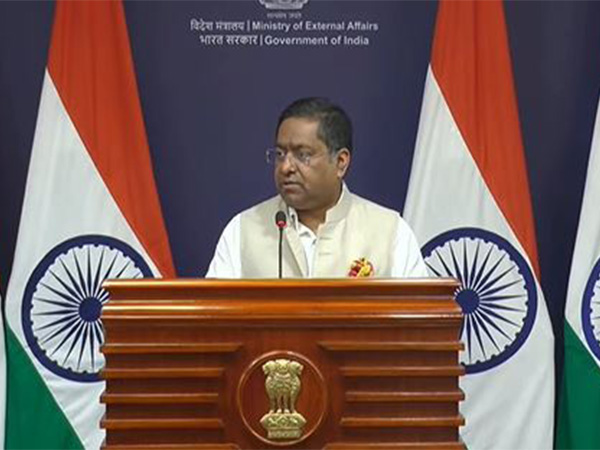
New Delhi [India], September 6 (ANI): The Ministry of External Affairs (MEA) on Friday dismissed a Bloomberg report claiming that Chinese President Xi Jinping had sent a 'secret' letter to President Droupadi Murmu.
"We have seen the report and can confirm that the story of the letter is incorrect," MEA spokesperson Randhir Jaiswal said while addressing the press conference.
The Bloomberg report claimed that the letter raised concerns over US agreements that could affect China's interests and named a provincial official responsible for managing Beijing's actions.
Amid these claims, the MEA highlighted ongoing high-level engagements between the two countries. Last month, on August 31, Prime Minister Narendra Modi invited Chinese President Xi Jinping to the BRICS Summit that India will host in 2026, the MEA said. President Xi thanked Prime Minister Modi for the invitation and offered China's support for India's upcoming BRICS Presidency. India is set to take over leadership of BRICS from the current president, Brazil.
This spirit of cooperation also carried forward into their recent face-to-face engagement. During their meeting on the sidelines of the Shanghai Cooperation Organisation (SCO) Summit in Tianjin, PM Modi also expressed support for China's SCO Presidency and the Summit in Tianjin, the MEA added. The two leaders had previously met in Kazan, Russia, in 2024 on the sidelines of the BRICS Summit.
These exchanges came on the back of India's growing role within BRICS. In July, PM Modi, during the BRICS summit in Rio de Janeiro, outlined India's vision for the grouping, saying it will attempt to give BRICS a "new form" next year. He defined BRICS as Building Resilience and Innovation for Cooperation and Sustainability and emphasised prioritising the issues of the Global South, similar to India's G-20 chairmanship approach.
That vision shaped the deliberations of the 17th BRICS Summit, held under the theme "Strengthening Global South Cooperation for a More Inclusive and Sustainable Governance," which saw participation from President Xi via video conference. Strategic commitments were adopted across global governance, finance, health, AI, climate change, and peace and security. In addition, BRICS leaders endorsed three supplementary frameworks: the BRICS Leaders' Framework Declaration on Climate Finance, the BRICS Leaders' Declaration on Global Governance of Artificial Intelligence, and the BRICS Partnership for the Elimination of Socially Determined Diseases.
Building on these decisions, the Leaders' Framework Declaration on Climate Finance marked a first-of-its-kind collective BRICS commitment under the UNFCCC and the Paris Agreement, proposing the mobilisation of USD 300 billion annually by 2035 for climate-related investments with an emphasis on accessible, timely, and concessional finance. The Rio de Janeiro summit also announced the establishment of a BRICS Climate Research Platform to harmonise data, share best practices, and advance joint modelling.
Alongside climate commitments, BRICS leaders also looked at technology and development. The BRICS Leaders' Statement on Global Governance of Artificial Intelligence underlined that AI must advance inclusive development, reduce digital inequalities, and empower the Global South through UN-led frameworks. The BRICS grouping includes Brazil, Russia, India, China, South Africa, and Saudi Arabia, Egypt, the UAE, Ethiopia, Indonesia, and Iran, serving as a political and diplomatic coordination forum for countries in the Global South.
While BRICS cooperation expanded, India and China also focused on bilateral matters. During his bilateral meeting with President Xi in Tianjin, PM Modi highlighted the importance of peace and tranquillity along the border for the continued development of bilateral relations. Both leaders noted the successful disengagement last year and the subsequent maintenance of peace. They reaffirmed their commitment to a fair, reasonable, and mutually acceptable resolution of the boundary question, recognising the decisions made by their Special Representatives earlier this month and agreeing to support their efforts further.
This reaffirmation also set the tone for broader engagement. The leaders welcomed positive momentum and steady progress in bilateral ties since their last meeting in Kazan, reaffirming that India and China are development partners, not rivals, and differences should not turn into disputes. They emphasised that a stable relationship, founded on mutual respect, shared interests, and sensitivity, is crucial for the growth of both countries, as well as for a multipolar world and Asia in the 21st century.
To further strengthen ties, the two leaders also emphasised the importance of strengthening people-to-people ties through direct flights and visa facilitation, including the resumption of the Kailash Manasarovar Yatra and tourist visas. On economic and trade relations, they recognised the role of their economies in stabilising world trade, stressing the need for political and strategic guidance to expand trade, investment, and reduce the trade deficit.
Underscoring their independent approaches, PM Modi highlighted that India and China pursue strategic autonomy, and their relations should not be viewed through the lens of a third country. Both leaders agreed to expand common ground on bilateral, regional, and global issues, such as terrorism and fair trade, in multilateral platforms.
Adding further weight to these engagements, PM Modi also held a meeting with Cai Qi, Member of the Standing Committee of the Politburo of the Communist Party of China, sharing his vision for bilateral relations and seeking support to realise the shared vision. Cai reiterated China's desire to expand bilateral exchanges and further improve relations in line with the consensus reached between the two leaders. (ANI)
Tags:
Get the App