 हिंदी खबर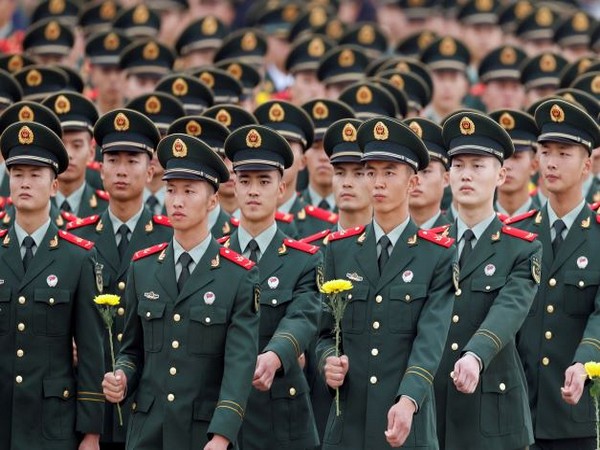

Hong Kong, August 16 (ANI): The People’s Liberation Army (PLA), an armed force beholden to the Chinese Communist Party, is the world’s largest military. Its pursuit of “jointness” between the various armed services has been made evident in the recent blockade of a Philippine outpost in the South China Sea, and in the recent transfer of naval aviation assets into the hands of the PLA Air Force.
On 5 August, forces of the PLA Navy (PLAN), China Coast Guard (CCG) and People’s Armed Forces Maritime Militia combined to prevent Philippine Coast Guard vessels from resupplying a dozen marines aboard BRP Sierra Madre, a rusting vessel that forms a Philippine military outpost at Second Thomas Shoal in the Spratly Islands.
It was deliberately beached there in 1999 to maintain Manila’s territorial claim in the face of Chinese encroachment, specifically its occupation of the then uninhabited Mischief Reef sitting 37.8km away. Clearly, by blockading Philippine vessels in this way, China has raised aggression a further notch, using water cannons and their larger ship hulls to prevent the monthly resupply of military personnel at Second Thomas Shoal within the Philippine exclusive economic zone. CCG vessels even tried to ram smaller Philippine resupply boats.
Without any legal justification, China stated: “We urge the Philippine side to immediately stop its infringing activities in these waters. China has indisputable sovereignty over the Nansha Islands and their adjacent waters, including the Second Thomas Shoal. The China Coast Guard will continue to carry out rights protection and law enforcement activities in waters under China’s jurisdiction according to law.”
The shoal is about 200 km from the Philippine island of Palawan, but more than 1,000 km from China’s nearest landmass of Hainan Island. In no uncertain terms, the Permanent Court of Arbitration proclaimed in 2016 that China has no claims there.
China is seeking to push the Philippines off this reef, as it will then have a clear path to claiming more of the South China Sea. Using the Filipino name for the shoal, Jonathan Malaya, the Philippine National Security Council spokesman, warned, “For the record, we will never abandon Ayungin Shoal.”
Unlike predecessor Rodrigo Duterte, who allowed China to trample over Philippine territorial claims, the current Philippine administration has taken a stronger line against Chinese coercion. Beijing was also willing to endure sharp criticism from the likes of Australia, Canada, France, Germany, Japan, the UK and USA for its actions. China is illegally blocking Philippine territory, practicing dangerous maneuvers at sea, and so it must face more than mild approbation for its actions. A US State Department spokesman warned that attacks on Philippine vessels, armed forces or aircraft would invoke the 1951 Mutual Defense Treaty.
Will Manila, with US support, even consider building a more permanent structure on the reef?
The Philippines will have to resupply its garrison on the dilapidated vessel within two weeks, so it will likely employ different tactics. In 2014 it resorted to an airdrop. If the Philippines uses helicopters in the future, for example, this would make it more difficult for China to intercept resupply runs, but it could escalate Chinese aggression.
While Beijing easily has the ability to up the ante – by capturing the rusting hull on Second Thomas Shoal by force, for instance – this would be escalatory as it could bring the USA into the equation. So far, China has been willing to play a long game at Second Thomas Shoal, but it is now pressing the issue. This water cannon incident can be viewed as a skirmish in a longer war. The end game, as far as China is concerned, is to seize the reef and thus to push the Philippines out completely.
Video footage of the incident showed the close cooperation between the PLAN, CCG and maritime militia. They worked seamlessly to pummel and prevent one of the vessels from reaching BRP Sierra Madre. Elsewhere, the PLA has taken a major move towards rationalizing aviation units to further improve jointness, a long-held ambition of China’s military. “Jointness” is defined as “the integration of the strengths of at least two limbs of the military in a coordinated effort to achieve a common goal”. This important restructuring of the PLAN and PLA Air Force (PLAAF) covers at least three fighter brigades, two bomber regiments, three radar brigades, three air defense brigades and numerous airfield stations. China has remained silent on why this reorganization has occurred, but this is typical for a country paranoid about national security.
In August, the China Aerospace Studies Institute (CASI), a think-tank affiliated with the US Department of the Air Force, released a report discussing these recent changes. Entitled “PLA Naval Aviation Reorganization 2023”, the author Rod Lee said the majority of aviation units had moved to the PLAAF by midyear. This conclusion was based on press reports, imagery showing former PLAN personnel now wearing PLAAF uniforms, and units that have been explicitly identified as air force units.
The most pertinent question is this, why has China transferred naval aviation units almost wholesale to the air force?
In one sense, it will make missions such as maritime strike far more complicated. As the PLAN previously owned JH-7 fighter-bombers and H-6 bombers capable of striking naval targets, the navy could conduct such missions without the kinetic support of any other PLA service. Now, such tasks will fall under the remit of theater joint command systems, and this will place greater demands on the latter.
Nonetheless, Lee pointed out that this move is consistent with what the PLA has been trying to achieve in promoting jointness. “…Between the growing emphasis on multi-domain operations, PLAAF maritime strike capabilities and PLA Rocket Force multi-domain fires, an increasing portion of maritime strike missions are joint in nature. As such, aligning all air-based maritime strike capabilities under the PLAAF is in line with preexisting joint command modernization efforts.”
Lee continued: “Despite this loss of kinetic capabilities, the PLAN still has organic information enablers in the form airborne early warning (AEW) aircraft; intelligence, surveillance and reconnaissance aircraft; anti-submarine aircraft; as well as unmanned aerial vehicles (UAV). If the PLA had removed these airborne assets from PLAN control, then the PLAN would constantly have to ask for support or control over said PLAAF assets. This, in turn, could significantly strain theater headquarters, theater navy and theater air force staff workloads as they attempt to manage PLAN requests for PLAAF assets.”
A side issue is how much aerial minelaying capability the PLAN will retain. Aircraft like the JH-7 and H-6 can drop sea mines. However, with these platforms given to the PLAAF, only Y-9 anti-submarine warfare aircraft will be left with this ability.
Will the PLAAF introduce mine-laying as part of its training curriculum, or will it leave this skill in the PLAN’s hands?
Lee voiced two key benefits that this transition to PLAAF command will bring for air operations. “Firstly…the PLA improves administrative management over these types of forces. Under the previous arrangement of the PLAN having its own fighter, bomber, air defense and air surveillance radar units separate from the PLAAF, the PLA had two separated management chains over similar types of personnel and equipment. For example, PLAN and PLAAF H-6 bomber pilots adhered to different training guidance despite flying the same airframe. Bringing similar types of units under the same administrative structure streamlines bureaucratic duplication and improves standardization across units with identical functions.”
Lee listed the second advantage too. “…This realignment also unifies all defensive air operations under theater command air forces rather than having it split between two theater services. Prior to the realignment, PLAN units appeared to have exclusive responsibility over air defense missions in certain parts of PRC airspace, including a roughly 250km swath of coastline between Zhoushan and Wenzhou along with the entirety of Hainan Island. There were no PLAAF radar or ground-based air defense units covering these coastal areas, and the closest ground-based fighter units were often a PLAN aviation unit. By realigning these former PLAN units under the PLAAF, the PLA did away with a potential geographic seam in the command and control of air defense missions.”
This move will also help the PLAN improve its carrier-based aviation force. This force currently comprises two J-15 fighter brigades that embark aboard China’s two active aircraft carriers, with a third carrier currently being fitted out. The PLAN is awaiting modern, stealthy carrier-borne fighters and new KJ-600 AEW aircraft that are facsimiles of the American E-2 Hawkeye. Lee noted, “By divesting themselves of thousands of billets, multiple pieces of infrastructure and numerous airframes, the PLAN is now free to pursue a more carrier-centric force within the constraints of its current level of resourcing.”
What about the impact on the PLAAF?
It has received relatively modern platforms from the navy, but the task of maintaining two dozen regiments and brigades will require further commitments of personnel and resources. Nonetheless, radar sites in littoral areas will greatly improve the PLAAF’s surveillance coverage, while extra H-6 bombers will permit it to commit more airframes to the nuclear mission. Lee concluded: “In all, this shift represents a noticeable change in the way the PLA organizes itself. Whether this was done voluntarily by the services or mandated from above, doing away with redundant capabilities across services demonstrates a marked improvement in PLA jointness.”
Significantly, the PLAN has retained some aviation-related units, including helicopter, UAV, the aforementioned carrier-based units and a single fighter unit (the 8th Aviation Brigade). Also remaining under its order of battle are several aviation training units, headquarters elements and some airfield stations. Lee was uncertain as to why the PLAN has kept the 8th Aviation Brigade, though he did speculate: “It is possible that the PLAN wants to retain at least a small ground-based fighter inventory to help support extensive operations in the South China Sea. Alternatively, this unit may be slated for conversion to a carrier-based fighter like the J-15. However, the latter hypothesis runs contrary to the PLAN’s typical model of standing up new carrier-based aviation units rather than converting pre-existing formations.”
According to data compiled by CASI, the PLAAF in the Eastern Theater Command has absorbed the 4th Aviation Brigade, 6th Aviation Brigade, Eastern Theater Navy (ETN) Bomber Regiment, ETN Air Defense Brigade and 2nd Radar Brigade. Remaining under the PLAN is the ETN 1st Aviation Division (containing special mission aircraft), ETN UAV Regiment and Helicopter Regiment. The navy keeps control of Feidong Air Base, where J-15 fighters and helicopters are stationed. As for the Southern Theater Command, the navy has divested itself of the 9th Aviation Brigade, Southern Theater Navy (STN) Bomber Regiment, STN Air Defense Brigade and 3rd Radar Brigade. However, the PLAN has retained the 8th Aviation Brigade, 10th Aviation Brigade (with J-15 fighters), 3rd Aviation Division (special mission aircraft), STN UAV Regiment and Helicopter Regiment. Concerning the Northern Theater Command, the Northern Theater Navy (NTN) Air Defense Brigade and 4th Radar Brigade have been turned over to the PLAAF.
Elsewhere, the navy still controls the 11th Aviation Regiment (with J-15s), 2nd Aviation Division (with special mission aircraft), NTN Helicopter Regiment, and assets under the PLAN Aviation University, Carrier Aircraft Test and Training Base, and PLAN Headquarters. The status of the 5th Aviation Brigade remains uncertain, according to CASI.
These changes in the PLAN and PLAAF are significant, a further step in the Chinese military’s journey to become more combat-effective and better able to work together. This all bodes ill, as China’s ongoing coercion of Taiwan demonstrates as it continuously flies aircraft towards and near Taiwan. Even while wildly blaming others for stoking tensions, China is ramping up its pummeling of Taiwan and anyone else who dares to defend their island territories or to sail or fly through international waterways and airspace. (ANI)




