 हिंदी खबर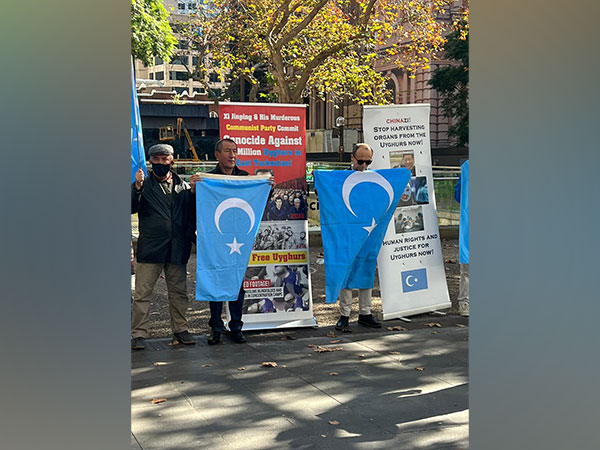

Hong Kong, May 31 (ANI): A cache of tens of thousands of leaked documents from the Chinese police and re-education camps have confirmed that the top leadership of the Chinese Communist Party (CCP) - reaching right to Chairman Xi Jinping at the top - are totally complicit in the human rights atrocities occurring in China's northwest province of Xinjiang.
The number of Uyghur inmates in Xinjiang's notorious concentration camps - which China calls "vocational skills education and training centers" - peaked in 2018-19, and perhaps up to two million had suffered imprisonment by 2020.
The Chinese government admits that these camps "wash brains", "cleanse hearts" and "remove evil". Muslim internees are punished and brainwashed in these camps that dramatically filled up from 2017 onwards, many detained for no other reason than that Beijing claimed they were "untrustworthy persons".
The so-called Xinjiang Police Files were "obtained" from Public Security Bureau computers in Konasheher and Tekes counties in Xinjiang. They contained a multiplicity of material such as police training PowerPoint presentations as well as sensitive files, photos and speech transcripts. The vast amount of material helped authenticate their veracity, for their level of detail could only have come from the Chinese government.
After arriving in Xinjiang from Tibet, Xinjiang Party Secretary Chen Quanguo commenced a five-year work plan to subjugate the restive province. The plan had these phases: in year one (2017) "stabilize" the region; in year two (2018) "consolidate" those gains; in year three (2019) achieve "basic normalization" of the new conditions; and by the fifth year (2021) reach "comprehensive stability".
What can be learnt from the Xinjiang Police Files?
Adrian Zenz, a German academic who is one of the world's foremost researchers on Chinese actions in Xinjiang, said the material was "unprecedented". He also ensured the documents were verified by peers and a consortium of 13 media outlets to verify their authenticity. Firstly, Zenz said, it included high-level speeches that implicated China's top leadership and contained very blunt language.
For example, Chen Quanguo admitted in a leaked transcript of one speech on 18 June 2018, that his authorization to suppress the Uyghur populace came directly from Xi. "The general secretary sent me to Xinjiang; first, not in order to be an official; second, not in order to make a fortune; third, not in order to have nothing but an empty title. [Rather,] the general secretary sent me to Xinjiang in order to make a stable Xinjiang arise..."
Personalization became supreme, with Chen justifying his policies as having Xi's blessing. Such was his fervor that he frequently issued death threats in various speeches against any who resist the state.
Then, in December 2021, the CCP appointed Ma Xingru as new party secretary in Xinjiang, replacing the Machiavellian Chen Quanguo. The fact that Chen was replaced by a technocrat suggests that his scheme had gone precisely according to plan - mission accomplished. This also accords with evidence that some overt forms of surveillance (for example, checkpoints on streets) have drawn down in Xinjiang in recent times.
In another transcript from a speech by Minister of Public Security Zhao Kezhi on 15 June 2018, after a five-day investigative visit to Xinjiang, Zhao offered support for international estimates that between one and two million people were incarcerated. His speech also showed that Xi himself was personally aware of the campaign, and that he issued instructions that enabled its expansion.
What else can be learned from the Xinjiang Police Files?
Secondly, according to Zenz, the world now has far more details concerning camp security instructions. As well as regular guards, camps possessed heavily armed strike units equipped with assault rifles. Their duties included armed patrols to "intimidate" detainees, to escort prisoners, to guard inmates during class hours (they carried shields, batons and handcuffs) and to suppress riots.
Guards in watchtowers possess sniper rifles and light machine guns, although only Han Chinese officers are allowed to carry firearms. Perhaps 150,000 police recruits from around China were sent to Xinjiang in 2018 to guard the mass influx of prisoners.
Chen's February 2018 speech highlighted the need for "absolute security of vocational skills education and training centers and internment facilities". Indeed, he was preoccupied with camp security, authorizing troops to shoot first and ask questions later if any camp were attacked externally. Chen also issued shoot-to-kill orders in case any prisoner tried to escape, a policy contrary to national police tactics. Chen brutally argued that when police made arrests, especially of those returning from other countries, they should "arrest them as soon as they see them" and "deal with them as with serious criminal offenders". That includes handcuffing them, blindfold them and using ankle shackles if needed.
The party secretary said China was unlike the USSR because "we have the wise leadership of General Secretary Xi Jinping and the backing of 1.3 billion of the people and millions of troops". He boasted in a May 2017 speech that 100,000 members of the People's Armed Police were actively hunting down and capturing suspects.
The intimidation and security measures were obviously effective. There are no eyewitness reports of anyone ever successfully escaping from these camps.
Thirdly, The Xinjiang Police Files included vivid photos of police drills and tactics at these camps, as well as more than 5,000 images of Uyghur suspects photographed at detention centers and police stations.
Of these photos, 2,884 were interned, the youngest of which was a 14-year-old girl named Rahile Omer. Her crime was being the daughter of a government official detained as part of Xinjiang's "strike hard" campaign in 2017. In fact, 424 of these photos depicted minors.
Fourthly, sets of spreadsheets showed the vast scale of the internments. In 2017/18, for example, more than 12% of the entire Uyghur adult population in Konasheher county was imprisoned simultaneously. This rate was 64 times the national imprisonment rate for China.
Under Chen's tutelage, Xinjiang became a "high-tech penal colony. Not only that, but China enacted the severest social engineering effort since the convoluted rule of Mao Zedong in the Cultural Revolution.
Chen observed there was a "bottom line" that cannot be crossed: detainees cannot be released, because "once they are let out, problems will immediately appear. He argued that they "must not be let out," because "some may not necessarily have been transformed well even after three or five years. It is notable that in 2018/19, the government started sentencing prisoners to longer sentences.
There is yet another aspect to be learned from the release of this treasure trove of Xinjiang documents. Importantly, it goes some way to answering why Xi and the CCP became so ruthless in their suppression of Xinjiang and its Muslim inhabitants, treating a whole ethnic group like a gang of dangerous criminals.
It can be said that Xinjiang entered a "crisis mode", one featuring increased centralization, personalization, militant mobilization rhetoric and impassioned demands, increased influence of disciplinary and security organs, and a greater role of ideology in decision-making. Exploring this, in an article published in the Journal of the European Association for Chinese Studies in May 2022, Zenz offered this assessment: "Scholars have argued that political paranoia is a common feature of atrocity crimes. Here, it is suggested that the preemptive internment of large numbers of ordinary citizens can be explained as a devolution into political paranoia that promotes exaggerated threat perceptions."
Central government figures have argued in classified speeches that if the Xinjiang situation were not handled properly, it would threaten the realization of China's most important political goals in the 21st century. "This intimate link between Xinjiang policy and major national political goals, also extensively highlighted by Xi Jinping in his internal speeches from 2014, explains the highly personalized, ideologized, militarized and mobilizational nature of the region's policy dynamics."
Questions definitely do need to be asked as to why an antiterrorism crackdown degenerated into mass and arbitrary detention of so many innocent citizens that were punished like radical villains.
Zenz suggested that the escalation of Xinjiang's de-extremification measures is partially explained by the state sincerely adopting a terror threat perception, but that this perception was then greatly and unjustifiably amplified. Furthermore, "The framing of entire ethnic groups as threats, and the attendant extreme preoccupations with security in the campaign's execution, reflected a devolution into paranoia."
Such paranoia can be rooted in reality - for terrorist acts were perpetrated by Uyghurs - but that threat became greatly exaggerated. Such lessons are easily observed in Nazi Germany, where political paranoia led to radical anti-Jewish measures that escalated even further after war broke out.
Zenz elaborated: "The paranoid-schizoid position uses projective identification and splitting to project the hated parts of the self out and onto the 'Other', while simultaneously idealizing the good within oneself. This psychological defense mechanism can explain how Xi Jinping, Chen Quanguo and other leaders came to frame Uyghurs as a pathological threat, while simultaneously portraying themselves as their kind benefactors."
Xi initially delineated the "enemy" as those who act directly against the state. Zenz explained, "However, anyone who cannot be controlled is 'untrustworthy' because they could conceivably end up resisting the state in some form. This creates a devolutionary logic by which the 'enemy' is no longer just those who actually engage in violent resistance, but also persons who are potentially 'untrustworthy' because the state fails to ascertain their state of mind."
China has convinced itself that permanent security is necessary - in other words, it must have invulnerability to threats - but such a state is truly unobtainable.
Nonetheless, in its hubris and paranoia, China has sought such a goal even if it ends up indiscriminately targeting entire ethnic groups. It irrationally believes the only way to do so is to put the "untrustworthy" in prisons, which are "trustworthy" places, even if the human rights and decency of millions are trampled upon. (ANI)




