 हिंदी खबर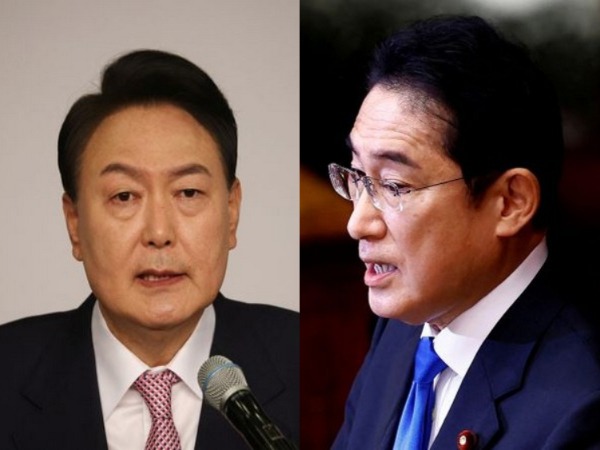

Tokyo [Japan], March 21 (ANI): In the world of fast-paced diplomatic activity, Japan and South Korea have shown that they can no longer remain strange bedfellows when China is racing against time to dictate its terms in the Indo-Pacific region.
For the first time after a gap of 12 years, the two countries held their formal summit in Tokyo on March 16, settling the vexatious wartime labour issue while promising to turn a new leaf in their relationship on several fronts, including diplomacy, security, and economic cooperation. The last formal summit between Tokyo and Seoul was held in December 2011 when then-South Korean President Lee Myung-bak visited Japan.
In November 2015, then-Japanese Prime Minister Shinzo Abe visited Seoul to hold a trilateral meeting with then-South Korean President Park Geun-hye and Chinese Prime Minister Li Keqiang, said the Japan Times. However, President Yoon Suk-yeol became the first South Korean leader to visit Japan since President Moon Jae-in's trip to Osaka for a G20 summit in June 2019.
The development took place a day after North Korea fired another ballistic missile that landed in the sea between the Korean Peninsula and Japan and three months after China and Russia conducted their last joint naval exercise in December 2022. The joint exercise witnessed the Chinese navy deploying several surface warships, aircraft, and a submarine for the exercise, while Russia had deployed the Varyag missile cruiser, the Marshal Shaposhnikov destroyer and two corvettes of Russia's Pacific fleet. The exercise was held in the East China Sea.
It is in this background that the Japan-South Korea summit assumed high significance as it offered the two countries an opportunity to draw a roadmap to counter security threats unitedly in the Pacific region. According to Japan's Kyodo news agency, foreign and defence ministry officials of the two countries will soon resume talks on security.
A hint of bolstering security cooperation with Japan was given by the South Korean in a written interview with international media, published a day before his visit to Japan for the summit. Yoon Suk-yeol stressed an increasing need for Seoul and Tokyo to strengthen cooperation in the face of mounting crisis--from North Korea's nuclear and missile threat to Chinese President Xi Jinping asking the PLA to be prepared for a war to disruption of supply chains crucial to both the South Korean and the Japanese economies.
"We cannot afford to waste time while leaving strained Korea-Japan relations unattended," South Korean President Yoon Suk-yeol said. And, this sentiment got reflected in abundance when the Japanese Prime Minister and the South Korean President agreed to drop an almost four-year-old dispute on high-tech materials and pledged to work together against deepening security threats.
Experts see it as a big slap on the face of those who tried to create a wedge between the two countries. "Part of China's entire strategy is division," US Ambassador to Japan, Rahm Emanuel was quoted by The Wall Street Journal as saying. There is a concern in the international community that China is protecting North Korea and is speaking as the reclusive state's advocate on its continued ballistic missile launches and nuclear threats.
In this context, experts cite China's Foreign Ministry Spokesperson Wang Wenbin's recent statement when he said, "The crux of how the Korean Peninsula situation gets to where it is today is clear. The main reason is that the parties concerned have refused to respond to denuclearization measures taken by the DPRK, and continued to intensify their pressurising and deterring of the DPRK."
However, Japan-South Korea friendship is expected to have a far-reaching impact on the geopolitics of the Indo-Pacific region where Quad is enhancing its diplomatic and strategic leverages. South Korea has planned to "proactively accelerate" its participation in the Quad's working group, said Yonhap, a South Korean news agency.
Seoul will offer "functional cooperation" by joining the Quad's working group on vaccines, climate change and new technologies, Yonhap said. This is seen as the beginning of the formal joining of South Korea in the US, Japanese, India and Australia-led group, a significant development in the backdrop of China's militaristic move in the Taiwan Strait, the South China Sea, and other parts of the Indo-Pacific region.
In fact, Yoon Suk Yeol is fast-forwarding South Korea's security and strategic interests. In June 2022, he became the first South Korean leader to attend a NATO summit as an observer in Spain. In his speech at the summit, he said, "As a new structure of competitions and conflicts is taking shape, there is also a movement that denies the universal values that we have been protecting." Seoul's move to improve relations with Japan, join Quad's working group and enhance its engagement with NATO should be seen in this background, experts say.
But is China happy with this development? It does not seem so. Instead, Beijing seems to be reminding its countrymen and South Koreans of Japan's past behaviour with the Chinese and Koreans.
"The aggression and colonial rule of Japanese militarism inflicted untold sufferings on China, the ROK and other Asian countries. Past experience, if not forgotten, is a guide for the future. We have all along asked Japan to deeply reflect on its history of aggression, properly handle historical issues with an honest and responsible attitude, and on this basis develop normal state-to-state relations with its neighbours," Chinese Foreign Ministry Spokesperson Wang Wenbin said. Whatever be China's opinion regarding the coming together of Japan and South Korea, the development appears to have rattled Chinese leadership. (ANI)


