ISRO-NASA's NISAR satellite to track movements of Earth’s land, ice surfaces in extremely fine detail
Two major components of the NISAR satellite have been combined to create a single spacecraft in Bengaluru, India. The NISAR satellite will deepen understanding of climate change, deforestation, glacier melt, volcanoes, earthquakes and other issues.
ANI
Jul 14, 2023 09:03 IST

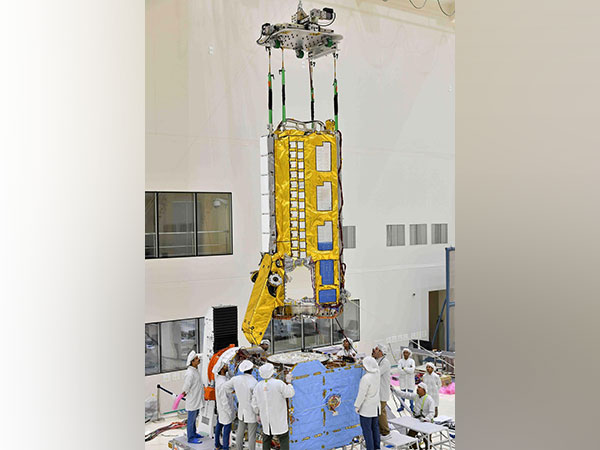
New Delhi [India], July 14 (ANI): The NISAR satellite, which has been developed in Bengaluru, in a collaboration between the National Aeronautics and Space Administration (NASA) and the Indian Space Research Organisation (ISRO) will deepen understanding of earth’s dynamics and provide detailed insights of environmental phenomenon.
The NISAR — short for NASA-ISRO Synthetic Aperture Radar — is being jointly developed by the two organisations, to track movements of Earth’s land and ice surfaces in extremely fine detail, and is all set to launch in early 2024, NASA informed in a press release.
Two major components of the NISAR satellite have been combined to create a single spacecraft in Bengaluru, India.
The NISAR satellite will deepen understanding of climate change, deforestation, glacier melt, volcanoes, earthquakes and other issues.
As NISAR monitors nearly every part of our planet at least once every 12 days, the satellite will also help scientists understand, among other observables, the dynamics of forests, wetlands, and agricultural lands, NASA stated in its release.
“A crane is used to align NISAR’s radar instrument payload, seen partially wrapped in gold-coloured thermal blanketing, with the satellite’s spacecraft bus, which is inside blue blanketing, in an ISRO clean room in Bengaluru, India, in June,” the release stated.
The satellite’s cylindrical radar instrument payload contains two radar systems and is about the size of an SUV and partially wrapped in gold-coloured thermal blanketing.
The S-band radar is particularly useful for monitoring crop structure and the roughness of land and ice surfaces, while the L-band instrument can penetrate denser forest canopies to study the woody trunks of trees, among other observables, the release added.
The wavelengths of the S-band and L-band signals are about 4 inches (10 centimetres) and 10 inches (25 centimetres), respectively, and both sensors have the potential to see through clouds and collect data day and night.
“The payload took a roundabout journey to get to this point. The S-band radar was built at the Space Applications Centre in Ahmedabad in western India, then flown in March 2021 to NASA’s Jet Propulsion Laboratory (JPL) in Southern California, where engineers had been developing NISAR’s L-band radar. At JPL, the two systems were fixed to the payload’s barrel-like frame before being flown to the U R Rao Satellite Centre (URSC) in the southern Indian city of Bengaluru in March 2023,” the release stated.
It added, “The engineers and technicians at URSC, collaborating with teams from JPL, were busy developing the spacecraft’s main body, or bus, which is covered in blue blanketing that protects it during assembly and testing prior to launch. The bus, which includes components and systems developed by both ISRO and JPL, will provide power, navigation, pointing control, and communications for the mission”.
After the radar payload and bus were joined in a URSC clean room in June this year, NASA and ISRO teams have been working together to route thousands of feet of cabling between them.
However, the satellite’s solar panels, as well as the drum-shaped, wire-mesh reflector that will unfold from the end of a 30-foot (9-meter) boom, are still to be attached.
At nearly 40 feet (12 meters) in diameter, the reflector will be the largest radar antenna of its kind ever launched into space, the NASA release added. (ANI)
Get the App