 हिंदी खबर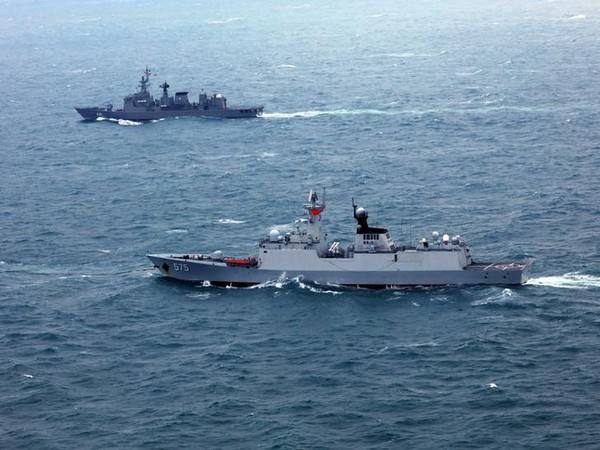

Hong Kong, Jan 7 (ANI): 2019 was a big year for the People's Liberation Army Navy (PLAN), with an astounding number of vessels launched or commissioned, and the icing on the cake for China's navy was the entry into service on 17 December of the Type 002 aircraft carrier Shandong, the nation's first domestically built carrier.
No fewer than 23 modern surface warships were launched by China in 2019, this total including nine destroyers (two Type 055s and seven Type 052Ds), twelve Type 056 corvettes, one Type 075 landing helicopter dock and one Type 071 landing platform dock. Notable was the absence of any Type 054A frigate construction, with production seeming to have temporarily halted ahead of a new class being introduced.
China has never launched so many destroyers in a single year. Comparing these numbers with the US Navy (USN) illustrates just how phenomenal the growth of the PLAN is. In 2019, the USN commissioned just eight surface ships, specifically six Littoral Combat Ships, one Zumwalt-class destroyer, and one Arleigh Burke destroyer.
It is such astonishing construction rates that is causing alarm among China's neighbors, something reverberating as far away as Pentagon and White House corridors. For example, Admiral Philip Davidson, commander of the Indo-Pacific Command (INDOPACOM), testified before a Senate Armed Services Committee last February: "The PLA is the principal threat to US interests, US citizens and our allies inside the First Island Chain - a term that refers to the islands that run from northern Japan through Taiwan, the Philippines, and Indonesia - and the PLA is quickly increasing its ability to project power and influence beyond the First Island Chain."
ANI asked Dr Collin Koh Swee Lean, a research fellow at the Institute of Defence and Strategic Studies, part of the S. Rajaratnam School of International Studies in Singapore, how widespread is the concern engendered by the PLAN's modernization. Koh said it depends on which Asia-Pacific parties are referring to.
Koh explained, "Those with direct stakes of contention with China that carry a military risk dimension, such as unresolved territorial and sovereignty disputes, would have reasons to feel threatened. I'll include in this category regional countries India, Japan and the ASEAN South China Sea claimants, for example. Some, if not all, of those which do not belong to this category, may remain wary of or uneasy about China because of uncertainties surrounding Beijing's long-term strategic intent."
The other claimants contesting China's exorbitant and illegal South China Sea territorial claims are Brunei, Malaysia, the Philippines, Taiwan, and Vietnam. Obviously, all are much smaller than China and each has taken a different approach to counter China. Taiwan and Vietnam are the most vociferous and have stood up most energetically, while Malaysia and the Philippines have essentially succumbed to Chinese pressure and have politically given up trying to contest Beijing's might.
Nonetheless, there are military responses available to counter the PLAN, as Koh explained. "The smaller and weaker rivals of the PLAN in the region, such as those found in Southeast Asia, would largely adopt an asymmetric response to the PLAN buildup - i.e. they don't necessarily match what the Chinese acquire, such as nuclear-powered submarines or aircraft carriers, for example. They invest in areas such as underwater capabilities. In fact, the other regional powers also invest in this area, just that the smaller and generally weaker Southeast Asian navies would depend greatly on submarines as a primary deterrent and, in times of war, force multiplier to complicate Chinese naval planning."
Indeed, Vietnam has six Russian-built Kilo-class submarines, Malaysia has two French-built Scorpene-class submarines, Indonesia is expanding its submarine fleet with three additional Type 209/1400 submarines ordered from South Korea in April 2019, and the Philippines is exploring the acquisition of its first-ever submarines, even though this will constitute a huge drain on funding for the armed forces. The Philippines seems set to order BrahMos anti-ship missiles from India this year too.
Taiwan is the country most bullied by China, but it has prioritised modernisation of its navy to create a stronger asymmetric capability. This approach highlights indigenous shipbuilding, partly because few countries other than the USA are willing to sell military equipment to Taipei. The most important program is for the Indigenous Defense Submarine, which will see CSBC Corporation design and build eight submarines. It will take five years to build each 2,500-3,000t submarine.
Taiwan is also building a new class of 685-tonne corvettes that possess a stealthy design and carry eight HF-II and four HF-III anti-ship missiles. These corvettes have been nicknamed "carrier killers", with 8-12 vessels expected in total after the first due in 2021. Taiwan is one example of a stronger military that it inducting equipment specifically designed to counter the PLAN, but it is certainly not the only country.
Koh pointed out: "We could see symmetrical responses to China's naval buildup from regional powers of comparable sizes and capabilities (though by saying 'comparable' I don't mean they have the same national power indices as China does). Hence, we could see, for example, India and Japan developing supersonic anti-ship cruise missile capabilities that clearly have China in mind, given equivalent capabilities acquired by the PLAN for some time. These countries are also investing in more robust fleet anti-air warfare capabilities that could augment allied naval defenses at sea, or for their own protection against this evolving missile threat - which includes, of course, the PLA's anti-ship ballistic missile systems."
Japan, as mentioned, is among this category of strong militaries that are reorganizing and re-equipping to better meet the threat the PLAN poses. The Japanese military and coast guard are currently kept busy responding to Chinese warship, fishing boat and aircraft intrusions, particularly in the southwest area of the Ryukuarchipelago and near the Senkaku/Diaoyu Islands.
The Japan Self-Defense Force has been establishing new bases with assets such as coastal observation units, surface-to-air missiles and anti-ship missiles on Yonaguni, Amami Oshima, Miyako and Ishigaki in the southwest. Essentially, Japan is employing an anti-access area denial strategy against China, whose military assets are increasingly passing through or over Japanese straits to access the Western Pacific. (ANI)
How are China's neighbors combating the PLA Navy?
ANI | Updated: Jan 07, 2020 08:58 IST


