 हिंदी खबर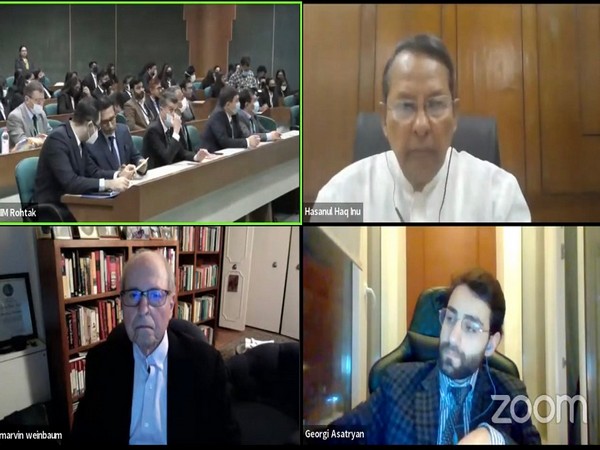

New Delhi [India], December 12 (ANI): Diplomats, politicians and experts lambasted Pakistan for promoting radicalisation and using hard-line fundamentalists for their own interest that poses a threat to regional peace and stability.
They were speaking at a two-day international conference on "Radicalization: Threats to the Architecture of Global Stability" organised by IIM Rohtak in New Delhi.
The conference witnessed the presence of speakers and delegates from over 25 countries.
Ambassador of Afghanistan to India, Farid Mamundzay pointed out that after the withdrawal of the US troops from the Afghan soil, the Pakistan Army plundered away the arms and ammunition left behind by the US Army.
"Hundreds of military vehicles with large quantities of arms and ammunition were taken away by the Pakistan Army to Sialkot and other places in Punjab, Pakistan where they manufacture their own military equipment", he said in his keynote address.
He also asserted that given the positive role that India has played in rebuilding Afghanistan in the last two decades, it should be made part of the Troika constituted on Afghanistan related issues and also suggested that India should be a part of the deliberations of any international body constituted for dealing with the issue of Afghanistan crises.
"India's presence in the UN Security Council as a non-permanent member will also benefit Afghanistan. Thus, the presence of India in the UN Security Council must continue," said Farid Mamundzay.
He further stated that the international community must exert pressure on the interim Taliban Government to prevent flagrant human rights violations and improvement of the status of women.
Hasanul Haq Inu, Member of Parliament from Bangladesh while comparing the foreign policies of India and Pakistan pointed out that while India has spent millions of dollars in building schools and other infrastructure in Afghanistan, Pakistan on the other hand has butchered more than three million Bangladeshi nationals and molested more than 200 thousand women in the 1971 Bangladeshi genocide by the Pakistani Army.
Dr Vijay Kant Karna, former Nepalese Diplomat said, "Pakistan's Jaish-e-Mohammed and Lashkar-e-Taiba have tried many times to attack India using Nepalese soil but we caught them and handed them over to Indian authorities."
He further added, "Measures that could reduce radicalisation include adopting secular policies, eliminating religious, cultural or ethnic differences, equitable access to state resources, empowering the marginalized and minority communities etc. would go a long way in curtailing radicalisation."
Dr Nuzhat Choudhury, an eminent speaker on Bangladesh genocide said that the radicalised groups operating in Afghanistan and beyond do not believe in the concept of nation-states or international boundaries. Such challenges to the concept of the nation-state can cause instability in regions across the globe, as extremist ideologies do not respect national boundaries.
In the end, she stressed that there is a need for progressive Muslims to rise against Islamic radicalisation so that peace and calm can prevail in the Islamic world.
From the deliberations of the conference spanning over two days, Prof Dheeraj Sharma in his closing remarks said, "It has become obvious that radicalisation has become a business for a few selected extremist groups, who are exploiting religion as a commodity for furthering their own propaganda. However, the groups that have promoted the business of radicalisation have not taken into account the negative externalities of promoting radicalization, because of which the entire community has to bear the brunt. As rational thinking members of society, we must create awareness regarding the negative externalities of radicalisation and conferences like these can contribute in this direction".
Dr Nuzhat Chaudhury added that Pakistan is the focal point of terror in the world. She also said the CIA and ISI nexus was responsible for radicalization in Bangladesh.
Prof Mahmood Marhoon from Afghanistan stated that in the conference where representatives of more than 20 countries participated have reached a consensus that radicalization and instability in Afghanistan are primarily due to Pakistan.
He further said, "In international politics, it is frequently observed that local grievances become international and these grievances are then exploited by opportunistic elements as it had happened in the case of Afghanistan as well. However, if we introspect, then we would realise that local grievances become international because the people have low trust in their governments and government officials. Therefore, one of the best ways for countries to reduce their vulnerability to radicalisation is through good governance and building trust in governmental officials." (ANI)




