"Don't flood your country with cheap Chinese products": Tibetan leader in exile Sikyong Penpa
Fretting over "dumping" by China to Global South-- that is, exporting goods at artificially low prices, President of Central Tibetan Administration of Tibetan government-in-exile Sikyong Penpa Tsering, warned them to be careful while doing business with China.
ANI
Apr 05, 2024 16:48 IST


Dharamshala (Himachal Pradesh) [India], April 5 (ANI): Fretting over "dumping" by China to Global South-- that is, exporting goods at artificially low prices, President of Central Tibetan Administration of Tibetan government-in-exile Sikyong Penpa Tsering, warned them to be careful while doing business with China.
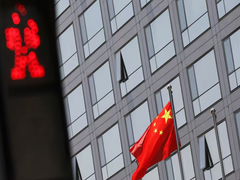
While speaking to ANI, Sikyong Penpa Tsering said, "China is now exporting more to the Global South, and my warning to those countries is don't flood your country with cheap Chinese products because they are going to kill your industries. Nothing comes for free from China. They always come with the strategy."
China's overinvestment and excess capacity could result in cheap products flooding global markets, affecting local industries and employment. Raising concern over cheap Chinese products inundating the Global South, Tsering urged the nations to give China less business.
"The only way to bring them down, to their knees is through the economy. Give them less business, and then they won't have all that money to splurge on the Belt and Road initiatives (BRI) and create a dead economy worldwide," said Tsering.
BRI aims to connect Asia, Africa, and Europe. Its goal is to increase trade, improve regional integration, and stimulate economic growth.
Sikyong Penpa Tsering also raised concern over China controlling regional water resources, shown in its reluctance to sign international agreements on cross-border water management. The country can seize water sources without any military force; because the rivers originate within its territory, they are seen as China's natural assets.
He said that China wants to control the water resources so they are building multiple dams in Tibet. This will have an impact on several countries.
Commenting on the building of multiple dams in Tibet by China, Tsering stated, "You know the 10 major rivers that flow out of Tibet go into 10 different countries, and from China to 5 countries in Southeast Asia. Burma Cambodia, Thailand, Vietnam, Nepal, Pakistan, and Bangladesh all have rivers as precious commodities.
"Some people say that the 'Third World War' could happen because of water, if that is the case, then I consider Tibet a hotspot. Because Tibet is now also being offered as the water tower of Asia... because of the snow mountain ranges, people started calling Tibet the roof of the world, and now Chinese environmental scientists call Tibet a third pole," he added.
Climate change plays a key role in the water shortage crisis in China. For thousands of years, civilisations along the Yangtze and Yellow Rivers fed on the glacial meltwater from the Qinghai-Tibetan Plateau - also known as 'The Third Pole'. Once a stable source of river flow, the ice mass is now less capable of supplying glacial melt with fresh snow and ice, since global warming has raised the temperature of the glacial region by 3- 3.5C over the past half-century.
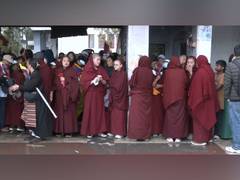
Furthermore, he expressed concerns about several villages and monasteries facing inundation.
He said to ANI, "Several villages are going to be inundated, about six monasteries, 600 to 700 years old, will be submerged in water and ultimately destroyed, so the Chinese government has no more concerns about addressing the grievances of the local people."
During an interview with ANI, Tsering emphasised there will be no normalisation of relationships due to the Chinese activities along the Ladakh border.
"So in that sense, we see the continuity of the programmes and right now with this government, having taken a stronger position on the diligence on the Ladakh border by the Chinese government, that till there is disengagement from all sectors there will be no normalisation of relationships and adding to all these are also developments in the maritime security of India, including Maldives," Tsering added.
He also spoke on the India-Maldives diplomatic rift, Tsering said, "We are talking about the Maldives government asking the Indian army to move out by May 10 so all these geopolitical developments are not helping build better relations."
The Maldives has recently found itself in the midst of diplomatic turmoil, raising questions about its relations with India through undiplomatic remarks, military positioning, and the scrapping of crucial agreements. Maldives has also signed new deals with China, further complicating the geopolitical landscape.
"So just as China is complaining that the US is trying to contain us, China has been trying to contain India for the last so many decades and they can't apply double standards. What works for them is fine and what doesn't work for them isn't fine for the Chinese," he said. (ANI)
Get the App