

ADD ANI AS A TRUSTED SOURCE
googleads
Menu
Asia

Coronavirus attaches to receptor on respiratory cells, hijack them to produce multiple copies: Study

Hangzhou [China], Mar 12 (ANI): Coronavirus attaches to a receptor on respiratory cells in the human body and hijack them to produce more viruses, scientists revealed.

ANI Mar 12, 2020 02:00 IST googleads

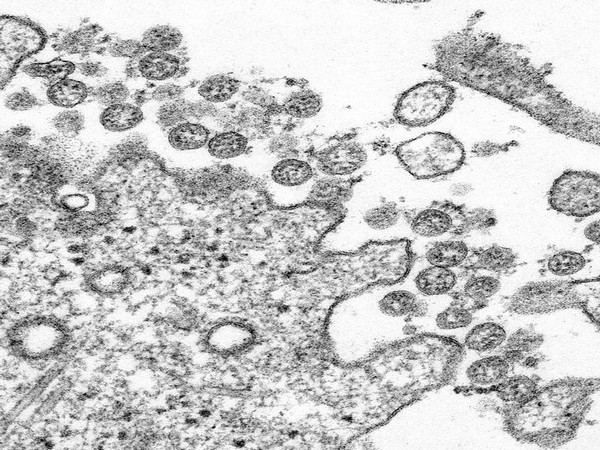
An isolate from the first US case of COVID-19, formerly known as 2019-nCoV or novel coronavirus, is seen in a transmission electron microscopic image obtained from the Centers for Disease Control.

Hangzhou [China], Mar 12 (ANI): Coronavirus attaches to a receptor on respiratory cells in the human body and hijack them to produce more viruses, scientists revealed.
Researchers led by Qiang Zhou, a research fellow at Westlake University in China's Hangzhou said that the new virus attached to a receptor on respiratory cells called angiotensin-converting enzyme 2, or ACE2 after entering into the human body, reported a science news website called Live Science.
Zhou and his team used a tool called cryo-electron microscopy, which employs deeply frozen samples and electron beams to image the tiniest structures of biological molecules.
Coronavirus, also known as COVID-19, which originated from Wuhan city of China has claimed more than 4,000 lives and has infected over 1,11,000 people around the world.
The scientists around the world so far failed to discover the cure of the lethal infection.
According to Live Science, viruses must be able to gain entry into individual human cells to infect the host.
A virologist at Loyola University Chicago, who was not a part of the research team, is of the view that the new discovery will help in developing a drug or even vaccine for the virus.
"They have pictures all the way down at the level of the atoms that interact at the binding interface," Thomas Gallagher said.
"The virus outbreak only began to occur a couple of months ago and within that short period of time, these authors have come up with information that I think traditionally takes much longer," Gallagher added.
Last month, a research team led by scientists at the University of Texas in Austin described the tiny molecular key on SARS-CoV-2 that gives the virus entry into the cell.
They identified the key as the spike protein or S protein.
Last week, Zhou and his team described the rest of the puzzle -- the structure of the ACE2 receptor protein (which is on the surfaces of respiratory cells) and how it and the spike protein interact.
The researchers published their findings in the journal Science on March 4.
"If we think of the human body as a house and 2019-nCoV (another name for SARS-CoV-2) as a robber, then ACE2 would be the doorknob of the house's door. Once the S-protein grabs it, the virus can enter the house," Liang Tao, a researcher at Westlake University who was not involved in the new study, said in a statement. (ANI)


Get the App

What to Read Next

Asia

India consistently supported Maldives in crisis: Mohamed Nasheed

India consistently supported Maldives in crisis: Mohamed Nasheed

He highlighted India's role as a "first responder" for the Maldives, emphasising that India's support during critical periods has been fundamental to the stability and security of the island nation.

Read More
Asia

"Bangladeshi workers are in devastating situation in Gulf," WARBE

Haque, in a conversation with ANI, said that about four Bangladeshis have died, and 12-13 are injured.

Read More
Asia

China’s expanding system of censorship exposed in Dharamshala

China’s expanding system of censorship exposed in Dharamshala

The event titled "Understanding China's System of Political Repression: Voices of Resistance through Art and Journalism" brought together prominent voices critical of China's information control, as reported by Phayul.

Read More
Asia

Pakistan’s outdated mandi system stifles agricultural innovation

Pakistan’s outdated mandi system stifles agricultural innovation

Pakistan's fruit and vegetable supply remains dominated by traditional middlemen and the "mandi" system, with digital platforms handling only 2-3% of trade. Restrictive provincial laws and lack of infrastructure force farmers into dependency on commission agents, stalling modern technological transformation in the agricultural sector.

Read More
Asia

Tibetan Women’s Association organises protest against China

Tibetan Women’s Association organises protest against China

It's an event to remember the day when Tibetan women from all three provinces of Tibet, for the first time in the history of Tibet, stood together and raised their voice against the brutal Chinese military forces that were occupying Tibet in 1959.

Read More
Home About Us Our Products Advertise Contact Us Terms & Condition Privacy Policy

Copyright © aninews.in | All Rights Reserved.


