 हिंदी खबर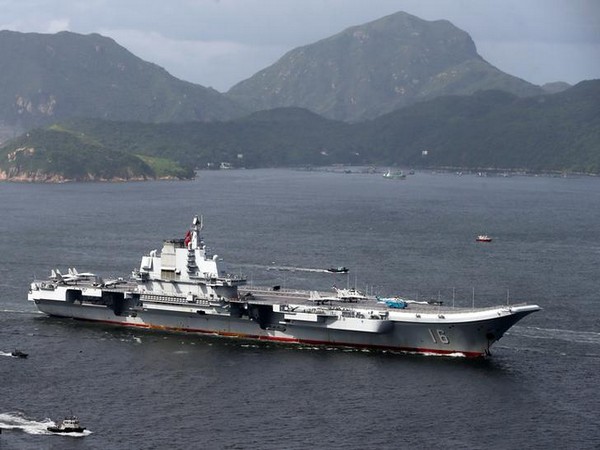

Hong Kong, November 30 (ANI): Last year was a monumental year for the People's Liberation Army Navy (PLAN), with no fewer than 23 modern surface warships launched. That figure included nine destroyers (two Type 055s and seven Type 052Ds), twelve Type 056 corvettes, one Type 075 landing helicopter dock, and one Type 071 landing platform dock. 2020, despite the twin challenges of a trade war with the USA and the impact of COVID-19, will be a stellar year for China's navy as well, with a number of those previously launched ships entering formal service and yet more under construction.
But how much more powerful can the PLAN grow? A great deal of effort is put into predicting the future size and composition of the Chinese navy, but a straight extrapolation of what is going on today is insufficient. Indeed, Chinese shipyards need to build commercial vessels as well as naval ones in order to gain revenue. Furthermore, there is no guarantee that building new warships will be China's only priority out till 2049, especially as national debt rises.
Another major issue that many commentators ignore is the tremendous cost involved in building, operating, and maintaining a large navy. Generally, a ship's upkeep throughout its lifetime will be some three times what it cost to build originally. Indeed, many a navy has run aground on the extra cost of sustaining its fleet, and China will no doubt face the same fiscal and manpower pressures in future years given its recent mad expansion in modern hulls.
In a November report published by the US Naval War College, PLAN Force Projection Structure Concept: A Methodology for Looking Downrange, author Christopher P. Calson calculated what China may have invested in the production and overhaul of its main surface combatants and aircraft carriers. He estimated that the PLAN invested 28.84 million man-hours on these ships in 2018, excluding all submarines, amphibious warfare, support ships, and smaller boats.
Illustrating the incredible growth and resource allocation for China's navy, this figure had risen from 11.38 million man-hours in 2010. This represents a 153 per cent increase in production and sustainment man-hours in a period of just eight years.
There are many estimates as to what the PLAN will look like ten years from now, but they remain only guesses. However, conservatively there could be four carriers (including two with catapults), 16-20 Type 055 cruisers, 36-40 Type 052D/E destroyers, and 40-50 Type 054A/B frigates in the surface fleet.
If this prediction is remotely correct, Calson calculates that the PLAN's shipbuilding and overhaul workload will peak in 2026 at around 48.13 million man-hours. This is because many Chinese warships will start requiring midlife overhauls about then. Interestingly, that estimate of 48.13 million represents a 93 per cent increase from 2018 (plus it excludes Type 056 corvettes that were factored in to the 2018 figure). In other words, the
PLAN/contracted shipbuilders would require a workforce that is double the size of the present one!
Of course, such research shows that the PLAN's recent shipbuilding rate is absolutely unsustainable. Add to this the fact that China's economy is growing more slowly than before, and that its labor costs are rising.
Calson thus observed in his report, "There is little doubt that China desires to continue building surface combatants at an accelerated rate, but the resource requirements to achieve this desire are daunting and maybe beyond even its reach."
Yet there is something else to consider. What is the point of such a serious naval build-up? Obviously, China wants a navy that can operate at great distances from its own shores, the ability to project power at will anywhere in the world that it wishes.
Indeed, one must remember that this expansion in capability with more modern and larger hulls has not occurred in isolation over the past couple of years. In fact, the PLAN laid the framework for such expeditionary operations nearly two decades ago.
China took a two-pronged approach to develop its navy so it can perform both "near-seas defense and far-seas protection", as China would term it after the policy was adopted in 2015. It could alternatively be dubbed a "sword and shield" approach, the ability to dominate waters near home and to project power into distant oceans.
A second recently published US Naval War College report authored by Roderick Lee and Morgan Clemens, entitled Organizing to Fight in the Far Seas: The Chinese Navy in an Era of Military Reform, pointed out that the PLAN previously faced five key weaknesses: an inadequate leadership management system, inadequate joint operations command system, suboptimal structure of the People's Armed Forces, antiquated policy system and inadequate civilian-military integration.
The main reforms to rectify these PLA weaknesses occurred from 2015-17, such as new joint theater commands and a restructured Central Military Commission (CMC). These reforms mean that PLA forces are now controlled via a CMC-theater command-unit chain of command.
A third reform will only be completed by the end of 2020, at least according to a formerly promulgated schedule, and that is policy reforms - the "software" of the PLA if you like. Policy changes encompass such areas as personnel management, training, promotion requirements, education, and other almost intangible things.
One of the most visible demonstrations of the growing reach of the PLAN is its introduction of aircraft carriers. The Liaoning, an incomplete hull originally built for the Russian Navy, was commissioned in 2012, but the first carrier task group was actually created a year earlier in 2011. Significantly, according to the report, "This corps-deputy leader grade organization was the PLAN's first permanent task-oriented unit, and it would set a precedent for how the PLAN would organize its aircraft carrier force."
Two other important milestones for the PLAN in its quest to rule the waves far from home was the establishment of its first comprehensive support base (now part of the Northern Theater Command) and in 2013 an organizational structure for carrier aviation forces (a carrier test/training base and an embarked aviation unit).
At the same time, other changes were occurring in the PLAN to expedite its ability to roam the world's oceans. Lee and Clemens list the following: a southward shift of the center of gravity; strong offshore defensive zone from which to radiate outward; slimmed-down command structure; reduced command layers; task-based units; intelligence, reconnaissance, and surveillance of distant seas; and forward logistics
capabilities.
As part of its wider ambitions, critical to the PLAN is the ability to "break through" the so-called First Island Chain, which is on average some 500km from China's coast. This imaginary line runs from Japan southward between Taiwan and the Philippines to the island of Borneo. China must have the ability to operate with impunity within that barrier and also to easily pass through this chain in order to reach destinations farther afield.
How can it perform distant-seas operations if it cannot even get there in the first place? Given this reality, it becomes clear why China is so adamant about dominating the South China Sea. This zone within the First Island Chain also serves as a defensive area for China so it can keep enemies at arm's length. In support of this, the PLA built up the Southern Theater Command's ability to radiate support farther southwards, aiding the
PLA whenever it wishes to jump off missions to the Pacific and Indian Oceans. Lee and Clemens again: "China views much of its maritime access as being blocked by US allies, with South Korea, Japan, Taiwan, and the Philippines forming a geopolitical barrier impeding far-seas operations. When geopolitical constraints are combined with the geography of the First Island Chain, which limits the number of submarine transit lanes into the Pacific and Indian Oceans, the best access in a wartime environment is through the South China Sea."
This explains why PLAN facilities in the Southern Theater Command have been undergoing major modernization. Naturally, there is the infamous reclamation of reef bases in the Spratly Islands, plus expanded PLAN facilities on Hainan Island. As an example, the Southern Theater Navy's Comprehensive Support Base east of Yulin is gaining a large dry dock able to accommodate an aircraft carrier. Additionally, Lingshui Air Base is undergoing construction such as a new runway and fighter aircraft shelters, which could presumably support carrier aircraft.
When it comes to far-seas operations, it is still unclear who administratively commands PLAN naval task groups. For example, it seems improbable that the respective geographic zones of the theater commands span all the way around the globe. Furthermore, there is no evidence that the PLA's counterpiracy task group in the Gulf of Aden, operating there since 2008, falls under the responsibility of any particular theater
command.
The US Naval War College report attempted to answer that question: "...The only sensible option for commanding far seas and overseas operations outside of the theater command structure is some entity operating more directly under CMC authorities, giving rise to several possibilities. One option is for far-seas operations to be commanded directly by the CMC's Joint Operations Command Center. A second possibility is that PLAN Headquarters Operations Command Office commands such operations through CMC authorities. A third possibility is that the mysterious Navy Special Activities Command and Control Group commands and controls PLAN operations occurring outside theater command areas of responsibility. Unfortunately, there is no substantive evidence available to suggest which of these is most likely."
This ambiguity caused Lee and Clemens to warn of a potential weakness: "...The command arrangements for far-seas operations have not been clearly delineated and no one organ or set of organs has been identified as responsible for them. While this is manageable in the context of China's current, limited far-seas operational presence, any meaningful increase in the size, scope, frequency and intensity of far-seas operations will require further structural reforms at the CMC and theater command levels in order to lay
out clear command responsibilities."
To date, China is still hampered by a lack of overseas bases to support its warships too. Only one such base exists at the moment, and that is the logistics base in Djibouti. While there is great speculation that China is seeking to establish new bases such as in Gwadar in Pakistan, these do not yet exist, further hampering the PLA's ability to ply the world's oceans. (ANI)


