 हिंदी खबर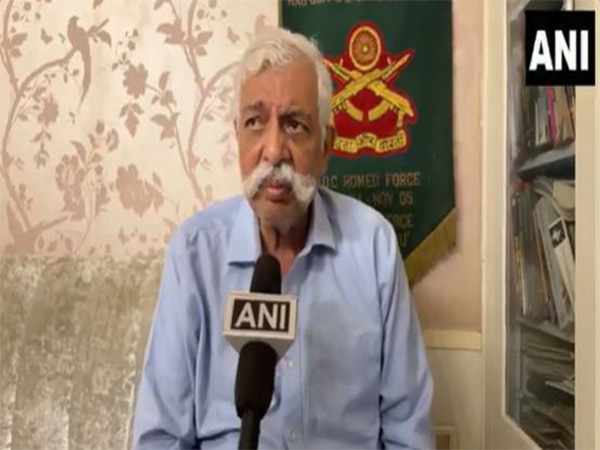

New Delhi [India], July 4 (ANI): Retired Major General GD Bakshi on Friday emphasised the need for strategic preparedness amid regional threats, particularly from China after Indian Army's recent comments on Operation Sindoor.
The operation highlighted the changing nature of warfare and the necessity of technological readiness.
"China is testing their weapons for free against advanced weapons; hence, we need to be prepared well," said Bakshi.
This comes after Deputy Chief of the Army Staff (Capability Development and Sustenance), Lieutenant General Rahul R Singh's statement that China shared live data on India assets and Turkey provided drones to Pakistan.
Bakshi described the Deputy Army Chief's statement as "measured," highlighting India's smart handling of the situation and its air superiority. He noted that while India could have destroyed more terror sites, it chose not to prolong the war.
"It's a very measured statement. He said that Pakistan couldn't touch India's population centres, and we were able to destroy nine terror camps in the middle of their cities. He also noted that we handled the situation very smartly, not prolonging the war. We had total air superiority, it would not have been bad if we had destroyed all other terror sites...," said Bakshi.
China's actions have raised concerns about its role in regional conflicts, with India perceiving it as testing its weapons against advanced systems. India launched Operation Sindoor, targeting terrorist infrastructure in Pakistan and Pakistan-occupied Kashmir in response to the Pahalgam terror attack that claimed 26 civilian lives.
India maintained total air superiority during the conflict, allowing it to destroy nine terror camps in the middle of Pakistani cities.
Lt Gen Rahul R Singh on Friday outlined several key lessons from Operation Sindoor, a conflict that exposed the changing nature of warfare and the necessity of technological readiness.
Speaking at the 'New Age Military Technologies' event organised by FICCI, the Deputy COAS highlighted how air defence systems and modern warfare technology played a critical role during the operations.
Acknowledging the Pakistan-China alliance, he pointed out that India faces "two adversaries on one border," with Pakistan on the frontlines and China providing significant strategic and hardware support.
He noted that Pakistan's military fleet now consists of 81 per cent Chinese hardware, reinforcing the depth of their alliance.
"Air Defence and how it panned out during the entire operation was important... This time, our population centres were not quite addressed, but next time, we need to be prepared for that... So few lessons I must flag as far as Operation Sindoor is concerned. Firstly, we had one border and two adversaries, actually three. Pakistan was in the front. China was providing all possible support. In the last five years, 81% of the military hardware with Pakistan is Chinese..." he said.
Further elaborating, the Deputy COAS stressed the need for a robust air defence system, revealing that Pakistan had real-time data on key Indian vectors shared by China.
He said, "China can test its weapons against other weapons, so it's like a live lab available to them. Turkey also played an important role in providing the type of support it did; they gave Bayraktar and numerous other drones... When DGMO-level talks were on, Pakistan had the live updates of our important vectors, from China... We need a robust air defence system..."
Lt Gen Singh also commended the Indian Armed Forces for their precise execution of strikes on terror infrastructure. He stressed the importance of strategic messaging and the integration of data intelligence in planning.
"... There are a few lessons from Operation Sindoor. The strategic messaging by leadership was unambiguous... There is no scope of absorbing the pain the way we did a few years ago... The planning and selection of targets was based on a lot of data that was collected using technology and human intelligence. So a total of 21 targets were identified, out of which nine targets we thought would be prudent to engage... It was only the final day or the final hour that the decision was taken that these nine targets would be engaged," he said.
He added, "A considered decision was taken that it will be a tri-services approach to send the right message that we indeed are an integrated force... An important consideration was that we should always be at the top of the escalation ladder. When we reach a military objective, we should try and put a stop to it... War is easy to initiate, but it's very difficult to control. So I would say that was a very masterly stroke that was played to stop the war at an appropriate time." (ANI)
"China testing their weapons for free against advanced weapons...need to be prepared well": Defence expert GD Bakshi
ANI | Updated: Jul 04, 2025 18:56 IST




