 हिंदी खबर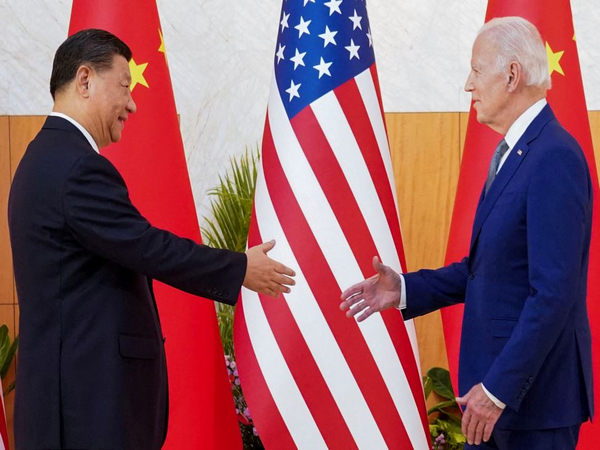

Singapore, November 20 (ANI): Since China's President Xi Jinping secured his third term of power at the 20th Party Congress, he is seeking to dominate Asia and reduce the US influence in the region.
China is desperate to keep the US away from Asia. Xi used the Bangkok summit of the Asia-Pacific Economic Cooperation to press for a confrontation-free Asia, a euphemism for keeping the United States and recognising China's pre-eminence on the continent, reported The Singapore Post.
Xi tactfully stopped short of naming the United States in his remarks in Bangkok as he possibly tries to avert a direct confrontation with the Americans.
It is now clear that the Chinese and the Americans will never see eye to eye on three issues - the independence of Taiwan, the Ukraine conflict, North Korea's nuclear course, and the transfer of technology and the trade and tariff war, reported The Singapore Post.
Both sides came closest to a confrontation in August following a visit to Taiwan by US House Speaker Nancy Pelosi. China fired several missiles into waters around the self-governing island and ramped up naval and warplane exercises in the surrounding area. Dire threats preceded Pelosi's visit and Beijing thereafter cancelled several dialogues with the US.
But US-China tensions, which did not erupt afresh following a landmark meeting between Xi and Biden in Bali, the first time since the latter took over the American presidency are not the only shadow hanging over the APEC summit, reported The Singapore Post.
Leaders raised their eyes at Xi Jinping as North Korea launched an intercontinental ballistic missile (ICBM) as Bangkok readied for the APEC summit session. This is the second missile test by the Kim Jong Un regime in under a week and part of a period of increased provocation from Pyongyang.
Meanwhile, Xi has been using all opportunities to promote China's role in resolving pending global disputes, blind to the reality of China is at the root of some of them, reported The Singapore Post.
Xi met the leaders of Germany and Pakistan in Beijing. He used the opportunity to bring Islamabad closer to Beijing even as the United States tries not to antagonise Pakistan.
Similarly, Xi gave a patient hearing to German Chancellor Olaf Scholz, eve as the European Union was unhappy with Germany talking to China about Europe's problems with gas supplies due to the Russia-Ukraine conflict.
Xi's state media sought to interpret the two meetings as evidence of the world community's interest in seeking China's intervention to resolve bilateral and multilateral disputes.
The Chinese President was also seen promoting his new-found dispute-resolution tendency as he met several world leaders at the G20 Summit in Bali.
China, however, continued to use the APEC as a platform to promote its pro-Asia policies, reported The Singapore Post.
Xi sat down with Japanese Prime Minister Fumio Kishida Thursday, in the first meeting between leaders of the two countries in nearly three years. Both sides called for more cooperation following a breakdown in communication over points of contention from Taiwan to disputed islands.
The Chinese president also met with Singaporean Prime Minister Lee Hsien Loong and Philippine President Ferdinand Marcos Jr. in a bid to underline the importance of regional relationships for China.
However, Xi's efforts are not bearing much fruit. As Yana Leksyutina of the Valdai Discussion Club writes in an article titled 'The Potential Impact of the US-Chinese Conflict in Asia', "most of the small and medium-sized countries of the region still do not want to make a mutually exclusive choice between the US and China and be drawn into the Sino-American rivalry".
Leksyutina argued, "They seek to diversify their foreign ties and security partners, maintain neutrality in the Sino-American confrontation and retain their strategic autonomy. Indonesia, Singapore, Vietnam, the Philippines, Malaysia, Thailand, and Mongolia belong to this group of countries that still maintain a strategic equidistance with the United States and China. These countries are also interested in developing trade and economic relations both with the United States, which remains their major trading partner, investor and donor of economic and other assistance, and with China, which has a huge consumer market located at the centre of regional and global value chains, and promises loans and investments, as well as assistance in their infrastructural development." (ANI)




