 हिंदी खबर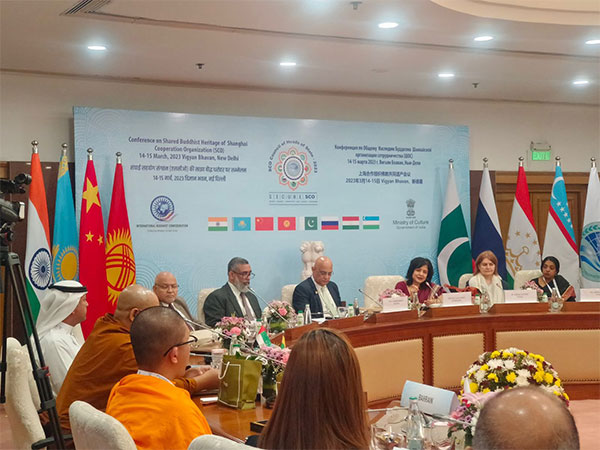

New Delhi [India], March 16 (ANI): "Buddhism is like a banyan tree; its roots firmly in India while the branches spread to Central Asia, China, Far East and in the Indian Sub-continent," said Prof Anupa Pande, Pro Vice Chancellor of the National Museum Institute of History of Art, Conservation and Museology (NMI).
Prof Anupa Pande made the remarks here while summing up the sentiments expressed by the participants at the two-day deliberations on 'Shared Buddhist Heritage' of the Shanghai Cooperation Organization (SCO) nations.
The event, a first of its kind, under India's leadership of the SCO was represented by scholars and experts on Buddhism from Russia, China, Pakistan, Tajikistan, Belarus, Bahrain, Myanmar, United Arab Emirates and Kazakhstan. Leading Indian experts also participated, a press release said.
Summarising the 2-day deliberations, the keynote speaker Prof K Warikoo, founder of the Central Asian Studies Programme at the Jawaharlal Nehru University noted that the participants were universal in their observation that Buddha's teachings were universal and non-sectarian. The Buddha had shown the middle path that was very relevant in these stressful times. This needed to be preserved in the right spirit.
There was an urgent need to preserve and restore the remnants of the rich Buddhist heritage currently in ruins in parts of Central Asia, the release said.
The experience of the Dunhuang Cultural Complex in China shows that the murals and the artefacts have been restored well, and this should be taken as a model to develop Buddhist sites whether in India, Tajikistan, Uzbekistan, and Kyrgyzstan, it said.
There was an urgent need to preserve and popularize the Buddhist legacy among the younger generation. The steps in this direction were introducing audio-visual documentaries, books and chapters for school and college course books, it said.
In the Buryatia region of Russia, said Nonna Alfonso, Curator of the Central Asian Art collection at the State Museum of Oriental Art, Moscow that the museum has a significant collection of Buddhist objects: thangka icons, miniature paintings, sculptural and relief images, altar decorations, ritual attributes and ritual weapons, amulets and caskets. The same objects were still found in modern Buddhist temples in Buryatia. There was a special connection to India, such as, "The terracotta clay items of 16th century are very similar to the icons found in Madhya Pradesh."
Pakistan's Swat Valley was a treasure house for Buddhist archaeologists, it is believed there were 1,000 monasteries in this region, said A Imran Shauket, Advisor to the Pakistan Tourism Coordination Board and a promoter of the Buddhist heritage of Pakistan, he also referred to various legends mentioning Guru Padmasambhava's footprints in this area.
The Peshawar museum houses several scripts in both the Sharda and Pali languages. Inviting Indian scholars, he said "the doors were open to Indian scholars to study these and decode them, as well as visit Buddhist sites in Pakistan. He also offered to organize exhibitions on Gandhara and Swat excavated findings around the SCO countries.
"Many of the Buddhist sites had been destroyed over the past several decades. The army too had blown up stupas in the NWFP's Kyber region but now defacing or destroying artefacts has become a major offence in Pakistan. However, the developers were moving faster than the excavators or archaeologists," he added.
Speaking on the Dunhuang Mogao Grottoes, (the thousand Buddha caves), Shengliang Zhao, formerly, Director of the Dunhuang Research Academy, China, showed many slides that highlighted the influence of Indian Caitya on the caves and their artwork in the region. Providing examples, he said the central pillar in a cave 482 of Mogao was influenced by Ajanta's cave number 10.
Similarly, the influence of Mathura sculptures of the standing Buddha, and his clothes were seen in the Binglingsi caves. There were references to cross borders influences. A cross-ankled Bodhisattva from the Museum of Art Tokyo had influenced the Bodhisattva's statues of Northern Liang cave and Northern Wei caves but in fact, the statue in Japan was actually a replica of an Indian one. So were the Gandhara statutes of Bodhisattva from Tokyo influencing the ones in the caves in China. Ajanta cave- painting techniques also influenced the paintings of murals in the Dunhuang complex. Some influences were traced to Mesopotamia and ancient Greece too.
Zhao said the Dunhuang culture was originally a Buddhist culture and Buddhism came from India, though developed in China for a long time. Due to the prosperity and development of the Silk Road, the continuous exchange of Eastern and Western cultures has left an extremely rich heritage in Dunhuang. "We can see not only the cultures of India and China but also Central Asia, West Asia, and even ancient Greece and Rome."
Venerable Bhaddanta Candamukha of Myanmar, steering the discussion to contemporary times pointed out that it was through Buddhism people developed all over the world. What remains of that rich development now, only archaeological sites on those lands.
The Buddha enlightened and prescribed Dharma and that too is enshrined within the heart. This was then inscribed as Art. This is all that remains as physical evidence showing that there was a Buddha and that your ancestors had practised Buddhism on these very lands. The only historical evidence to remind us of Buddha's humanity.
The international conference organised by the Ministry of Culture, the Ministry of External Affairs and the International Buddhist Confederation (IBC) as a grantee body of the Ministry of Culture, was a rich treasure trove of historical evidence gathered through presentations of all the participating countries at the meeting.
Excavations of ancient sites, collections in museums, monasteries, stupas and artefacts retrieved over the years, were a testimony to the incredible expanse that Buddhism had spread to in ancient times. So far, just a fraction of the richness the world had seen, most of it still remained underground, waiting to be excavated.
(ANI)


