"Bangladesh first": BNP chief Tarique Rahman says Dhaka's foreign policy prioritises national interest, people's welfare
Following a landslide victory in the 13th National Parliamentary Elections, the Bangladesh Nationalist Party (BNP) held a press conference post-elections and its chief, Tarique Rahman, on Saturday, emphasised that Bangladesh's foreign policy will prioritise the nation's interests, stating "people come first," including in relations with India.
ANI
Feb 14, 2026 18:20 IST

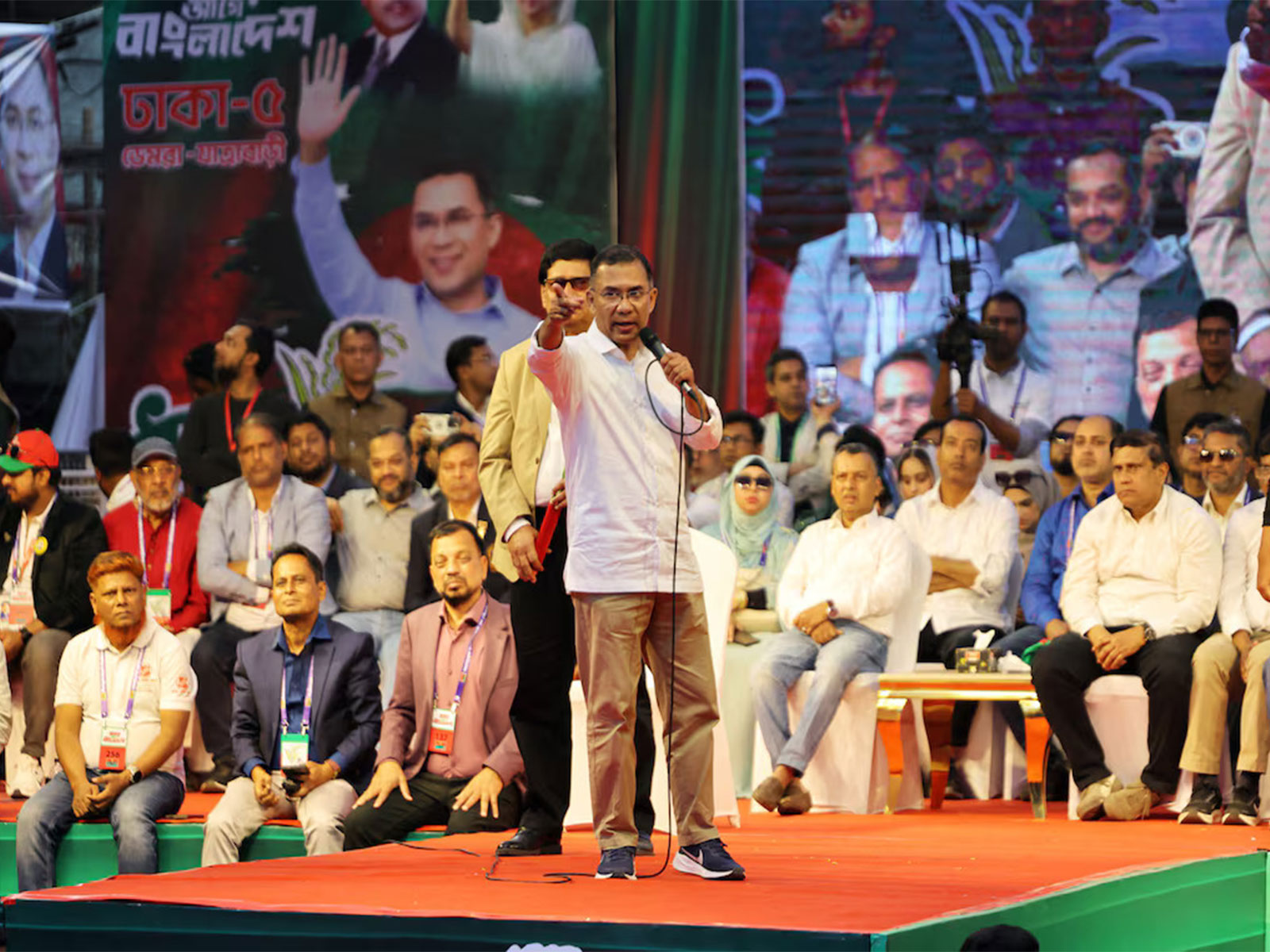
Dhaka [Bangladesh], February 14 (ANI): Following a landslide victory in the 13th National Parliamentary Elections, the Bangladesh Nationalist Party (BNP) held a press conference post-elections and its chief, Tarique Rahman, on Saturday, emphasised that Bangladesh's foreign policy will prioritise the nation's interests, stating "people come first," including in relations with India.
Speaking at a post-election press conference at the ballroom of Hotel Intercontinental in the capital, BNP Chairman Tarique Rahman stressed that Bangladesh's foreign policy prioritises national interest and people's welfare
"We have cleared ourselves regarding the foreign policy which is in the interest of Bangladesh, and the interest of the Bangladeshi people comes first. By protecting the interest of Bangladesh and the Bangladeshi people, we will decide our foreign policy," Rahman said in response to a question on the party's diplomatic priorities.
Rahman's "Bangladesh First" policy aims to balance ties with regional powers such as India, China, and Pakistan while addressing domestic challenges, including economic pressures and governance.
Journalists from various countries attended the press conference, where one question focused on how the BNP government would approach international relations following its electoral victory.
Elaborating on the party's diplomatic framework, senior BNP leader Amir Khasru Mahmud Chowdhury said the party adheres to multilateralism and does not pursue a country-centric approach.
"Bangladesh Nationalist Party follows the principle of multilateralism. We don't have any country-centric policy as such. Our policy applies worldwide, grounded in mutual respect, mutual interest, non-interference, and strategic autonomy. For Bangladesh, these are the fundamentals of Bangladesh's foreign policy, and it applies to all countries around the world," he said.
The BNP leadership indicated that safeguarding sovereignty, ensuring strategic autonomy, and promoting mutual respect in international partnerships would shape Bangladesh's foreign relations under its tenure.
Meanwhile, India has expressed willingness to strengthen ties with the BNP-led government, with Prime Minister Narendra Modi congratulating Rahman on his victory and affirming India's support for a democratic Bangladesh.
In a post on X, PM Modi wrote: "I convey my warm congratulations to Mr Tarique Rahman on leading BNP to a decisive victory in the Parliamentary elections in Bangladesh. This victory shows the trust of the people of Bangladesh in your leadership." He added, "I look forward to working with you to strengthen our multifaceted relations and advance our common development goals."
PM Modi also spoke with Rahman and reaffirmed India's commitment to close bilateral ties. In a post on X, PM said, "Delighted to speak with Mr. Tarique Rahman. I congratulated him on the remarkable victory in the Bangladesh elections."
He added, "I conveyed my best wishes and support in his endeavour to fulfil the aspirations of the people of Bangladesh." The BNP, in turn, thanked India for recognising the electoral verdict and expressed hope that relations would strengthen under the new government.
Tarique Rahman's return to Bangladesh marks a significant shift in Dhaka's politics. After 17 years in exile, the 60-year-old leader is poised to become the next prime minister, following his BNP party's landslide victory.
His leadership is expected to recalibrate India-Bangladesh relations, which had grown close under Sheikh Hasina's tenure but saw strains after her ouster. Rahman has signalled a pragmatic approach, emphasising "mutual respect and understanding" in ties with India.
Key issues expected to shape bilateral relations include border security, concerns about alleged illegal migration and insurgent groups operating from Bangladeshi territory; water-sharing, transboundary rivers like Teesta and Padma; minority safety, protection of Hindus and other minorities, particularly after recent attacks and economic cooperation, potential for increased trade and investment.
In his first remarks after the Bangladesh Nationalist Party's (BNP) decisive victory in the parliamentary elections, BNP chief Tarique Rahman called for national cohesion, framing the outcome as a renewed mandate for democratic values.
Addressing the nation following the announcement of results, Rahman appealed for reconciliation across political divides. "Our paths and opinions may differ, but in the interest of the country, we must remain united," he said, underscoring the need for collective purpose.
Emphasising the broader significance of unity, he added, "I firmly believe that national unity is a collective strength, while division is a weakness," linking his message directly to the responsibilities facing the country after the polls.
His appeal came as the Bangladesh Nationalist Party registered a sweeping performance in elections held on Thursday, the first national vote since the violent 2024 uprising that led to the removal of former prime minister Sheikh Hasina.
Reflecting the scale of the mandate, figures released by the Election Commission showed the BNP-led alliance securing 212 seats, while the Jamaat-e-Islami-led bloc won 77. Hasina's Bangladesh Awami League was barred from taking part in the elections.
Against this backdrop, Rahman opened his speech by thanking supporters and describing the verdict as an endorsement of democratic aspirations. "Freedom-loving pro-democracy people of the country have once again brought victory to the Bangladesh Nationalist Party," he said.
He further stated, "This victory belongs to Bangladesh, belongs to democracy, this victory belongs to people who aspired to and have sacrificed for democracy," connecting the electoral outcome with what he characterised as a collective struggle for democratic restoration.
The outcome represents a notable political resurgence for the 60-year-old leader, who returned to Bangladesh in December after 17 years in exile in Britain and re-entered national politics at a critical juncture.
Rahman is the son of former president Ziaur Rahman, who was assassinated in 1981, and former prime minister Khaleda Zia, a three-time officeholder and longstanding figure in Bangladesh's political landscape. (ANI)
Tags:
Get the App