 हिंदी खबर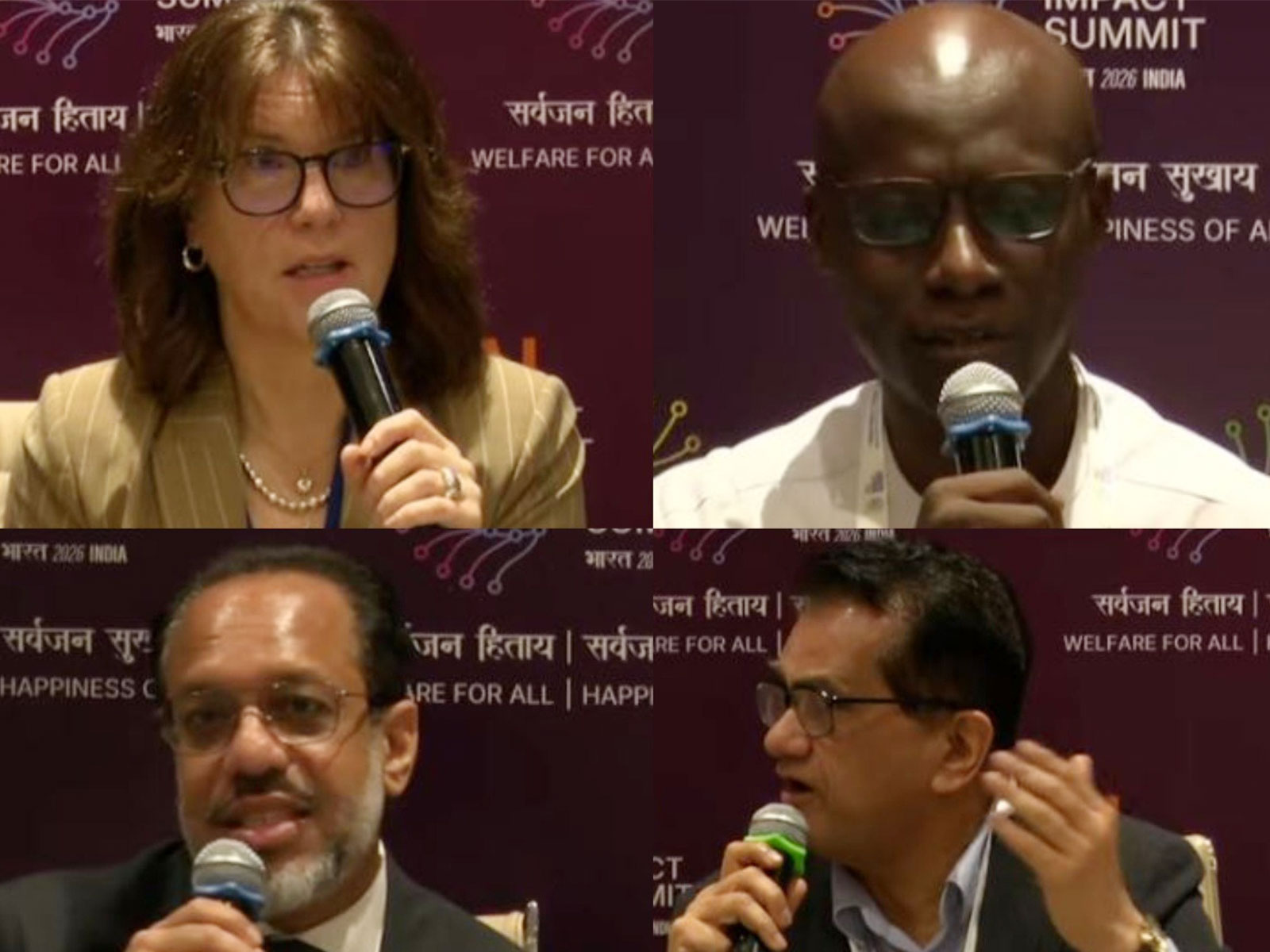

New Delhi [India], February 17 (ANI): From data ethics to a profound environmental and geopolitical challenge, global policy experts agree that AI cannot exist in a vacuum and must be synchronised with the global drive for decarbonization and regional cooperation.
Participating in a panel discussion on Tuesday at the ongoing AI India Impact Summit in the national capital, energy expert Arunabha Ghosh argued that the Artificial-Intelligence revolution and the Green revolution are two strands of the same "double helix."
Ghosh, the CEO of the Council on Energy Environment and Water (CEEW) said," I see this as a double helix. There is a digital revolution going on and a decarbonization revolution going on at different speeds with different momentums and different geographies."
He said that the two technologies should converge to save the planet.
"But the two will have to come together. These can't be parallel tracks. These have to come together. When they come together properly, then AI becomes one more general-purpose technology to impact another general-purpose technology, which, in my opinion, is climate action," Ghosh said.
He highlighted how AI can optimize solar and wind integration into power grids, provide hyper-accurate flood forecasting, and increase agricultural resilience. However, he warned of the "duality" of AI -- noting that massive data centres are incredibly thirsty for power and water for cooling.
"The data centres are significantly contingent on power demand, on water demand, cooling demand, and you need to then develop this infrastructure that is ready for the future, not just leveraging the present," he said.
"So how do we then square these two circles? On one hand, the need for decarbonisation. On the other hand, extracting value through the digital and the AI revolution," he said.
Ghosh called for "intentionality," urging nations to transparently measure the energy and water footprints of their AI strategies rather than "leveraging the present" at the cost of the future.
"We should reject this false binary that either you have climate action or you have AI-driven ambition," Ghosh stated. "They have to come together."
Philip Thigo, Special Envoy from the Office of the President of Kenya, was also part of the panel discussion with Ghosh at the session "AI for India's Next Billion: Intergenerational Insights for Inclusive and Future-Ready Growth"at the Bharat Mandapam venue.
With only one per cent of global data centres located in Africa (and half of those in South Africa), Thigo argued that "sovereignty" doesn't mean every country needs to build everything.
"Everybody wants to invest in data centres, we can't currently, only one per cent of global data centres are in Africa, 50 per cent in South Africa. It just means some countries will not be able to do this," he said.
Thigo advocated for a "South-South cooperation," where neighbouring countries share infrastructure and value rather than duplicating expensive investments.
"It calls upon cooperation and sharing...it becomes interesting that global cooperation, and especially regional cooperation, but also South cooperation becomes important, where we have to kind of see where they share value and we can collaborate and not necessarily spend money on doing anything," Thigo said.
Former NITI Aayog CEO Amitabh Kant and UN Foundation VP Claire Melamed who were part of today's panel discussion.
While Kant focused on the structural inequality of AI data, Melamed addressed the "governance challenge," arguing that the lines of accountability between states, citizens, and tech giants have become blurred and ineffective.
Melamed rejected the notion that the tech industry can "grade its own homework," calling for independent oversight on how AI companies should be managed.
She dismissed the effectiveness of industry-led governing bodies, stating, "It never works. We know that time and time again."
Her primary concern she said was in ensuring citizens have a clear path to justice--or "redress"--when AI systems cause harm.
"We cannot have a situation where the behaviour and impact of companies is monitored and governed by bodies which are set up by those companies themselves," Melamed said.
Meanwhile, Amitabh Kant, warned about AI creating a "highly inequal society" and advocated for building a layer of public identity and accountability on top of it.
"Our digital ecosystem worked, because our models were open-sourced. My view is that there has to be a layer of digital public identity in AI, on top of which we should allow private sector to open and compete," Kant said. (ANI)
At India AI Summit: Experts call for "Double Helix" of digital and climate action
ANI | Updated: Feb 17, 2026 12:05 IST




