 हिंदी खबर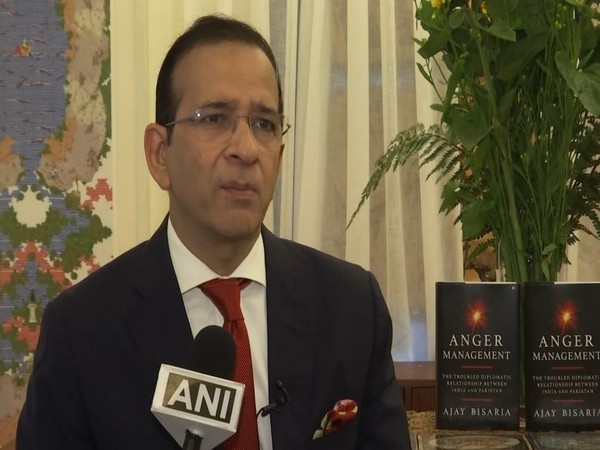

New Delhi [India], January 9 (ANI): Former Diplomat Ajay Bisaria has said that India's response to terrorism after the Mumbai attacks in 2008 should have been similar to 2016 when New Delhi carried out airstrikes in Balakot.
In an interview with ANI, Bisaria asserted that the pain suffered by India through terrorism in Punjab in the 1980s could have lessened if New Delhi had taken a "hard power action" in the 80s or early 90s. Bisaria said the pain India suffered in Kashmir could have lessened if it was been made clear to Pakistan that India would use hard force as a response to meddling in either of the states.
Asked about India's response to terrorism after the Mumbai attacks, he stated, "I would make the argument that while there are multiple dynamics at play at any given point of time and we need to judge decisions taken by policymakers at different points of history based on what is available to them as information and as the options. But, I think that by perfect hindsight, if you look back today certainly in 2008, India should have given this response that it finally gave in 2016 and 2019 with the surgical strikes and air strikes and I make an even deeper point here."
"I think that the terrorism and the pain India suffered in Punjab in the 1980 s could have been lessened if India had taken hard power action in the 80s or early 90s. Similarly, in the 90s, the pain that India suffered in Kashmir could have been lessened if the point was made to Pakistan that India would use hard force as a response to meddling in either of these states," he added.
He stated that terrorism happening all over India in the 2000s could have been prevented if India had taken action.
"And similarly in the 2000s, when there was terrorism happening all over India. I think that could have been prevented if we had taken action in the 90s. So I think certainly if it had entered Pakistan's calculus that India would respond very sharply and with force punitive or preventive to stop terrorism, then the responses in Pakistan of using terrorism as a low-cost option would have been different," he said.
Earlier in 2016, India carried out a surgical strike under the aegis of the National Democratic Alliance (NDA), spearheaded by Prime Minister Narendra Modi. The Indian Army conducted surgical strike across the Line of Control (LoC) in Pakistan-occupied Kashmir and destroyed terrorist launch pads and killed many terrorists, on September 29, 2016. The strikes were in retaliation for a terrorist attack on Indian forces in Jammu and Kashmir's Pulwama on February 14, 2019.
Former Indian Ambassador to Pakistan has said that India has finally found an answer in subconvential space to terrorism.
Speaking about India's approach in dealing with terrorism, he said, "Well that is the argument certainly that we make that India has finally found an answer in the subconventional space to terrorism because now Pakistan knows it has entered its security paradigms that there would be a strong response to any act of terrorism, whether by state actors or non-state actors and therefore it would know that there would be a cost to any such behaviour and therefore it would modify that behaviour."
Ajay Bisaria has written a book, 'Anger Management: The Troubled Diplomatic Relationship between India and Pakistan. In the book, he has shared many instances between India and Pakistan, including India's response after the Balakot strike, the meeting between former Prime Minister Atal Bihari Vajpayee and former Pakistan President Pervez Musharraf in Agra in 2001.
On the abrogation of Article 370, former High Commissioner to Pakistan, Ajay Bisaria said, "(Abolition of) Article 370 was something that took Pakistan by surprise, they did not expect this to happen. They hadn't really expected this to happen and I think it was a symptom of India saying that our Kashmir policy is separate from our Pakistan policy which is foreign policy and this is an internal adjustment that we are doing with."
"Pakistan has no locus in it and Pakistan wanted to react to it but its options were very limited because it could not at that point use hard power. There was a strong power differential between the countries so what they thought was the easiest option was to ask the High Commissioner to leave and therefore I was asked to leave. But that was simply in a sense a lazy option that you have to express anger somehow. So, you do it by asking the Indian head of mission to leave. But that was not something that Pakistan could seriously think about and consider and have a policy on how to deal with," he added. (ANI)


