 हिंदी खबर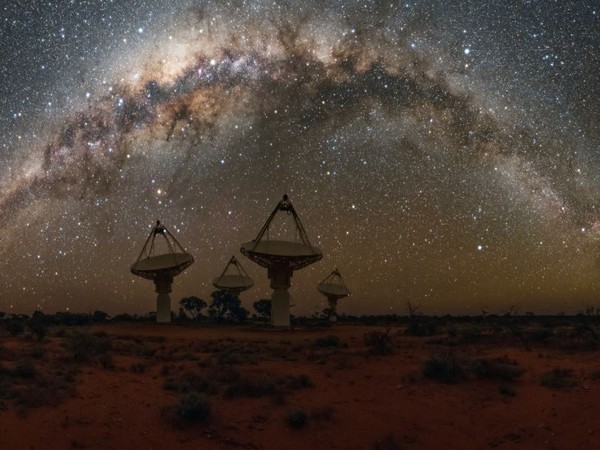

Washington D.C. [USA], June 2 (ANI): Astronomers have peered into the home galaxies of fast radio bursts, ruling out supermassive black holes as a cause and bringing us a step closer to understanding the origins of these mysterious signals from outer space.
Fast radio bursts - the hottest topic in astronomy right now - were first detected in 2007, but astronomers are still working out what could make such a brief signal appear so bright. In just a millisecond, a single burst releases more energy than our Sun emits in 80 years.
Now Dr Shivani Bhandari, an astronomer with CSIRO, Australia's national science agency, has made a key breakthrough by zooming in on the precise location of four fast radio bursts and having a look around their 'neighbourhoods'.
Dr Bhandari led the research published today in The Astrophysical Journal Letters.
"Just like doing video calls with colleagues shows you their homes and gives you a bit of an insight into their lives, looking into the host galaxies of fast radio bursts gives us insights to their origins."
Using a specially designed transient detector on CSIRO's ASKAP radio telescope in outback Western Australia, Dr Bhandari and her team found the exact location of four fast radio bursts.
"These precisely localised fast radio bursts came from the outskirts of their home galaxies, removing the possibility that they have anything to do with supermassive black holes," Dr Bhandari said.
This first detailed study of the galaxies that host fast radio bursts rules out several of the more extreme theories put forward to explain their origins, getting us closer to knowing their true nature.
Co-author CSIRO's Prof Elaine Sadler said these fast radio bursts could not have come from a super-luminous stellar explosion, or from cosmic strings.
"Models such as mergers of compact objects like white dwarfs or neutron stars, or flares from magnetars created by such mergers, are still looking good," added Prof Sadler.
Follow-up observations with the world's largest optical telescopes -- Gemini South, ESO's Very Large Telescope, Magellan Baade, Keck, and LCOGT-1m -- identified, imaged and found the distances to the host galaxies.
Investigating if fast radio bursts favour a certain type of galaxy, the researchers found all four bursts came from massive galaxies that are forming new stars at a modest rate, very similar to our own Milky Way galaxy.
Dr J Xavier Prochaska of the University of California, Santa Cruz, co-led the team responsible for the optical observations.
"Major advances for other transient events have been made by studying their home galaxies. We are optimistic that studies like ours will be just as vital," Dr Prochaska said.
Dame Jocelyn Bell Burnell, who as a postgraduate student in 1967 was the first to detect rapidly spinning neutron stars now known as 'pulsars', praised the research.
"Positioning the sources of fast radio bursts is a huge technical achievement, and moves the field on enormously," said Dame Jocelyn.
"We may not yet be clear exactly what is going on, but now, at last, options are being ruled out. This is a highly significant paper, thoroughly researched and well written."
ASKAP is located at CSIRO's Murchison Radio-astronomy Observatory (MRO) and is a precursor to the future Square Kilometre Array (SKA) telescope.
When built, the SKA will be the largest and most sensitive radio telescope in the world and is expected to revolutionise our understanding of the Universe.
CSIRO acknowledges the Wajarri Yamatji as the traditional owners of the MRO site. (ANI)


