

ADD ANI AS A TRUSTED SOURCE
googleads
ANI Logo
Menu
Science

Wolves, dogs appear to remember where people hid food: Research

In a research involving many wolves and dogs, both animals did better at finding hidden food if they had previously watched the food being hidden by a person, implying that they remembered where the food was and did not rely simply on scent to discover it. Sebastian Vetter of the University of Veterinary Medicine Vienna, Austria, and colleagues published their findings in the open-access journal PLOS ONE.

ANI Sep 14, 2023 17:13 IST googleads

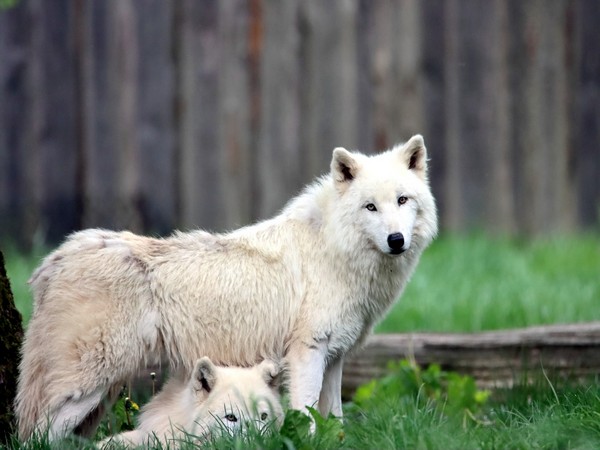
Representative Image

Washington DC [US], September 14 (ANI): In a research involving many wolves and dogs, both animals did better at finding hidden food if they had previously watched the food being hidden by a person, implying that they remembered where the food was and did not rely simply on scent to discover it.  Sebastian Vetter of the University of Veterinary Medicine Vienna, Austria, and colleagues published their findings in the open-access journal PLOS ONE.
Many species transmit important information through social learning, where one individual learns by observing or interacting with another. Prior research has suggested that wolves and dogs—who were domesticated from wolves—are capable of a form of social learning known as observational spatial memory, in which an individual can remember where another individual hid a cache of food and pilfer it. However, much remains to be learned about these abilities and how they may differ between wolves and dogs.
To shed new light, Vetter and colleagues conducted a study with 9 timber wolves and 8 mongrel dogs living at the Wolf Science Center in Ernsbrunn, Austria. They tested the ability of each animal to find 4, 6, or 8 caches of food, either after seeing a human hiding them or without the animal seeing the hiding.
The researchers found that both dogs and wolves found more of the first 5 food caches more quickly and with less distance travelled if they saw the food being hidden than if they did not see the hiding. This suggests that the animals did not just use scent in order to find the food, and it provides further support for the hypothesis that both kinds of animals are capable of observational spatial memory.
Whether or not they saw the food being hidden, wolves outperformed the dogs in finding the caches. The researchers suggest that this difference in performance may not be due to differing observational spatial memory abilities, but instead arises from differences in other traits, such as persistency and food-related motivation.
The authors add: “While domestication probably affected dogs’ willingness to adjust to humans, the results of the current study collaborate previous findings suggesting that cognitive abilities do not differ very much between dogs and wolves.” (ANI)


Get the App

What to Read Next

Science

New insights into how cancer evades the immune system: Study

New insights into how cancer evades the immune system: Study

Immunotherapy research primarily focuses on better recognition of cancer cells by the body's own immune system. Researchers at Amsterdam UMC and Moffitt Cancer Center have taken a different approach.

Read More
Science

Strand Life Sciences launches portal for rare disease diagnosis

Strand Life Sciences launches portal for rare disease diagnosis

Marking Rare Disease Day, Strand Life Sciences, a subsidiary of Reliance Industries and a leading genomics research company, has launched the StrandOmics Portal, an innovative digital platform designed to assist doctors in diagnosing rare diseases more efficiently.

Read More
Science

Discovery of unexpected collagen structure to influence research

Discovery of unexpected collagen structure to influence research

Collagen, the body's most abundant protein, has long been considered a predictable structural component of tissues.

Read More
Science

Shubhanshu Shukla: IAF officer becomes first Indian astronaut for

Shubhanshu Shukla: IAF officer becomes first Indian astronaut for

Shubhanshu Shukla, Indian Air Force (IAF) officer and one of four astronauts for Indian Space Research Organisation's (ISRO) Gaganyaan mission, has been sele Shubhanshu Shukla, Indian Air Force (IAF) officer and one of four astronauts for Indian Space Research Organisation's (ISRO) Gaganyaan mission, has been selected as the pilot for Axiom Mission 4, scheduled for Spring 2025.cted as the pilot for Axiom Mission 4, scheduled for Spring 2025.

Read More
Science

Weather change linked to heightened risk of Salmonella outbreaks

Weather change linked to heightened risk of Salmonella outbreaks

According to new research from the University of Surrey, climate change has an impact on Salmonella spread. This study builds on prior work by the researchers, which discovered that weather change is contributing to the spread of deadly diarrhoeal illnesses.

Read More
Science

Study finds connection between quantum theory, information theory

Study finds connection between quantum theory, information theory

"Our results have no clear or direct application right now. It's basic research that lays the foundation for future technologies in quantum information and quantum computers. There's enormous potential for complete discoveries in many different research fields," said Guilherme B Xavier, a researcher in quantum communication at Linkoping University, Sweden.

Read More
Science

Bacterial vaccine demonstrates potential as cancer treatment

Bacterial vaccine demonstrates potential as cancer treatment

Columbia researchers developed probiotic bacteria that train the immune system to eliminate cancer cells, paving the way for a new class of cancer vaccinations that take advantage of bacteria's innate tumour-targeting abilities. These microbial cancer vaccines can be tailored to each person's specific original tumour and metastases, perhaps preventing future recurrences.

Read More
Science

Alzheimer’s disease can damage brain in two phases

Alzheimer’s disease can damage brain in two phases

Alzheimer's disease may cause brain damage in two stages, according to new research supported by the National Institutes of Health (NIH) that uses sophisticated brain mapping methods.

Read More
Science

Study discovers how special immune cells stop metastatic cancer

Study discovers how special immune cells stop metastatic cancer

The majority of cancer deaths are caused by metastatic disease, which occurs when cancer spreads from the primary tumour to other areas of the body. and researchers understand how cancer cells escape the primary location to seed new tumours, it is unclear why some cancer cells produce new tumours decades later and others do not.

Read More
Science

Medication increases radiation therapy's efficacy for lung cancer

Medication increases radiation therapy's efficacy for lung cancer

A group of researchers from the University of Cincinnati has discovered a possible novel approach to enhance the efficacy of radiation therapy and enhance the prognosis of patients with lung cancer metastasizing to the brain.

Read More
Home About Us Our Products Advertise Contact Us Terms & Condition Privacy Policy

Copyright © aninews.in | All Rights Reserved.
