 हिंदी खबर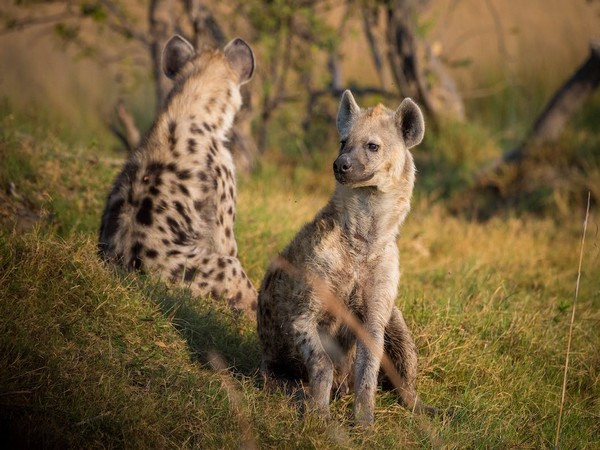

Washington [US], December 20 (ANI): In most mammals, males disperse to a new group after reaching sexual maturity. Dispersal often entails costs and is risky. New results from spotted hyenas show that males from the same birth group and particularly twin brothers very often disperse together and choose the same group to breed.
The coordination is likely the combined result of males having similar preferences when they have a similar social and genetic background, and of related males actively sticking together to support one another. What shapes the social life and evolution of spotted hyenas has been the subject of research for a quarter of a century by the Hyena Project of the Leibniz Institute for Zoo and Wildlife Research (Leibniz-IZW) in the Ngorongoro Crater in Tanzania. The new results have been published in the journal Biology Letters.
Spotted hyenas (Crocuta crocuta) are highly social mammals that live in large groups (clans) dominated by females. While the females remain in their natal clan, the males eventually have to decide whether or not to immigrate into another clan to breed. This decision is important for their reproductive success and most males decide to leave their birth clan. But dispersal and social integration into a new clan are challenging; newcomers drop to the very bottom of the social hierarchy of the new clan and are treated as scapegoats by established males. How do males decide when, where and with whom to disperse? Do they disperse alone or together with friends and brothers? Is coordinated dispersal a deliberate decision or a passive process that is driven by similarities among males in their genotype and their social upbringing?
These questions are of great interest to behavioural ecologists and conservation biologists but are rarely addressed in wild populations because they require detailed data on the behaviour and success of many individuals over their lifetime. Only a few science teams have access to such data on large mammals. The quarter-of-a-century-long Hyena Project in the Ngorongoro Crater in Tanzania is one of these.
The Ngorongoro Crater is inhabited by approximately 400 hyenas divided into eight clans. All hyenas of this population are individually known by their spot pattern and monitored on a near-daily basis. Over the last 26 years, the team of the IZW has compiled detailed data from 2800 hyenas with almost complete individual life histories. This dataset offers worldwide unique opportunities for behavioural and evolutionary research.
"We show for the first time that in spotted hyenas, twin brothers and buddies from the same birth clan often disperse to the same clan to reproduce," explains Oliver Honer, head of the Ngorongoro Hyena Project. Twin brothers disperse together in 70% of the cases, and male relatives of the same age and the same birth clan do so in 36% of the cases. By contrast, unrelated males from different clans only settle in the same clan in 7% of cases. "This is new and exciting because until now spotted hyenas have been assumed to disperse solitarily. It also means that immigrants may often be genetically related. This has major consequences for our understanding of social dynamics and gene flow in wild populations," says Eve Davidian, the first author of the article.
The frequent joint dispersal among twins and buddies can have, in theory, two causes: one passive, the other active. The passive process arises when males with a similar genetic and social backgrounds think and act alike, and are thus more likely to choose the same breeding clan, by chance. Alternatively, it can be a deliberate and adaptive decision, in which case males should adjust their decision depending on the relative costs and benefits of joint dispersal. "Whether the benefits outweigh the costs depends on clan size," explains Eve Davidian. "When clans are large and contain many males, it may be highly beneficial to disperse with an ally to better cope with resistance from these males." Potential costs are that males that disperse together compete for the same females. "This is particularly costly for close kin such as twins when clans are small and contain few females because impairing their brother's success also affects their own. It's like a double penalty," adds Eve Davidian.
The scientists found that twin brothers and kin were most likely to disperse together when clans were large, demonstrating that males make an active choice. The result that not only twin brothers but also buddies of the same birth clan often immigrated together shows that the social and ecological environment during development as well as the genetic background influences the decision. (ANI)


