 हिंदी खबर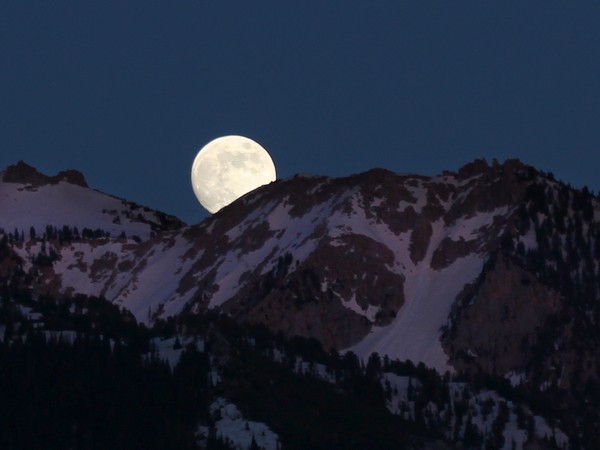

Washington D.C. [USA], April 7 (ANI): The next full Moon is the Pink Moon, Sprouting Grass Moon, Egg Moon, Fish Moon, the Pesach or Passover Moon, Paschal Moon, Hanuman Jayanti, Bak Poya and a "supermoon."
The Moon will be full on Tuesday night, April 7, 2020, appearing opposite the Sun (in Earth-based longitude) at 10:35 PM EDT. The Moon will appear full for about three days around this time, from Monday night through Thursday morning.
The Maine Farmer's Almanac first published "Indian" names for the Full Moons in the 1930s. According to this Almanac, as the full Moon in April and the first Full Moon of spring, this is the Pink Moon, a name that comes from the herb moss pink, also known as creeping phlox, moss phlox, or mountain phlox, which is native to the eastern USA and one of the earliest widespread flowers of Spring.
Other names for this Moon include the Sprouting Grass Moon, the Egg Moon, and among coastal tribes the Fish Moon, as this was the time that the shad swam upstream to spawn.
This is the Pesach or Passover Moon. Pesach or Passover begins at sundown on Wednesday, April 8, and ends at nightfall on Thursday, April 16, 2020. In the Hebrew lunisolar calendar, the months change with the new Moon and full Moons fall in the middle of the lunar months. This full Moon is in the middle of Nisan.
In the Christian ecclesiastical calendar, this is the Paschal Moon, the full Moon from which the date of Easter is calculated. Paschal is the Latinized version of Pesach. Generally, the Christian holiday of Easter, also called Pascha, is celebrated on the first Sunday after the first full moon of spring.
However, there are differences between the times of these astronomical events and the calendars used by the Eastern and Western churches. This is one of the years where it makes a difference. Western Christianity will celebrate Easter on Sunday, April 12, 2020, while Eastern Christianity will celebrate Easter a week later, on Sunday, April 19, 2020.
There are a number of variations of the Hindu lunisolar calendar, but for many, this full Moon corresponds with the Hanuman Jayanti festival celebrating the birth of Lord Sri Hanuman.
In the Chinese lunisolar calendar, the months change with the new Moon and full Moons fall in the middle of the lunar months. This full Moon is in the middle of the third month of the Chinese calendar. In the Islamic calendar, the months start with the first sighting of the waxing crescent Moon shortly after the New Moon. This full Moon is near the middle of Sha'ban, the eighth month of the Islamic year 1441 and the month before Ramadan.
As usual, the wearing of suitably celebratory celestial attire is encouraged in honour of the full Moon.
On the evening of the Full Moon on Tuesday, April 7, 2020, as evening twilight ends (at 8:37 PM EDT for the Washington, DC area), the brightest of the planets, Venus, will appear as the Evening Star about 32 degrees above the horizon in the west-northwest.
The brightest of our stars, Sirius, along with the other bright stars of the local arm of our home galaxy, will appear spread across the southwestern horizon. The twin stars (Castor and Pollux) from the constellation Gemini will appear nearly overhead, with Pollux the brighter of the two.
As this lunar cycle progresses, the background of stars will appear to shift towards the west, while Venus will appear to shift slightly towards the north and towards the horizon. Venus will reach its greatest brilliancy (a geometric approximation of its greatest brightness) on April 28, 2020.
When Venus is near its brightest, if the weather is clear and you know where to look, Venus can be seen during the day. By the evening of the Full Moon on May 7, 2020, as evening twilight ends (at 9:12 PM for the Washington, DC area), Venus will appear about 19 degrees above the horizon in the west-northwest. None of the brightest stars will appear directly overhead; the closest to overhead will be Regulus, appearing about 59 degrees above the southwestern horizon.
On the morning of the Full Moon on Tuesday, April 7, 2020, at the time morning twilight begins (at 5:43 AM EDT for the Washington, DC area), the bright planet Jupiter will appear in the south-southeast at about 23 degrees above the horizon. Next in brightness, the planet Saturn will appear to the left of Jupiter at about 21 degrees above the horizon, and third in brightness, the planet Mars will appear further to the left at about 19 degrees above the southeastern horizon.
The planet Mercury will be below the horizon but may be visible (if you have a clear view of the eastern horizon) after it rises about 45 minutes before sunrise. As the lunar cycle progresses, the background of stars will appear to shift towards the west. Jupiter, Saturn, and Mars will also shift towards the west, but at differing rates, such that Mars will appear to shift away from Jupiter and Saturn. Mercury will shift closer towards the Sun, becoming harder to see in the glow of dawn. (ANI)




