

ADD ANI AS A TRUSTED SOURCE
googleads
ANI Logo
Menu
Science

Study suggest giraffes are highly socially complex species

Bristol [UK], August 14 (ANI): Evidence has been discovered that giraffes are as socially complex as elephants, according to a new study by scientists at the University of Bristol.

ANI Aug 14, 2021 22:53 IST googleads

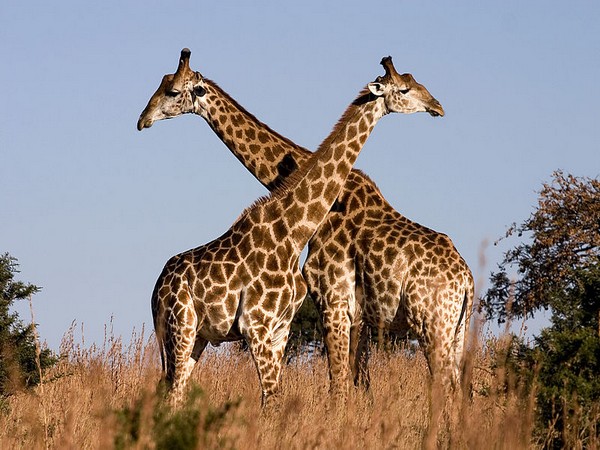
Representative Image

Bristol [UK], August 14 (ANI): Evidence has been discovered that giraffes are as socially complex as elephants, according to a new study by scientists at the University of Bristol.
The findings of the study were published in the journal 'Mammal Review'.
Traditionally, giraffes were thought to have little or no social structure, and only fleeting, weak relationships. However, in the last ten years, research has shown that giraffe social organisation is much more advanced than once thought.
In the study, Zoe Muller of Bristol's School of Biological Sciences has demonstrated that giraffes spend up to 30 per cent of their lives in a post-reproductive state.
This is comparable to other species with highly complex social structures and cooperative care, such as elephants and killer whales which spend 23 per cent and 35 per cent of their lives in a post-reproductive state respectively.
In these species, it has been demonstrated that the presence of post-menopausal females offers survival benefits for related offspring.
In mammals -- and including humans -- this is known as the 'Grandmother hypothesis' which suggests that females live long past menopause so that they can help raise successive generations of offspring, thereby ensuring the preservation of their genes.
Researchers proposed that the presence of post-reproductive adult female giraffes could also function in the same way, and supported the author's assertion that giraffes are likely to engage in cooperative parenting, along matrilines, and contribute to the shared parental care of related kin.
Muller said, "It is baffling to me that such a large, iconic and charismatic African species has been understudied for so long. This paper collates all the evidence to suggest that giraffes are actually a highly complex social species, with intricate and high-functioning social systems, potentially comparable to elephants, cetaceans and chimpanzees."
Muller added, "I hope that this study draws a line in the sand, from which point forwards, giraffes will be regarded as intelligent, group-living mammals which have evolved highly successful and complex societies, which have facilitated their survival in tough, predator-filled ecosystems."
For scientists to recognise giraffes as a socially complex species, Muller has suggested eight key areas for future research, including the need to understand the role that older, post-reproductive adults play in society and what fitness benefits they bring for group survival.
Muller further said, "Recognising that giraffes have a complex cooperative social system and live in matrilineal societies will further our understanding of their behavioural ecology and conservation needs."
Muller concluded, "Conservation measures will be more successful if we have an accurate understanding of the species' behavioural ecology. If we view giraffes as a highly socially complex species, this also raises their 'status' towards being a more complex and intelligent mammal that is increasingly worthy of protection." (ANI)


Get the App

What to Read Next

Science

Amphibians bounce-back from Earth’s greatest mass extinction

Amphibians bounce-back from Earth’s greatest mass extinction

Researchers at the University of Bristol discovered that ancient frog ancestors survived the biggest mass extinction of species by eating on freshwater prey that evaded terrestrial predators.

Read More
Science

Scientists use AI to better understand nanoparticles: Study

Scientists use AI to better understand nanoparticles: Study

A group of scientists has created a way to illuminate the dynamic behavior of nanoparticles, which are essential components in the production of pharmaceuticals, electronics, and industrial and energy-conversion materials.

Read More
Science

Study reveals impact of animals as architects of Earth

Study reveals impact of animals as architects of Earth

A new study led by Professor Gemma Harvey from Queen Mary University of London has revealed how hundreds of species shape the landscapes we depend on, from termite mounds visible from space to beavers creating wetlands and hippos carving drainage systems.

Read More
Science

New technology enhances gravitational-wave detection: Study

New technology enhances gravitational-wave detection: Study

A team of physicists led by Jonathan Richardson of the University of California, Riverside, demonstrated how new optical technology can extend the detection range of gravitational-wave observatories such as the Laser Interferometer Gravitational-Wave Observatory, or LIGO, and pave the way for future observatories.

Read More
Science

AI can reveals hidden hazards of chemical mixtures in rivers

AI can reveals hidden hazards of chemical mixtures in rivers

Artificial intelligence can provide important insights into how complex chemical mixes in rivers affect aquatic life, paving the path for more effective environmental protection.

Read More
Science

Astronomers find the smallest main-belt asteroids ever detected:

Astronomers find the smallest main-belt asteroids ever detected:

The majority of known asteroids orbit inside the main asteroid belt, which is positioned between Mars and Jupiter at an average distance of around 250 million km from Earth. Since the discovery of the first asteroid in 1801, about 750.000 asteroids have been identified, primarily in the last decade thanks to several optical surveys that examine the sky on clear nights.

Read More
Science

Study finds connection between quantum theory, information theory

Study finds connection between quantum theory, information theory

"Our results have no clear or direct application right now. It's basic research that lays the foundation for future technologies in quantum information and quantum computers. There's enormous potential for complete discoveries in many different research fields," said Guilherme B Xavier, a researcher in quantum communication at Linkoping University, Sweden.

Read More
Science

When devices can read human emotions without a camera: Study

When devices can read human emotions without a camera: Study

Tokyo Metropolitan University researchers employed long-term skin conductance measurements to distinguish between emotions. Volunteers were given videos representing frightening scenarios, family bonding, and humour, while their skin conductance was measured.

Read More
Science

'Nuroscience study results can be better predicted by AI'

'Nuroscience study results can be better predicted by AI'

Large language models, a type of AI that analyses text, can anticipate the results of proposed neuroscience studies more correctly than human experts, according to a new study led by UCL (University College London) researchers.

Read More
Science

Thermal imaging may help fruits, veggies stay fresher longer: Study

Thermal imaging may help fruits, veggies stay fresher longer: Study

Before your favourite produce arrives at the grocery store, it must be carefully harvested and stored for extended periods of time. A recent University of Georgia assessment argues that new temperature sensing devices could make that procedure considerably easier, as agricultural issues are exacerbated by changing climates.

Read More


