

ADD ANI AS A TRUSTED SOURCE
googleads
ANI Logo
Menu
Science

Study reveals tiger sharks are social creatures

Washington [US], September 7 (ANI): Scientists have found that tiger sharks, often considered a solitary nomadic species, are social creatures, having preferences for one another.

ANI Sep 07, 2021 17:01 IST googleads

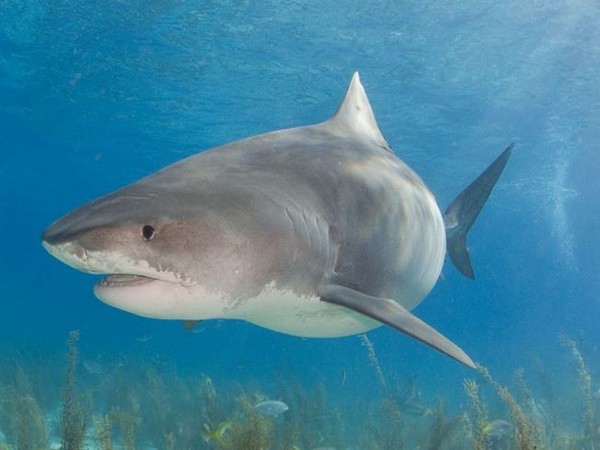
Representative image

Washington [US], September 7 (ANI): Scientists have found that tiger sharks, often considered a solitary nomadic species, are social creatures, having preferences for one another.
A first of its kind, the study by the University of Miami Rosenstiel School of Marine and Atmospheric Science (UM) and the Institute of Zoology at the Zoological Society London (ZSL) also evaluated if exposure of the tiger shark to baited dive tourism impacted their social behaviour.
The study was conducted at a site named Tiger Beach, located off the northwest side of Little Bahama bank in the Bahamas.
The area is known for hosting shark diving encounters, where the sharks are attracted with chum and often fed in front of dive tourists.
The research team tagged and tracked the movements of tiger sharks over the course of three years.
They then applied a tool called Social Network Analysis to the tracking data to examine if tiger sharks exhibited social grouping behaviour and if this social behaviour differed at locations where sharks were exposed to baited shark dive tourism.
The study not only found that tiger sharks formed social groups, but also discovered that at sites where tiger sharks were being fed by dive tourism operators, tiger sharks became more aggregated, but interactions between sharks became more random, suggesting a breakdown in social organization.
"Given that tiger sharks spend months at a time out in the open ocean as solitary predators, it's amazing to me that they show social preferences for one another when they are at the Tiger Beach area," said Neil Hammerschlag, senior author of the study and research associate professor at the UM Rosenstiel School.
"For nearly two decades, I have spent countless hours diving at Tiger Beach, always wondering if these apex predators interacted socially. Now we know," added Hammerschlag.
Baited shark dives are often conducted by dive tourism companies to attract the animals so that tourists may observe them.
This approach has been known to cause mixed feelings among conservationists and shark experts, due to the possible long-term impacts on the predators, such as changes to their natural foraging behaviour.
This study found that tiger sharks aggregated at the dive sites, but social preferences between sharks were less prevalent as compared to areas outside of these dive sites.
These results suggest that feeding sharks may disrupt their social organization, but only temporarily, as the study found that tiger sharks resumed their social groupings outside of the dive sites.
"The boundary between wildlife and people is becoming increasingly thin, so as well as observing a new social behaviour for the first time in what was once thought of as a solitary shark, we also measured the impacts of human activity on these predators' interactions," said David Jacoby, ZSL Honorary Research Associate and lead author of the study.
"They seem to show some resilience to the bait feeding," added Jacoby.
The social behaviour of predators is an important area of study as it provides another tool to help scientists and wildlife managers build a picture of how they live, what drives them to form social groups, and the roles they play within the wider ecosystem. (ANI)


Get the App

What to Read Next

Science

New method guides magnetism without magnets

New method guides magnetism without magnets

Researchers at Paul Scherrer Institute PSI have demonstrated an innovative method to control magnetism in materials using an energy-efficient electric field.

Read More
Science

Amphibians bounce-back from Earth’s greatest mass extinction

Amphibians bounce-back from Earth’s greatest mass extinction

Researchers at the University of Bristol discovered that ancient frog ancestors survived the biggest mass extinction of species by eating on freshwater prey that evaded terrestrial predators.

Read More
Science

New insights into how cancer evades the immune system: Study

New insights into how cancer evades the immune system: Study

Immunotherapy research primarily focuses on better recognition of cancer cells by the body's own immune system. Researchers at Amsterdam UMC and Moffitt Cancer Center have taken a different approach.

Read More
Science

Scientists use AI to better understand nanoparticles: Study

Scientists use AI to better understand nanoparticles: Study

A group of scientists has created a way to illuminate the dynamic behavior of nanoparticles, which are essential components in the production of pharmaceuticals, electronics, and industrial and energy-conversion materials.

Read More
Science

New device could allow you to taste cake in virtual reality

New device could allow you to taste cake in virtual reality

The 'e-Taste' interface employs sensors and wireless chemical dispensers to enable remote taste perception, often known as gestation. Field testing done by researchers at The Ohio State University confirmed the device's ability to digitally simulate a range of taste intensities, while still offering variety and safety for the user.

Read More
Science

Study reveals impact of animals as architects of Earth

Study reveals impact of animals as architects of Earth

A new study led by Professor Gemma Harvey from Queen Mary University of London has revealed how hundreds of species shape the landscapes we depend on, from termite mounds visible from space to beavers creating wetlands and hippos carving drainage systems.

Read More
Science

Opposing arrows of time emerge from certain quantum systems

Opposing arrows of time emerge from certain quantum systems

Researchers at the University of Surrey made a thought-provoking discovery. A new study reveals that opposing arrows of time can theoretically emerge from certain quantum systems.

Read More
Science

COVID-19 severity may be predicted by White Blood Cell Count

COVID-19 severity may be predicted by White Blood Cell Count

A COVID-19 diagnosis is no longer as frightening as it used to be, thanks to developments in treatment choices. However, a new study reveals that leukocyte (white blood cell) count may now be used to identify who is more likely to develop more significant disease symptoms.

Read More
Science

Seals can essentially act as 'smart sensors': Study

Seals can essentially act as 'smart sensors': Study

A new study by marine biologists reports that seals can essentially act as 'smart sensors' for monitoring fish populations in the ocean's eerily dim 'twilight zone.'

Read More
Science

New technology enhances gravitational-wave detection: Study

New technology enhances gravitational-wave detection: Study

A team of physicists led by Jonathan Richardson of the University of California, Riverside, demonstrated how new optical technology can extend the detection range of gravitational-wave observatories such as the Laser Interferometer Gravitational-Wave Observatory, or LIGO, and pave the way for future observatories.

Read More


