

ADD ANI AS A TRUSTED SOURCE
googleads
Menu
Science

Study reveals Saturn's rings and tilt could be product of an ancient 'missing moon'

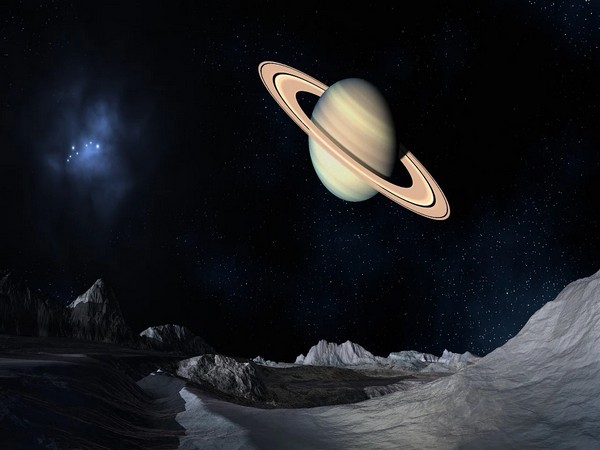
Washington [US], September 16 (ANI): Scientists propose a lost moon of Saturn, which they call Chrysalis, pulled on the planet until it ripped apart, forming rings and contributing to Saturn's tilt.

ANI Sep 16, 2022 23:36 IST googleads

Representative Image

Washington [US], September 16 (ANI): Scientists propose a lost moon of Saturn, which they call Chrysalis, pulled on the planet until it ripped apart, forming rings and contributing to Saturn's tilt.
But a new modeling study by astronomers at MIT and elsewhere has found that, while the two planets may have once been in sync, Saturn has since escaped Neptune's pull. What was responsible for this planetary realignment? The team has one meticulously tested hypothesis: a missing moon.
In a study appearing in Science, the team proposes that Saturn, which today hosts 83 moons, once harbored at least one more, an extra satellite that they name Chrysalis. Together with its siblings, the researchers suggest, Chrysalis orbited Saturn for several billion years, pulling and tugging on the planet in a way that kept its tilt, or "obliquity," in resonance with Neptune.
But around 160 million years ago, the team estimates, Chrysalis became unstable and came too close to its planet in a grazing encounter that pulled the satellite apart. The loss of the moon was enough to remove Saturn from Neptune's grasp and leave it with the present-day tilt.
What's more, the researchers surmise, while most of Chrysalis' shattered body may have made impact with Saturn, a fraction of its fragments could have remained suspended in orbit, eventually breaking into small icy chunks to form the planet's signature rings.
The missing satellite, therefore, could explain two longstanding mysteries: Saturn's present-day tilt and the age of its rings, which were previously estimated to be about 100 million years old -- much younger than the planet itself.
"Just like a butterfly's chrysalis, this satellite was long dormant and suddenly became active, and the rings emerged," says Jack Wisdom, professor of planetary sciences at MIT and lead author of the new study.
The study's co-authors include Rola Dbouk at MIT, Burkhard Militzer of the University of California at Berkeley, William Hubbard at the University of Arizona, Francis Nimmo and Brynna Downey of the University of California at Santa Cruz, and Richard French of Wellesley College. (ANI)


Get the App

What to Read Next

Science

Google marks total solar eclipse with special animation

Google marks total solar eclipse with special animation

A total solar eclipse is slated to take place today when the Moon will pass between the Sun and Earth, completely blocking out the Sun's light.

Read More
Science

Loss of cells in pancreas in elderly cause age-related diabetes

Loss of cells in pancreas in elderly cause age-related diabetes

Researchers have looked into the disappearance of pancreatic islet cells in people who have never suffered pancreatitis. They determined that the loss of insulin-producing beta cells was the primary cause of islet cell loss in the elderly after finding notable trends in the types of cells lost as a result of islet cell loss in different age groups and genders. This may be the underlying cause of diabetes associated with ageing and offers guidance for new preventative treatments.

Read More
Science

Research reveals how jellyfish regenerate functional tentacles

Research reveals how jellyfish regenerate functional tentacles

Cladonema, a jellyfish about the size of a pinkie nail, can regenerate an amputated tentacle in two to three days - but how? Across animals, including salamanders and insects, regenerating functional tissue is dependent on the ability to generate a blastema, a clump of undifferentiated cells that may repair damage and grow into the missing appendage

Read More
Space

Wearable devices can prevent astronauts from being lost in space

Wearable devices can prevent astronauts from being lost in space

Wearable gadgets that vibrate to provide orientation cues, however, have been identified by scientists to significantly improve the efficacy of this training, making spaceflight marginally safer.

Read More
Science

Wearable devices may help astronauts avoid being 'lost' in space

Wearable devices may help astronauts avoid being 'lost' in space

The sky is no longer the limit - but flying is risky. We lose many of the clues we need to orient ourselves when we leave the Earth's surface, and this spatial disorientation can be fatal. Astronauts typically require extensive training to protect themselves against it. However, scientists have discovered that wearable devices that vibrate to provide orientation cues may considerably improve the efficacy of this training, making spaceflight slightly safer.

Read More
Home About Us Our Products Advertise Contact Us Terms & Condition Privacy Policy

Copyright © aninews.in | All Rights Reserved.
