

ADD ANI AS A TRUSTED SOURCE
googleads
ANI Logo
Menu
Science

Study reveals new information about movement and evolution of dinosaurs

Bristol (England) [UK], January 22, (ANI): A new research led by the University of Bristol has revealed the evolution of giant 50-tonne sauropod dinosaurs, like Diplodocus, from its much smaller ancestors, like the wolf-sized Thecodontosaurus.

ANI Jan 22, 2022 11:11 IST googleads

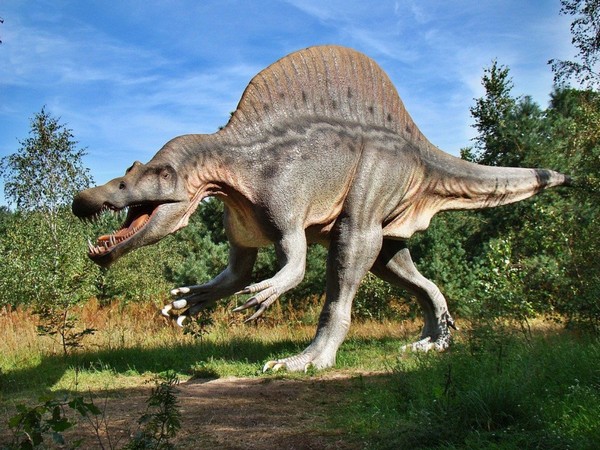
Representative image

Bristol (England) [UK], January 22, (ANI): A new research led by the University of Bristol has revealed the evolution of giant 50-tonne sauropod dinosaurs, like Diplodocus, from its much smaller ancestors, like the wolf-sized Thecodontosaurus.
In the study published in the journal 'Royal Society Open Science', researchers presented a reconstruction of the limb muscles of Thecodontosaurus, detailing the anatomy of the most important muscles involved in the movement.
Thecodontosaurus was a small to a medium-sized two-legged dinosaur that roamed around the area that is presently the United Kingdom, during the Triassic period (around 205 million years ago).
This dinosaur was one of the first-ever to be discovered and named by scientists, in 1836, but continues to surprise scientists with new information about how the earliest dinosaurs lived and evolved.
Antonio Ballell, PhD student in Bristol's School of Earth Sciences and lead author of the study, said: "The University of Bristol houses a huge collection of beautifully preserved Thecodontosaurus fossils that were discovered around Bristol. The amazing thing about these fossilised bones is that many preserve the scars and rugosities that the limb musculature left on them with its attachment."
These features are extremely valuable in scientific terms to infer the shape and direction of the limb muscles. Reconstructing muscles in extinct species requires this kind of exceptional preservation of fossils, but also a good understanding of the muscle anatomy of living, closely related species.
Antonio Ballell added: "In the case of dinosaurs, we have to look at modern crocodilians and birds, that form a group that we call archosaurs, meaning 'ruling reptiles'. Dinosaurs are extinct members of this lineage, and due to evolutionary resemblance, we can compare the muscle anatomy in crocodiles and birds and study the scars that they leave on bones to identify and reconstruct the position of those muscles in dinosaurs."
Professor Emily Rayfield, co-author of the study, said: "These kinds of muscular reconstructions are fundamental to understand functional aspects of the life of extinct organisms. We can use this information to simulate how these animals walked and ran with computational tools."
From the size and orientation of its limb muscles, the authors argued that the Thecodontosaurus was quite agile and probably used its forelimbs to grasp objects instead of walking.
This contrasts with its later relatives, the giant sauropods, which partly achieved these huge body sizes by shifting to a quadrupedal posture. The muscular anatomy of Thecodontosaurus seemed to indicate that key features of later sauropod-line dinosaurs had already evolved in this early species.
Professor Mike Benton, another co-author, said: "From an evolutionary perspective, our study adds more pieces to the puzzle of how the locomotion and posture changed during the evolution of dinosaurs and in the line to the giant sauropods."
"How were limb muscles modified in the evolution of multi-ton quadrupeds from tiny bipeds? Reconstructing the limb muscles of Thecodontosaurus gives us new information of the early stages of that important evolutionary transition," he added. (ANI)


Get the App

What to Read Next

Science

Amphibians bounce-back from Earth’s greatest mass extinction

Amphibians bounce-back from Earth’s greatest mass extinction

Researchers at the University of Bristol discovered that ancient frog ancestors survived the biggest mass extinction of species by eating on freshwater prey that evaded terrestrial predators.

Read More
Science

New insights into how cancer evades the immune system: Study

New insights into how cancer evades the immune system: Study

Immunotherapy research primarily focuses on better recognition of cancer cells by the body's own immune system. Researchers at Amsterdam UMC and Moffitt Cancer Center have taken a different approach.

Read More
Science

Scientists use AI to better understand nanoparticles: Study

Scientists use AI to better understand nanoparticles: Study

A group of scientists has created a way to illuminate the dynamic behavior of nanoparticles, which are essential components in the production of pharmaceuticals, electronics, and industrial and energy-conversion materials.

Read More
Science

Strand Life Sciences launches portal for rare disease diagnosis

Strand Life Sciences launches portal for rare disease diagnosis

Marking Rare Disease Day, Strand Life Sciences, a subsidiary of Reliance Industries and a leading genomics research company, has launched the StrandOmics Portal, an innovative digital platform designed to assist doctors in diagnosing rare diseases more efficiently.

Read More
Science

New technology enhances gravitational-wave detection: Study

New technology enhances gravitational-wave detection: Study

A team of physicists led by Jonathan Richardson of the University of California, Riverside, demonstrated how new optical technology can extend the detection range of gravitational-wave observatories such as the Laser Interferometer Gravitational-Wave Observatory, or LIGO, and pave the way for future observatories.

Read More
Science

Discovery of unexpected collagen structure to influence research

Discovery of unexpected collagen structure to influence research

Collagen, the body's most abundant protein, has long been considered a predictable structural component of tissues.

Read More
Science

Shubhanshu Shukla: IAF officer becomes first Indian astronaut for

Shubhanshu Shukla: IAF officer becomes first Indian astronaut for

Shubhanshu Shukla, Indian Air Force (IAF) officer and one of four astronauts for Indian Space Research Organisation's (ISRO) Gaganyaan mission, has been sele Shubhanshu Shukla, Indian Air Force (IAF) officer and one of four astronauts for Indian Space Research Organisation's (ISRO) Gaganyaan mission, has been selected as the pilot for Axiom Mission 4, scheduled for Spring 2025.cted as the pilot for Axiom Mission 4, scheduled for Spring 2025.

Read More
Science

Weather change linked to heightened risk of Salmonella outbreaks

Weather change linked to heightened risk of Salmonella outbreaks

According to new research from the University of Surrey, climate change has an impact on Salmonella spread. This study builds on prior work by the researchers, which discovered that weather change is contributing to the spread of deadly diarrhoeal illnesses.

Read More
Science

Astronomers find the smallest main-belt asteroids ever detected:

Astronomers find the smallest main-belt asteroids ever detected:

The majority of known asteroids orbit inside the main asteroid belt, which is positioned between Mars and Jupiter at an average distance of around 250 million km from Earth. Since the discovery of the first asteroid in 1801, about 750.000 asteroids have been identified, primarily in the last decade thanks to several optical surveys that examine the sky on clear nights.

Read More
Science

Study finds connection between quantum theory, information theory

Study finds connection between quantum theory, information theory

"Our results have no clear or direct application right now. It's basic research that lays the foundation for future technologies in quantum information and quantum computers. There's enormous potential for complete discoveries in many different research fields," said Guilherme B Xavier, a researcher in quantum communication at Linkoping University, Sweden.

Read More
Home About Us Our Products Advertise Contact Us Terms & Condition Privacy Policy

Copyright © aninews.in | All Rights Reserved.


