

ADD ANI AS A TRUSTED SOURCE
googleads
Menu
Science

Study reveals how insects contribute to atmospheric electricity

As with most living creatures, bees carry an innate electric charge. Having found that honeybee hive swarms change the atmospheric electricity by 100 to 1,000 volts per meter, increasing the electric field force normally experienced at ground level, the team developed a model that can predict the influence of other species of insects.

ANI Oct 24, 2022 22:22 IST googleads

Representative Image

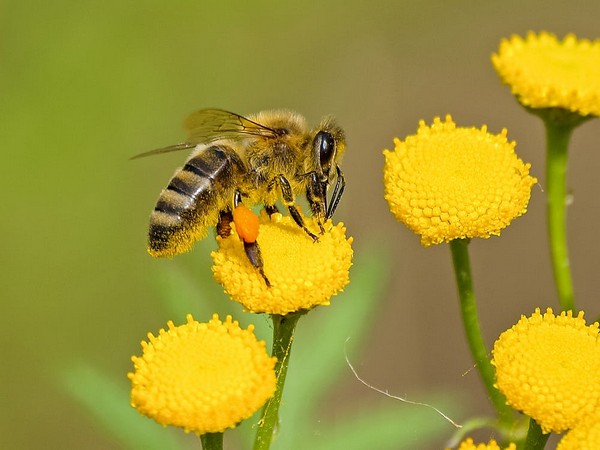
Washington [US], October 24 (ANI): Researchers have found that insects can produce as much electrical charge in the atmosphere as a thunderstorm cloud by observing the electrical fields around swarming honeybees. This kind of energy aids in influencing weather patterns, helps insects discover food and propels spiders into the air to travel long distances.
The findings of the research published in the journal iScience, demonstrates that living things can have an impact on atmospheric electricity.
"We always looked at how physics influenced biology, but at some point, we realized that biology might also be influencing physics," says first author Ellard Hunting, a biologist at the University of Bristol. "We're interested in how different organisms use the static electric fields that are virtually everywhere in the environment."
As with most living creatures, bees carry an innate electric charge. Having found that honeybee hive swarms change the atmospheric electricity by 100 to 1,000 volts per meter, increasing the electric field force normally experienced at ground level, the team developed a model that can predict the influence of other species of insects.
"How insect swarms influence atmospheric electricity depends on their density and size," says co-author Liam O'Reilly, a biologist at the University of Bristol. "We also calculated the influence of locusts on atmospheric electricity, as locusts swarm on biblical scales, sizing 460 square miles with 80 million locusts in less than a square mile; their influence is likely much greater than honeybees."
"We only recently discovered that biology and static electric fields are intimately linked and that there are many unsuspected links that can exist over different spatial scales, ranging from microbes in the soil and plant-pollinator interactions to insect swarms and perhaps the global electric circuit," says Ellard.
"Interdisciplinarity is valuable here--electric charge can seem like it lives solely in physics, but it is important to know how aware the whole natural world is of electricity in the atmosphere," says co-author Giles Harrison, an atmospheric physicist from the University of Reading. (ANI)


Get the App

What to Read Next

Science

New method guides magnetism without magnets

New method guides magnetism without magnets

Researchers at Paul Scherrer Institute PSI have demonstrated an innovative method to control magnetism in materials using an energy-efficient electric field.

Read More
Science

New insights into how cancer evades the immune system: Study

New insights into how cancer evades the immune system: Study

Immunotherapy research primarily focuses on better recognition of cancer cells by the body's own immune system. Researchers at Amsterdam UMC and Moffitt Cancer Center have taken a different approach.

Read More
Science

Scientists use AI to better understand nanoparticles: Study

Scientists use AI to better understand nanoparticles: Study

A group of scientists has created a way to illuminate the dynamic behavior of nanoparticles, which are essential components in the production of pharmaceuticals, electronics, and industrial and energy-conversion materials.

Read More
Science

New device could allow you to taste cake in virtual reality

New device could allow you to taste cake in virtual reality

The 'e-Taste' interface employs sensors and wireless chemical dispensers to enable remote taste perception, often known as gestation. Field testing done by researchers at The Ohio State University confirmed the device's ability to digitally simulate a range of taste intensities, while still offering variety and safety for the user.

Read More
Science

Strand Life Sciences launches portal for rare disease diagnosis

Strand Life Sciences launches portal for rare disease diagnosis

Marking Rare Disease Day, Strand Life Sciences, a subsidiary of Reliance Industries and a leading genomics research company, has launched the StrandOmics Portal, an innovative digital platform designed to assist doctors in diagnosing rare diseases more efficiently.

Read More
Home About Us Our Products Advertise Contact Us Terms & Condition Privacy Policy

Copyright © aninews.in | All Rights Reserved.
