

ADD ANI AS A TRUSTED SOURCE
googleads
Menu
Science

Study finds stellar flares can lead to the diminishment of a planet's habitability

Abu Dhabi [UAE], November 9 (ANI): In new study researchers, led by Research Scientist Dimitra Atri of the Center for Space Science at NYU Abu Dhabi (NYUAD), identified which stars were most likely to host habitable exoplanets based on the calculated erosion rates of the planetary atmospheres.

ANI Nov 09, 2020 08:29 IST googleads

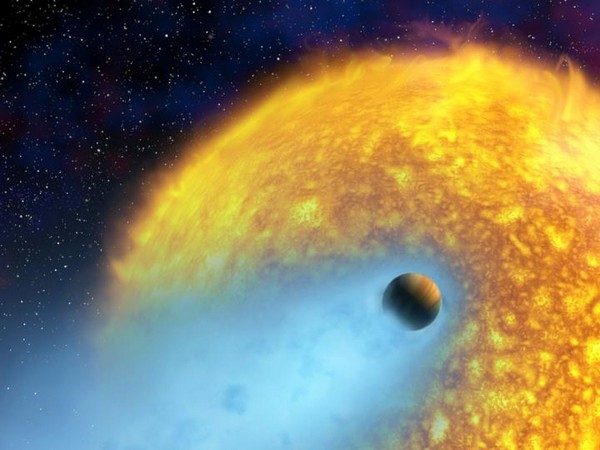
An artist's conception of HD 209458 b. (Photo- NASA/European Space Agency/Alfred Vidal-Madjar (Institut d'Astrophysique de Paris, CNRS)

Abu Dhabi [UAE], November 9 (ANI): In new study researchers, led by Research Scientist Dimitra Atri of the Center for Space Science at NYU Abu Dhabi (NYUAD), identified which stars were most likely to host habitable exoplanets based on the calculated erosion rates of the planetary atmospheres.
In the paper titled Stellar flares versus luminosity: XUV-induced atmospheric escape and planetary habitability, published in the journal Monthly Notices of Royal Astronomical Society: Letters, Atri and graduate student Shane Carberry Mogan present the process of analyzing flare emission data from NASA's TESS (Transiting Exoplanet Survey Satellite) observatory.
It was found that more frequent, lower energy flares had a greater impact on an exoplanet's atmosphere than less frequent, higher energy flares. The researchers also determined how different types of stars extreme ultraviolet radiation (XUV) through stellar flares, and how nearby planets are affected.
The ability to sustain an atmosphere is one of the most important requirements for a habitable planet. This research provides new insights into the habitability of exoplanets, as the effects of stellar activity were not well understood. This study also highlights the need for better numerical modelling of atmospheric escape - how planets release atmospheric gases into space - as it can lead to the erosion of atmosphere and the diminishment of the planet's habitability.
"Given the close proximity of exoplanets to host stars, it is vital to understand how space weather events tied to those stars can affect the habitability of the exoplanet," said Atri. "The next research step would be to expand our data set to analyze stellar flares from a larger variety of stars to see the long-term effects of stellar activity, and to identify more potentially habitable exoplanets." (ANI)


Get the App

What to Read Next

Science

New method guides magnetism without magnets

New method guides magnetism without magnets

Researchers at Paul Scherrer Institute PSI have demonstrated an innovative method to control magnetism in materials using an energy-efficient electric field.

Read More
Science

Amphibians bounce-back from Earth’s greatest mass extinction

Amphibians bounce-back from Earth’s greatest mass extinction

Researchers at the University of Bristol discovered that ancient frog ancestors survived the biggest mass extinction of species by eating on freshwater prey that evaded terrestrial predators.

Read More
Science

New insights into how cancer evades the immune system: Study

New insights into how cancer evades the immune system: Study

Immunotherapy research primarily focuses on better recognition of cancer cells by the body's own immune system. Researchers at Amsterdam UMC and Moffitt Cancer Center have taken a different approach.

Read More
Science

Scientists use AI to better understand nanoparticles: Study

Scientists use AI to better understand nanoparticles: Study

A group of scientists has created a way to illuminate the dynamic behavior of nanoparticles, which are essential components in the production of pharmaceuticals, electronics, and industrial and energy-conversion materials.

Read More
Science

New device could allow you to taste cake in virtual reality

New device could allow you to taste cake in virtual reality

The 'e-Taste' interface employs sensors and wireless chemical dispensers to enable remote taste perception, often known as gestation. Field testing done by researchers at The Ohio State University confirmed the device's ability to digitally simulate a range of taste intensities, while still offering variety and safety for the user.

Read More
Home About Us Our Products Advertise Contact Us Terms & Condition Privacy Policy

Copyright © aninews.in | All Rights Reserved.


