

ADD ANI AS A TRUSTED SOURCE
googleads
ANI Logo
Menu
Science

Squid brains nearly as complex as that of dogs: Study

Queensland [Australia], Jan 28 (ANI): A new study has brought us a step closer to understanding the unique abilities of a squid's relatively complex and sophisticated brain that allows it to pull-off amazing camouflage tricks.

ANI Jan 28, 2020 23:18 IST googleads

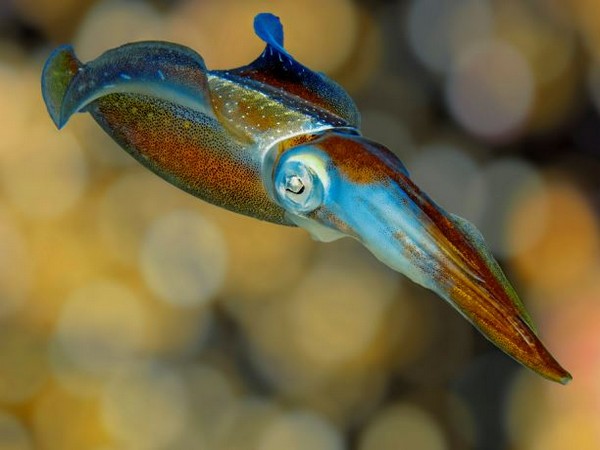
Squid have famously complex brains approaching that of a dog and surpassing mice and rats

Queensland [Australia], Jan 28 (ANI): A new study has brought us a step closer to understanding the unique abilities of a squid's relatively complex and sophisticated brain that allows it to pull-off amazing camouflage tricks.
Dr. Wen-Sung Chung and Professor Justin Marshall, from the University of Queensland's Brain Institute, completed the first MRI-based mapping of the squid brain in 50 years to develop an atlas of neural connections.
"This the first time modern technology has been used to explore the brain of this amazing animal, and we proposed 145 new connections and pathways, more than 60 per cent of which are linked to the vision and motor systems," Dr. Chung said.
"The modern cephalopods, a group including octopus, cuttlefish, and squid, have famously complex brains, approaching that of a dog and surpassing mice and rats, at least in neuronal number.
"For example, some cephalopods have more than 500 million neurons, compared to 200 million for a rat and 20,000 for a normal mollusc.
Some examples of complex cephalopod behaviour include the ability to camouflage themselves despite being colourblind, count, recognise patterns, problem solve and communicate using a variety of signals.
"We can see that a lot of neural circuits are dedicated to camouflage and visual communication. Giving the squid a unique ability to evade predators, hunt and conspecific communicate with dynamic colour changes".
Dr. Chung said the study also supported emerging hypotheses on convergent evolution - when organisms independently evolve similar traits - of cephalopod nervous systems with parts of the vertebrate central nervous system.
"The similarity with the better-studied vertebrate nervous system allows us to make new predictions about the cephalopod nervous system at the behavioural level," he said.
"For example, this study proposes several new networks of neurons in charge of visually-guided behaviours such as locomotion and countershading camouflage - when squid display different colours on the top and bottom of their bodies to blend into the background whether they are being viewed from above or below."
The team's ongoing project involves understanding why different cephalopod species have evolved different subdivisions of the brain.
"Our findings will hopefully provide evidence to help us understand why these fascinating creatures display such diverse behaviour and very different interactions." (ANI)

Get the App

What to Read Next

Science

AI can reveals hidden hazards of chemical mixtures in rivers

AI can reveals hidden hazards of chemical mixtures in rivers

Artificial intelligence can provide important insights into how complex chemical mixes in rivers affect aquatic life, paving the path for more effective environmental protection.

Read More
Science

Alzheimer’s disease can damage brain in two phases

Alzheimer’s disease can damage brain in two phases

Alzheimer's disease may cause brain damage in two stages, according to new research supported by the National Institutes of Health (NIH) that uses sophisticated brain mapping methods.

Read More
Science

Medication increases radiation therapy's efficacy for lung cancer

Medication increases radiation therapy's efficacy for lung cancer

A group of researchers from the University of Cincinnati has discovered a possible novel approach to enhance the efficacy of radiation therapy and enhance the prognosis of patients with lung cancer metastasizing to the brain.

Read More
Science

Study: Role of tRNA modifying enzyme in brain function

Study: Role of tRNA modifying enzyme in brain function

A pioneering study undertaken by a Kumamoto University research team shed light on the crucial role of TRMT10A, a tRNA methylation enzyme, in sustaining brain function. The findings show how TRMT10A deficiency reduces specific transfer RNA (tRNA) levels in the brain, altering protein synthesis and affecting synapse structure and function.

Read More
Science

Study gives insights into possible cause of Alzheimer’s disease

Study gives insights into possible cause of Alzheimer’s disease

Researchers at Case Western Reserve University will investigate the possibility that specific brain proteins are involved in the onset of Alzheimer's disease.

Read More
Science

Researchers discover changes in the brain throughout pregnancy

Researchers discover changes in the brain throughout pregnancy

Pregnancy is a transforming period in a person's life during which the body undergoes rapid physiological adjustments to prepare for parenthood, as we all know. What the broad hormonal alterations caused by pregnancy do to the brain is still a mystery.

Read More
Science

Cancer drug may ease cognitive function for some with autism

Cancer drug may ease cognitive function for some with autism

According to recent research from the University of California San Diego, people with Rett syndrome, a rare disorder linked to autism, may find it easier to think when taking an experimental cancer treatment. This finding could lead to medicines for patients with other neurological conditions.

Read More
Science

Blood cancer medication more effective on brain tumours

Blood cancer medication more effective on brain tumours

According to a recent study, medications intended to treat blood and other malignancies may also increase the effectiveness of radiation therapy for low-grade brain tumours in adults.

Read More
Science

Blood tests predict Parkinson’s seven years before symptoms

Blood tests predict Parkinson’s seven years before symptoms

A group of scientists from University College London (UCL) and University Medical Centre Goettingen have created a straightforward blood test that employs artificial intelligence (AI) to forecast Parkinson's disease up to seven years before symptoms appear.

Read More
Science

Omega-3 therapy prevents brain damage in newborn rodents

Omega-3 therapy prevents brain damage in newborn rodents

A study conducted by researchers at Columbia University Vagelos College of Physicians and Surgeons discovered that an injectable emulsion containing two omega-3 fatty acids contained in fish oil significantly reduced brain damage in newborn rodents after a disturbance in the flow of oxygen to the brain near delivery.

Read More
Home About Us Our Products Advertise Contact Us Terms & Condition Privacy Policy

Copyright © aninews.in | All Rights Reserved.




