

ADD ANI AS A TRUSTED SOURCE
googleads
Menu
Space

Supernova in distant space allows us to understand the origin of elements in the universe: Research

A supernova is a stellar explosion, which occurs when the lives of some really massive stars come to an end. In this violent epilogue, the star expels the material from its outer layers by means of a shock wave, allowing us to see the various elements it was composed of.

ANI Nov 11, 2022 18:26 IST googleads

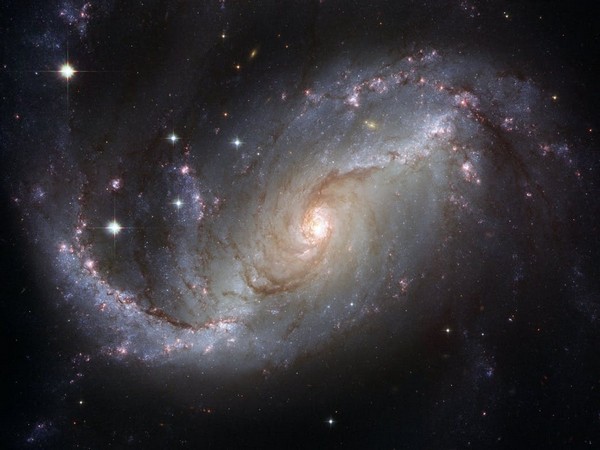
Representative image

Washington [US], November 11 (ANI): A supernova is a stellar explosion, which occurs when the lives of some really massive stars come to an end. In this violent epilogue, the star expels the material from its outer layers by means of a shock wave, allowing us to see the various elements it was composed of.
The research team developed a model of the gravitational field of the galaxy that acted as a lens, and that way it was possible to determine that the light from these three images travelled along three different paths, differing in distance by a few days. This accounts for the three colours obtained in the images because a variation in the colour emitted takes place as the gas in the supernova expands and cools. The higher the temperature is, the bluer the light emitted will be, and as the temperature falls, the light emitted tends towards red. So the blue image is a photograph of the supernova a few hours after the stellar explosion, while the green and red images correspond to 2 and 8 days, respectively, after the explosion.
This information enabled the radius of the star that exploded to be determined; it was a red super-giant with a radius equal to 500 times that of the Sun, and exploded 11.5 billion years ago, long before the Earth was born, specifically at the moment when our Galaxy is thought to have formed. The images of this supernova captured by the Hubble Space Telescope are highly magnified by the gravitational field of a nearby galaxy that acts as a lens and allows us to see much further in distance and in time than all local supernovae in nearby galaxies.
The study of the explosions of these red super-giant stars tallies with the current understanding of how the heavier atomic elements were created inside stars and during supernova explosions: elements forged inside stars are released in these supernova explosions to become the next generation of gas and material from which solar systems and life as we know it are created. Without these explosions, the gas in today's galaxies would only include the hydrogen and helium that formed during the Big Bang and would not support complex life that requires other heavier chemical elements. Moreover, this supernova observed through a gravitational lens demonstrates that an event taking place in the distant Universe can be witnessed several times, so in principle, we could focus our instruments in advance to get a detailed view of the eruption of a star turning into a supernova. (ANI)


Get the App

What to Read Next

Science

New insights into how cancer evades the immune system: Study

New insights into how cancer evades the immune system: Study

Immunotherapy research primarily focuses on better recognition of cancer cells by the body's own immune system. Researchers at Amsterdam UMC and Moffitt Cancer Center have taken a different approach.

Read More
Science

Study reveals impact of animals as architects of Earth

Study reveals impact of animals as architects of Earth

A new study led by Professor Gemma Harvey from Queen Mary University of London has revealed how hundreds of species shape the landscapes we depend on, from termite mounds visible from space to beavers creating wetlands and hippos carving drainage systems.

Read More
Science

'Creation of black holes without singularities through gravity'

'Creation of black holes without singularities through gravity'

Traditional black holes, as predicted by Albert Einstein's theory of General Relativity, contain what are known as singularities, i.e. points where the laws of physics break down. Identifying how singularities are resolved in the context of quantum gravity is one of the fundamental problems in theoretical physics. Now, a team of experts has described the creation of regular black holes from gravitational effects without the need for the existence of exotic matter required by some previous models.

Read More
Science

New technology enhances gravitational-wave detection: Study

New technology enhances gravitational-wave detection: Study

A team of physicists led by Jonathan Richardson of the University of California, Riverside, demonstrated how new optical technology can extend the detection range of gravitational-wave observatories such as the Laser Interferometer Gravitational-Wave Observatory, or LIGO, and pave the way for future observatories.

Read More
Science

Shubhanshu Shukla: IAF officer becomes first Indian astronaut for

Shubhanshu Shukla: IAF officer becomes first Indian astronaut for

Shubhanshu Shukla, Indian Air Force (IAF) officer and one of four astronauts for Indian Space Research Organisation's (ISRO) Gaganyaan mission, has been sele Shubhanshu Shukla, Indian Air Force (IAF) officer and one of four astronauts for Indian Space Research Organisation's (ISRO) Gaganyaan mission, has been selected as the pilot for Axiom Mission 4, scheduled for Spring 2025.cted as the pilot for Axiom Mission 4, scheduled for Spring 2025.

Read More
Home About Us Our Products Advertise Contact Us Terms & Condition Privacy Policy

Copyright © aninews.in | All Rights Reserved.


