 हिंदी खबर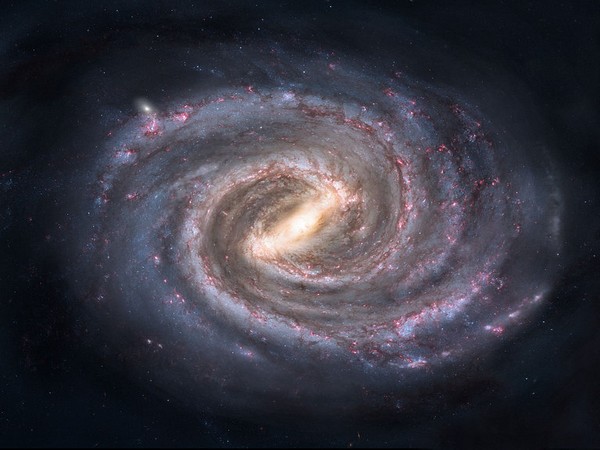

Washington D.C. [USA], Jan 8 (ANI): Scientists have spotted a flock of young stars in the outskirts of the Milky Way, which is the home to some of the oldest stars of the galaxy.
Spectral analysis suggests that young stars have an extragalactic origin. According to the insight , the stars have formed from two nearby dwarf galaxies known as Magellanic Clouds.
The discovery suggested that a stream of gas extending from the galaxies is about half as far from crashing into the Milky Way as previously thought.
"This is a puny cluster of stars -- less than a few thousand in total -- but it has big implications beyond its local area of the Milky Way," said the lead researcher Adrian Price-Whelan.
The newly found stars can be used for revealing new insights into the Milky Way's history. The discovery was published in the Astrophysical Journal.
The identification of clusters of different stars is tricky because the Milky Way is full of radiant orbits. Determining which of the stars are actually clustered together needs precise measurements.
The new cluster is younger and is aged 117 million-years-old and is present on the outskirts of the Milky Way Galaxy.
"It's really, really far away. It's further than any known young stars in the Milky Way, which are typically in the disk. So right away, I was like, 'Holy smokes, what is this?" said Price-Whelan.
The cluster consists of a region near a river of gas, which is dubbed Magellanic Stream. The region forms the outermost edge of the large and small Magellanic Clouds and reaches toward the Milky Way. Gas present in the stream doesn't consist of metal content, unlike the gases that are present in the outer reaches of the Milky Way.
The researchers have proposed that the cluster of gas from the Magellanic Stream passed through the gases surrounding the Milky Way. The pass-through created a drag force that compressed the Magellanic Stream gas and then along with tidal forces from the gravitational tug of the galaxy have condensed the gas which triggers star formation.
The distance of stars, on the other hand, is comparatively trivial. Using the current positions and movements of stars in the cluster, the researchers have predicted that the edge of the Magellanic Stream is 90,000 light-years away from the Milky Way.
"If the Magellanic Stream is closer, especially the leading arm closest to our galaxy, then it's likely to be incorporated into the Milky Way sooner than the current model predicts," said Nidever.
"Eventually, that gas will turn into new stars in the Milky Way's disk. Right now, our galaxy is using up gas faster than its being replenished. This extra gas coming in will help us replenish that reservoir and make sure that our galaxy continues to thrive and form new stars," added Nidever.
The improved numbers could help settle the debate over whether the Magellanic Clouds have crossed through the Milky Way before.(ANI)
Scientists spot young stars in outskirts of Milky Way Galaxy
ANI | Updated: Jan 08, 2020 09:25 IST




