

ADD ANI AS A TRUSTED SOURCE
googleads
ANI Logo
Menu
Space

Researchers discover how impact causes a new planet to 'break up'

Washington [US], August 19 (ANI): Impacts affect the porosity and structure of moons and planets more dramatically than scientists suspected, increasing their potential habitability for life. Studying how those impacts affect planetary bodies, asteroids, moons and other rocks in space helps planetary scientists understand extraplanetary geology, especially where to look for precious matter including water, ice and even, potentially, microbial life.

ANI Aug 19, 2022 05:56 IST googleads

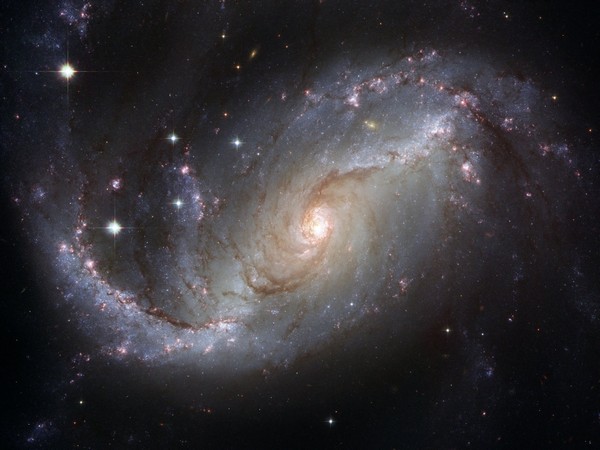
Representative Image

Washington [US], August 19 (ANI): Impacts affect the porosity and structure of moons and planets more dramatically than scientists suspected, increasing their potential habitability for life. Studying how those impacts affect planetary bodies, asteroids, moons and other rocks in space helps planetary scientists understand extraplanetary geology, especially where to look for precious matter including water, ice and even, potentially, microbial life.
Studying how those impacts affect planetary bodies, asteroids, moons and other rocks in space helps planetary scientists including Brandon Johnson, associate professor, and Sean Wiggins, postdoctoral researcher, in the College of Science's Department of Earth, Atmospheric, and Planetary Sciences at Purdue University, understand extraplanetary geology, especially where to look for precious matter including water, ice and even, potentially, microbial life.
Every solid body in the solar system is constantly pummeled by impacts, both large and small. Even on Earth, every single spot has been affected by at least three big impacts. Using the moon as a test subject, Johnson, Wiggins and their team set out to quantify the relationship between impacts and a planet's porosity.
The researchers used extensive lunar gravity data and detailed modeling and found that when large objects hit the moon or any other planetary body, that impact can affect surfaces and structures, even very far away from the point of impact and deep into the planet or moon itself. This finding, detailed in their new study published in the journal Nature Communications, explains existing data on the moon that had puzzled scientists. The research was partially funded by funded by NASA's Lunar Data Analysis Program.
"NASA's GRAIL (Gravity Recovery and Interior Laboratory) mission measured the gravity of the moon and showed that the moon crust is very porous to very great depths," Johnson said. "We didn't have a description of how the moon would get so porous. This is the first work that really shows that large impacts are capable of fracturing the moon's crust and introducing this porosity."
Understanding where planets and moons have fractured, and why, can help direct space exploration and tell scientists where the best place to look for life might be. Anywhere that rock, water and air meet and interact, there is a potential for life.
"There's a lot to be excited about," Wiggins said. "Our data explains a mystery. This research has implications for the early Earth and for Mars. If life existed back then, there were these intermittently big impacts that would sterilize the planet and boil off the oceans. But if you had life that could survive in pores and interstices a few hundred feet or even a few miles down, it could have survived. They could have provided these refuges where life could hide out from these kinds of impacts.
"These findings have a lot of potential for directing future missions on Mars or elsewhere. It can help direct searches, tell us where to look." (ANI)


Get the App

What to Read Next

Science

New method guides magnetism without magnets

New method guides magnetism without magnets

Researchers at Paul Scherrer Institute PSI have demonstrated an innovative method to control magnetism in materials using an energy-efficient electric field.

Read More
Science

Amphibians bounce-back from Earth’s greatest mass extinction

Amphibians bounce-back from Earth’s greatest mass extinction

Researchers at the University of Bristol discovered that ancient frog ancestors survived the biggest mass extinction of species by eating on freshwater prey that evaded terrestrial predators.

Read More
Science

New insights into how cancer evades the immune system: Study

New insights into how cancer evades the immune system: Study

Immunotherapy research primarily focuses on better recognition of cancer cells by the body's own immune system. Researchers at Amsterdam UMC and Moffitt Cancer Center have taken a different approach.

Read More
Science

Scientists use AI to better understand nanoparticles: Study

Scientists use AI to better understand nanoparticles: Study

A group of scientists has created a way to illuminate the dynamic behavior of nanoparticles, which are essential components in the production of pharmaceuticals, electronics, and industrial and energy-conversion materials.

Read More
Science

New device could allow you to taste cake in virtual reality

New device could allow you to taste cake in virtual reality

The 'e-Taste' interface employs sensors and wireless chemical dispensers to enable remote taste perception, often known as gestation. Field testing done by researchers at The Ohio State University confirmed the device's ability to digitally simulate a range of taste intensities, while still offering variety and safety for the user.

Read More
Science

Strand Life Sciences launches portal for rare disease diagnosis

Strand Life Sciences launches portal for rare disease diagnosis

Marking Rare Disease Day, Strand Life Sciences, a subsidiary of Reliance Industries and a leading genomics research company, has launched the StrandOmics Portal, an innovative digital platform designed to assist doctors in diagnosing rare diseases more efficiently.

Read More
Science

Study reveals impact of animals as architects of Earth

Study reveals impact of animals as architects of Earth

A new study led by Professor Gemma Harvey from Queen Mary University of London has revealed how hundreds of species shape the landscapes we depend on, from termite mounds visible from space to beavers creating wetlands and hippos carving drainage systems.

Read More
Science

Opposing arrows of time emerge from certain quantum systems

Opposing arrows of time emerge from certain quantum systems

Researchers at the University of Surrey made a thought-provoking discovery. A new study reveals that opposing arrows of time can theoretically emerge from certain quantum systems.

Read More
Science

COVID-19 severity may be predicted by White Blood Cell Count

COVID-19 severity may be predicted by White Blood Cell Count

A COVID-19 diagnosis is no longer as frightening as it used to be, thanks to developments in treatment choices. However, a new study reveals that leukocyte (white blood cell) count may now be used to identify who is more likely to develop more significant disease symptoms.

Read More
Science

Seals can essentially act as 'smart sensors': Study

Seals can essentially act as 'smart sensors': Study

A new study by marine biologists reports that seals can essentially act as 'smart sensors' for monitoring fish populations in the ocean's eerily dim 'twilight zone.'

Read More
Home About Us Our Products Advertise Contact Us Terms & Condition Privacy Policy

Copyright © aninews.in | All Rights Reserved.
