

ADD ANI AS A TRUSTED SOURCE
googleads
ANI Logo
Menu
Space

Perseid meteor shower to be visible from August 11

Washington [US], August 10 (ANI): The Perseid meteor shower, an annual celestial event, is all set to return on Wednesday night.

ANI Aug 10, 2021 08:57 IST googleads

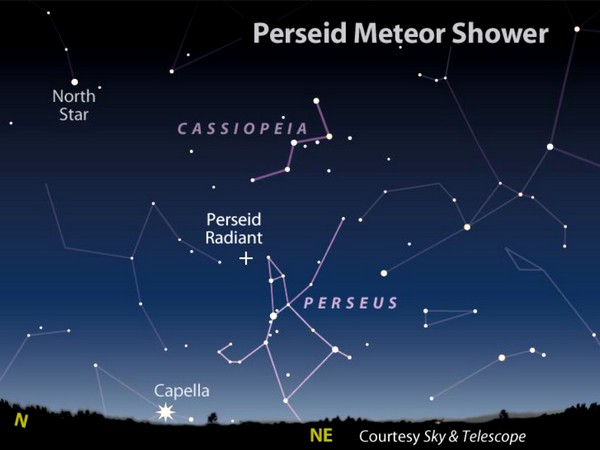
Perseid meteor shower (Image source: Sky & Telescope)

Washington [US], August 10 (ANI): The Perseid meteor shower, an annual celestial event, is all set to return on Wednesday night.
It is predicted to reach its peak before dawn on Thursday, August 12, though the display could put on a fine show for a night or two before and after. Also, it is believed that this year's conditions are as near to perfect as can be. The waxing crescent Moon sets around 10 p.m. local time, meaning dark, Moonless skies until dawn.
Astronomy lovers can catch the best glimpses of meteors soon after evening twilight ends. By then the shower's radiant -- its perspective point of origin in the constellation Perseus -- has risen above the northeastern horizon. The few Perseids that appear this early will be spectacularly long "earthgrazers" that skim along the top of the atmosphere. The higher the radiant, the more meteors you'll see -- so when Perseus climbs higher in the northeast, especially after midnight, more meteors will appear all over the sky.
One does not need any equipment to enjoy the Perseid meteor shower. All you just have to do is to find a dark spot away from bright lights with a wide-open view all around if possible.
According to Diana Hannikainen, Sky & Telescope's Observing Editor, comfort plays an important role in order to enjoy the show in the best way.
"You'll want to make yourself comfortable to fully enjoy the show -- craning your neck for many hours can ruin your experience," Diana Hannikainen said.
Bring a reclining lawn chair or a ground cloth so you can lie back. Bundle up in blankets or a sleeping bag, both for mosquito shielding and for warmth; clear nights can grow surprisingly chilly, even in August. Next, relax, be patient, and let your eyes adapt to the darkness.
"These 'shooting stars' can appear anywhere and everywhere in the sky -- you don't have to look toward the radiant to see them. So the best direction to watch is wherever your sky is darkest, usually straight up," Diana Hannikainen added.
Faint Perseids appear as tiny, quick streaks. Occasional brighter ones might sail across the sky for several seconds and leave a brief train of glowing smoke. When you see a meteor, trace its path back to its origin. If you eventually come to the constellation Perseus (see the accompanying sky chart), you've just witnessed a Perseid. Occasionally you might spot an interloper. The weaker Delta Aquariid and Kappa Cygnid showers are also active during Perseid season, and there are always a few random, "sporadic" meteors too. All of these come from other parts of the sky. It's a fun exercise to trace meteors back to their radiants: If the tracks don't lead you to Perseus, they aren't Perseids!
Any light pollution or cloudiness will cut down the number of meteors visible. But the brightest ones shine right through light pollution (though usually not through clouds). In fact, a NASA analysis of all-sky images taken from 2008 to 2013 shows that the Perseids deliver more bright meteors (those that outshine any star) than any other annual meteor shower.
For the unversed, meteors are caused by tiny, sandgrain- to pea-size bits of dusty debris striking the top of Earth's atmosphere roughly 80 miles (130 km) up. Each Perseid zips in at 37 miles per second, glowing as it burns to soot and creating a quick, white-hot streak of superheated air. The nuggets in Grape Nuts cereal are a close match to the estimated size, color, and texture of typical meteor-shower particles.
The Perseid bits were shed long ago by Comet Swift-Tuttle and are distributed all along the comet's orbital path around the Sun. Earth passes through this tenuous "river of rubble" every year in mid-August. The comet is so named because it was independently discovered by Lewis Swift and Horace Parnell Tuttle in July 1862. (ANI)


Get the App

What to Read Next

Science

Astronomers find the smallest main-belt asteroids ever detected:

Astronomers find the smallest main-belt asteroids ever detected:

The majority of known asteroids orbit inside the main asteroid belt, which is positioned between Mars and Jupiter at an average distance of around 250 million km from Earth. Since the discovery of the first asteroid in 1801, about 750.000 asteroids have been identified, primarily in the last decade thanks to several optical surveys that examine the sky on clear nights.

Read More
Science

Wearable devices may help astronauts avoid being 'lost' in space

Wearable devices may help astronauts avoid being 'lost' in space

The sky is no longer the limit - but flying is risky. We lose many of the clues we need to orient ourselves when we leave the Earth's surface, and this spatial disorientation can be fatal. Astronauts typically require extensive training to protect themselves against it. However, scientists have discovered that wearable devices that vibrate to provide orientation cues may considerably improve the efficacy of this training, making spaceflight slightly safer.

Read More
Science

Super Blue Moon lights up sky

Super Blue Moon lights up sky

Astronomers got a special treat on August 30 when a rare celestial event known as a Super Blue Moon became visible in the sky across the nation. A blue moon has nothing to do with the colour of the Moon. NASA defines it as the second full moon in a single month. "Once in a blue moon" occurs every two and a half years on average.

Read More
Science

Study determines age of Saturn's rings

Study determines age of Saturn's rings

The best proof to date that Saturn's rings are astonishingly young has been provided by recent research headed by physicist Sascha Kempf at the University of Colorado Boulder. This finding may provide an answer to a subject that has baffled scientists for well over a century.

Read More
Science

A new measurement could change understanding of the Universe

A new measurement could change understanding of the Universe

Published in Astronomy & Astrophysics, a study carried out by the Stellar Standard Candles and Distances research group, led by Richard Anderson at EPFL's Institute of Physics, achieved the most accurate calibration of Cepheid stars -- a type of variable star whose luminosity fluctuates over a defined period -- for distance measurements to date based on data collected by the European Space Agency's (ESA's) Gaia mission.

Read More
Science

Discovery of early galaxies defies understanding of universe

Discovery of early galaxies defies understanding of universe

What scientists previously believed about the genesis of galaxies in the cosmos is being challenged by the discovery of six huge galaxies in the early universe.

Read More
Science

Tumultuous migration on the edge of the hot Neptune desert

Tumultuous migration on the edge of the hot Neptune desert

All kinds of exoplanets orbit very close to their star. Some look like the Earth, others like Jupiter. Very few, however, are similar to Neptune. Why this anomaly in the distribution of exoplanets? Researchers from the University of Geneva (UNIGE) and the National Centre of Competence in Research (NCCR) PlanetS have observed a sample of planets located at the edge of this Hot Neptune Desert to understand its creation. Using a technique combining the two main methods of studying exoplanets (radial velocities and transits), they were able to establish that a part of these exoplanets has migrated in a turbulent way near their star, which pushed them out of the orbital plane where they were formed. These results are published in the specialized journal Astronomy & Astrophysics.

Read More
Science

Astronomers discover clues about stellar 'glitching'

Astronomers discover clues about stellar 'glitching'

Astronomers have found a way to peer into the physics of some of the brightest stars in the sky. Using data from NASA's Kepler space telescope, an international team of researchers has found new evidence that red giants, dying stars that have exhausted their supply of hydrogen and are in the final stages of stellar evolution, often experience large-scale structural variations, or what is known as "glitches" deep inside their inner core.

Read More
Science

Light from outside our galaxy brighter than expected

Light from outside our galaxy brighter than expected

Washington [US], December 17 (ANI): Scientists analyzed new measurements showing that the light emitted by stars outside our galaxy is two to three times brighter than the light from known populations of galaxies, challenging assumptions about the number and environment of stars in the universe. Results of the study led by researchers at Rochester Institute of Technology have been posted to ArXiv and accepted for publication in The Astrophysical Journal.

Read More
Science

Space atomic clocks could help uncover the nature of dark matter

Space atomic clocks could help uncover the nature of dark matter

Studying an atomic clock on-board a spacecraft inside the orbit of Mercury and very near to the Sun might be the trick to uncovering the nature of dark matter, suggests a new study published in Nature Astronomy.

Read More
Home About Us Our Products Advertise Contact Us Terms & Condition Privacy Policy

Copyright © aninews.in | All Rights Reserved.


