

ADD ANI AS A TRUSTED SOURCE
googleads
ANI Logo
Menu
Space

Here's how to prepare for the Perseids meteor shower on its annual return

Massachusetts [USA], August 6 (ANI): The Perseid meteor shower, an annual celestial event widely loved by millions of skywatchers around the world, is about to make its annual return to the night sky.

ANI Aug 06, 2020 20:49 IST googleads

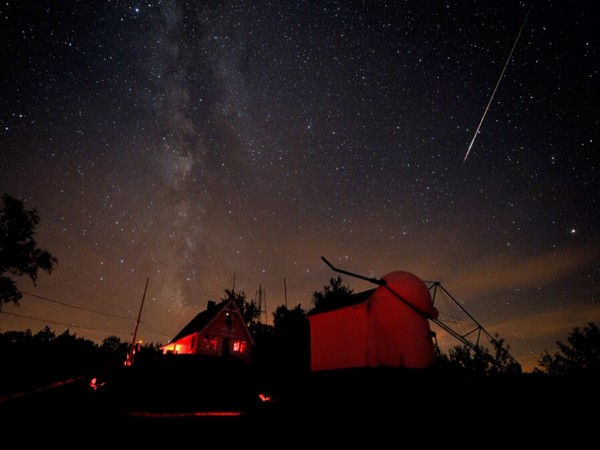
A bright Perseid meteor streaked down on August 7, 2010, at the Stellafane amateur astronomy convention in Springfield, Vermont (Image credits: Sky & Telescope / Dennis di Cicco)

Massachusetts [USA], August 6 (ANI): The Perseid meteor shower, an annual celestial event widely loved by millions of skywatchers around the world, is about to make its annual return to the night sky.
It's predicted to reach its peak late on the night of Tuesday, August 11, and early on Wednesday, August 12th. Head out after sunset and catch as many meteors as you can before the Moon rises shortly after midnight (local time).
Begin watching for meteors soon after evening twilight ends. By then the shower's radiant, its perspective point of origin in the constellation Perseus, has risen above the northeastern horizon.
The few Perseids that appear this early will be spectacularly long "earthgrazers" that skim along the top of the atmosphere. The higher the radiant, the more meteors you'll see -- so when Perseus is higher in the northeast, more meteors will appear all over the sky.
The last-quarter Moon rises shortly after midnight, and its light will wash out fainter meteors. But don't despair: The Perseids are a long-lived event, and you should see meteors -- though fewer in number -- for several nights before and after the night of the peak.
To enjoy the Perseids, you need no equipment but your eyes. Find a dark spot away from bright lights with a wide-open view all around if possible. Bring a reclining lawn chair or a ground cloth so you can lie back and watch the sky in comfort.
Bundle up in blankets or a sleeping bag, both for mosquito shielding and for warmth; clear nights can grow surprisingly chilly. Next, relax, be patient, and let your eyes adapt to the darkness.
"These 'shooting stars' can appear anywhere and everywhere in the sky -- you don't have to look at the radiant to see them. So the best direction to watch is wherever your sky is darkest, usually straight up," advises Diana Hannikainen (pronounced HUHN-ih-KY-nen), Sky & Telescope's Observing Editor.
Faint Perseids appear as tiny, quick streaks. Occasional brighter ones might sail across the heavens for several seconds and leave a brief train of glowing smoke.
When you see a meteor, track its path backward. If you eventually come to the constellation Perseus -- which climbs higher in the northeastern sky as the night progresses -- then you've just witnessed a Perseid.
Occasionally you might spot an interloper. The weaker Delta Aquariid and Kappa Cygnid showers are also active during Perseid season, and there are sometimes a few random, "sporadic" meteors. All of these tracks back to other parts of the sky. It's a fun exercise to track these back to their radiants: If it's not in Perseus, they're not Perseids!
Any light pollution will cut down the numbers visible. But the brightest few meteors shine right through light pollution. In fact, a NASA analysis of all-sky images taken from 2008 to 2013 shows that the Perseids deliver more bright meteors (those that outshine any star) than any other annual meteor shower.
Meteors are caused by tiny, sandgrain- to pea-size bits of dusty debris streaking into the top of Earth's atmosphere roughly 80 miles (130 km) up. Each Perseid particle zips in at 37 miles per second, creating a quick, white-hot streak of superheated air. The nuggets in Grape Nuts cereal are a close match to the estimated size, color, and texture of typical meteor-shower particles.
The Perseid bits were shed long ago by Comet Swift-Tuttle and are distributed all along the comet's 133-year-long orbit around the Sun. Earth passes through this tenuous "river of rubble" every year in mid-August. The comet is so named because it was independently discovered by Lewis Swift and Horace Parnell Tuttle in July 1862. (ANI)


Get the App

What to Read Next

Science

COVID-19 severity may be predicted by White Blood Cell Count

COVID-19 severity may be predicted by White Blood Cell Count

A COVID-19 diagnosis is no longer as frightening as it used to be, thanks to developments in treatment choices. However, a new study reveals that leukocyte (white blood cell) count may now be used to identify who is more likely to develop more significant disease symptoms.

Read More
Science

Study finds connection between quantum theory, information theory

Study finds connection between quantum theory, information theory

"Our results have no clear or direct application right now. It's basic research that lays the foundation for future technologies in quantum information and quantum computers. There's enormous potential for complete discoveries in many different research fields," said Guilherme B Xavier, a researcher in quantum communication at Linkoping University, Sweden.

Read More
Science

Study finds new source of cardiac inflammation

Study finds new source of cardiac inflammation

Globally, ischemic heart disease is the leading cause of death. A myocardial infarction (MI), commonly referred to as a "heart attack," is the first event in which insufficient coronary blood flow results in the death of a portion of the heart. Heart failure, heart wall remodelling, and severe inflammation result from this.

Read More
Science

Study finds genetic cause of rare childhood immune disorders

Study finds genetic cause of rare childhood immune disorders

Researchers have identified specific genetic changes that can result in newborns having little to no immune protection against illness.

Read More
Science

Odors might prompt certain brain cells to make decisions: Study

Odors might prompt certain brain cells to make decisions: Study

Researchers at the University of Colorado Anschutz Medical Campus revealed that smells trigger certain brain cells, which may play a role in quick 'go, no-go' decision making.

Read More
Science

Study finds CT scan effective to assess people with chest pain

Study finds CT scan effective to assess people with chest pain

Previous studies found that fewer than 40 per cent of patients with stable chest pain who underwent invasive coronary angiography had obstructive coronary artery disease. Recent randomized clinical trials have shown that evaluating these patients first with computed tomography angiography (CTA) is beneficial, and a new study presented at the American College of Cardiology Cardiovascular Summit supports this strategy, finding that CT was associated with a higher likelihood of revascularization when compared to other imaging modalities or no testing.

Read More
Science

Loss of cells in pancreas in elderly linked to diabetes

Loss of cells in pancreas in elderly linked to diabetes

Researchers at Tokyo Metropolitan University looked at pancreatic islet cell loss (ICL) in people who had no previous pancreatic disorders

Read More
Science

Ways to restore sense of smell in patients with long covid

Ways to restore sense of smell in patients with long covid

Research presented at the annual meeting of the Radiological Society of North America (RSNA) suggested that an image-guided minimally invasive technique may help restore scent in individuals suffering from long-term COVID.

Read More
Science

Alzheimer's disease is linked to hidden abdominal fat

Alzheimer's disease is linked to hidden abdominal fat

According to a study that will be presented next week at the annual conference of the Radiological Society of North America (RSNA), the development of Alzheimer's disease is connected with higher levels of visceral abdominal fat in midlife.

Read More
Science

New treatment restore sense of smell in patients with Covid

New treatment restore sense of smell in patients with Covid

Researchers may be able to restore the sense of smell in people who have suffered from long-COVID via an image-guided minimally invasive approach, according to research presented at the annual meeting of the Radiological Society of North America (RSNA).

Read More
Home About Us Our Products Advertise Contact Us Terms & Condition Privacy Policy

Copyright © aninews.in | All Rights Reserved.
