

ADD ANI AS A TRUSTED SOURCE
googleads
ANI Logo
Menu
Space

Betelgeuse nearing its demise, might go supernova: Scientists

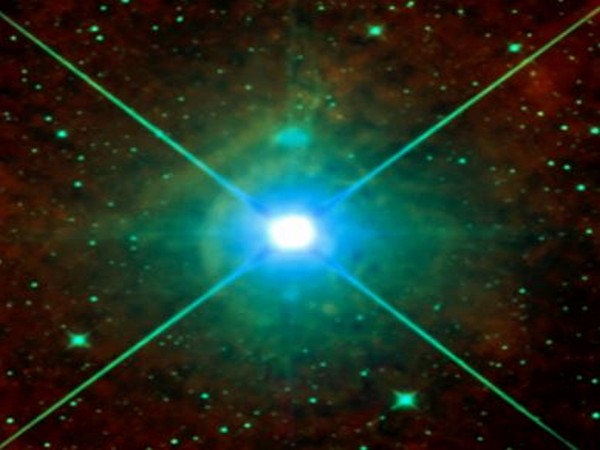
Washington D.C. [USA], Feb 29 (ANI): Betelgeuse, the red supergiant is nearing the end of its life, and when a star over 10 times the mass of the Sun dies, it goes out in spectacular fashion.

ANI Feb 29, 2020 08:39 IST googleads

Representative Image

Washington D.C. [USA], Feb 29 (ANI): Betelgeuse, the red supergiant is nearing the end of its life, and when a star over 10 times the mass of the Sun dies, it goes out in spectacular fashion.
With its brightness recently dipping to the lowest point in the last hundred years, many space enthusiasts are excited that Betelgeuse may soon go supernova, exploding in a dazzling display that could be visible even in daylight.
While the famous star in Orion's shoulder will likely meet its demise within the next million years -- practically couple days in cosmic time -- scientists maintain that its dimming is due to the star pulsating. The phenomenon is relatively common among red supergiants, and Betelgeuse has been known for decades to be in this group.
Coincidentally, researchers at UC Santa Barbara have already made predictions about the brightness of the supernova that would result when a pulsating star like Betelgeuse explodes.
Physics graduate student Jared Goldberg has published a study with Lars Bildsten, director of the campus's Kavli Institute for Theoretical Physics (KITP) and Gluck Professor of Physics, and KITP Senior Fellow Bill Paxton detailing how a star's pulsation will affect the ensuing explosion when it does reach the end. The paper appears in the Astrophysical Journal.
"We wanted to know what it looks like if a pulsating star explodes at different phases of pulsation," said Goldberg, a National Science Foundation graduate research fellow. "Earlier models are simpler because they don't include the time-dependent effects of pulsations."
When a star the size of Betelgeuse finally runs out of material to fuse in its centre, it loses the outward pressure that kept it from collapsing under its own immense weight. The resultant core-collapse happens in half a second, far faster than it takes the star's surface and puffy outer layers to notice.
As the iron core collapses the atoms disassociate into electrons and protons. These combine to form neutrons, and in the process release high-energy particles called neutrinos.
Normally, neutrinos barely interact with other matter -- 100 trillion of them pass through your body every second without a single collision. That said, supernovae are among the most powerful phenomena in the universe. The numbers and energies of the neutrinos produced in the core-collapse are so immense that even though only a tiny fraction collides with the stellar material, it's generally more than enough to launch a shockwave capable of exploding the star.
That resulting explosion smacks into the star's outer layers with stupefying energy, creating a burst that can briefly outshine an entire galaxy. The explosion remains bright for around 100 days, since the radiation can escape only once ionized hydrogen recombines with lost electrons to become neutral again.
This proceeds from the outside in, meaning that astronomers see deeper into the supernova as time goes on until finally, the light from the centre can escape. At that point, all that's left is the dim glow of radioactive fallout, which can continue to shine for years.
A supernova's characteristics vary with the star's mass, total explosion energy and, importantly, its radius. This means Betelgeuse's pulsation makes predicting how it will explode rather more complicated.
The researchers found that if the entire star is pulsating in unison -- breathing in and out, if you will -- the supernova will behave as though Betelgeuse was a static star with a given radius. However, different layers of the star can oscillate opposite each other: the outer layers expand while the middle layers contract, and vice versa.
For the simple pulsation case, the team's model yielded similar results to the models that didn't account for pulsation. "It just looks like a supernova from a bigger star or a smaller star at different points in the pulsation," Goldberg explained. "It's when you start considering pulsations that are more complicated, where there's stuff moving in at the same time as stuff moving out -- then our model actually does produce noticeable differences," he said.
In these cases, the researchers discovered that as light leaks out from progressively deeper layers of the explosion, the emissions would appear as though they were the result of supernovae from different sized stars.
"Light from the part of the star that is compressed is fainter," Goldberg explained, "just as we would expect from a more compact, non-pulsating star." Meanwhile, light from parts of the star that were expanding at the time would appear brighter, as though it came from a larger, non-pulsating star.
Goldberg plans to submit a report to Research Notes of the American Astronomical Society with Andy Howell, a professor of physics, and KITP postdoctoral researcher Evan Bauer summarizing the results of simulations they ran specifically on Betelgeuse.
Goldberg is also working with KITP postdoc Benny Tsang to compare different radiative transfer techniques for supernovae, and with physics graduate student Daichi Hiramatsu on comparing theoretical explosion models to supernova observations. (ANI)


Get the App

What to Read Next

Science

Strange new fossils give light on prehistoric plankton

Strange new fossils give light on prehistoric plankton

Researchers have uncovered a new type of fossil that suggests life in the oceans half a billion years ago.

Read More
Science

Study discovers highest energy gamma rays from dead star, pulsar

Study discovers highest energy gamma rays from dead star, pulsar

Scientists discovered the highest intensity gamma rays yet from a dead star known as a pulsar, using the H.E.S.S. observatory in Namibia.

Read More
Science

Researchers find highest energy gamma rays from dead star

Researchers find highest energy gamma rays from dead star

Scientists have discovered the highest intensity gamma rays ever from a dead star known as a pulsar using the H.E.S.S. observatory in Namibia.

Read More
Science

New information about an exoplanet's star, atmosphere

New information about an exoplanet's star, atmosphere

The interesting TRAPPIST-1 exoplanetary system was initially found in 2016 amid speculation that it might one day be a home for mankind. Astronomers working under the direction of a team at the Université de Montréal have made significant progress in studying this system.

Read More
Science

Scientists detect sea star hybridization in North Atlantic Ocean

Scientists detect sea star hybridization in North Atlantic Ocean

In the chilly waters of the North Atlantic Ocean, scientists have long speculated that two kinds of sea stars—commonly known as starfish—found along the rocky coastlines of Europe and North America may have interbred. Hybrid starfish are already present and prospering along the coasts of New England and the Canadian Maritimes, according to freshly analysed genomic data.

Read More
Science

Scientists witness planet being swallowed by sun-like star

Scientists witness planet being swallowed by sun-like star

Scientists have observed a Sun-like star swallowing a planet for the first time, confirming a prediction that Earth will face the same fate in 5 billion years.

Read More
Science

A new measurement could change understanding of the Universe

A new measurement could change understanding of the Universe

Published in Astronomy & Astrophysics, a study carried out by the Stellar Standard Candles and Distances research group, led by Richard Anderson at EPFL's Institute of Physics, achieved the most accurate calibration of Cepheid stars -- a type of variable star whose luminosity fluctuates over a defined period -- for distance measurements to date based on data collected by the European Space Agency's (ESA's) Gaia mission.

Read More
Science

Terminator zones on distant planets could harbour life: Research

Terminator zones on distant planets could harbour life: Research

In a recent study, astronomers from the University of California, Irvine explain how the possibility of extraterrestrial life exists on far-off exoplanets within a special region known as the "terminator zone," which is a ring on planets that have one side that is always facing its star and one side that is always dark.

Read More
Science

High fat diet reduce brain's ability to regulate food intake

High fat diet reduce brain's ability to regulate food intake

Regularly eating a high fat/calorie diet could reduce the brain's ability to regulate calorie intake. New research in rats found that after short periods of being fed a high fat/high calorie diet, the brain adapts to react to what is being ingested and reduces the amount of food eaten to balance calorie intake. The researchers suggest that calorie intake is regulated in the short-term by cells called astrocytes (large star-shaped cells in the brain that regulate many different functions of neurons in the brain) that control the signalling pathway between the brain and the gut. Continuously eating a high fat/calorie diet seems to disrupt this signalling pathway.

Read More
Science

Tumultuous migration on the edge of the hot Neptune desert

Tumultuous migration on the edge of the hot Neptune desert

All kinds of exoplanets orbit very close to their star. Some look like the Earth, others like Jupiter. Very few, however, are similar to Neptune. Why this anomaly in the distribution of exoplanets? Researchers from the University of Geneva (UNIGE) and the National Centre of Competence in Research (NCCR) PlanetS have observed a sample of planets located at the edge of this Hot Neptune Desert to understand its creation. Using a technique combining the two main methods of studying exoplanets (radial velocities and transits), they were able to establish that a part of these exoplanets has migrated in a turbulent way near their star, which pushed them out of the orbital plane where they were formed. These results are published in the specialized journal Astronomy & Astrophysics.

Read More
Home About Us Our Products Advertise Contact Us Terms & Condition Privacy Policy

Copyright © aninews.in | All Rights Reserved.


