

ADD ANI AS A TRUSTED SOURCE
googleads
ANI Logo
Menu
Space

Astronomers spot twinkling heart of milky way using ALMA

Washington DC [USA], May 23 (ANI): Astronomers using the Atacama Large Millimeter/submillimeter Array (ALMA) found quasi-periodic flickers in millimeter-waves from the center of the Milky Way, Sagittarius (Sgr) A*.

ANI May 23, 2020 10:04 IST googleads

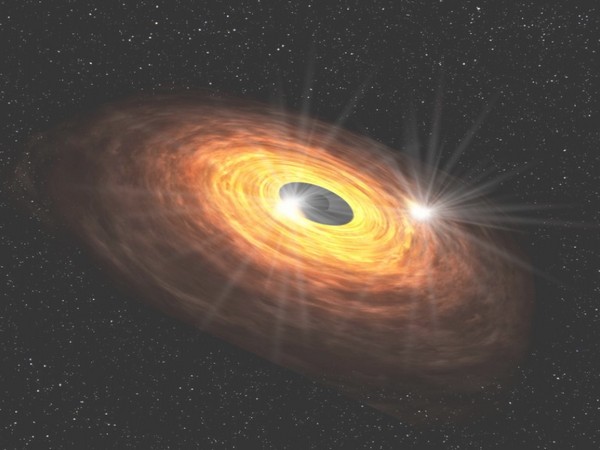
Artist's impression of the gaseous disk around the supermassive black hole (Image credit: Keio University)

Washington DC [USA], May 23 (ANI): Astronomers using the Atacama Large Millimeter/submillimeter Array (ALMA) found quasi-periodic flickers in millimeter-waves from the center of the Milky Way, Sagittarius (Sgr) A*.
The team interpreted these blinks to be due to the rotation of radio spots circling the supermassive black hole with an orbit radius smaller than that of Mercury. This is an interesting clue to investigate space-time with extreme gravity.
"It has been known that Sgr A* sometimes flares up in millimeter-wavelength," told Yuhei Iwata, the lead author of the paper published in the Astrophysical Journal Letters and a graduate student at Keio University, Japan.
"This time, using ALMA, we obtained high-quality data of radio-wave intensity variation of Sgr A* for 10 days, 70 minutes per day. Then we found two trends: quasi-periodic variations with a typical time scale of 30 minutes and hour-long slow variations," Iwata added.
Astronomers presume that a supermassive black hole with a mass of 4 million Suns is located at the center of Sgr A*. Flares of Sgr A* have been observed not only in millimeter-wavelength but also in infrared light and X-ray.
However, the variations detected with ALMA are much smaller than the ones previously detected, and it is possible that these levels of small variations always occur in Sgr A*.
The black hole itself does not produce any kind of emission. The source of the emission is the scorching gaseous disk around the black hole. The gas around the black hole does not go straight to the gravitational well, but it rotates around the black hole to form an accretion disk.
The team focused on short timescale variations and found that the variation period of 30 minutes is comparable to the orbital period of the innermost edge of the accretion disk with a radius of 0.2 astronomical unit (1 astronomical unit corresponds to the distance between the Earth and the Sun: 150 million kilometers).
For comparison, Mercury, the solar system's innermost planet, circles around the Sun at a distance of 0.4 astronomical units. Considering the colossal mass at the center of the black hole, its gravity effect is also extreme in the accretion disk.
"This emission could be related to some exotic phenomena occurring at the very vicinity of the supermassive black hole," said Tomoharu Oka, a professor at Keio University.
Their scenario is as follows. Hot spots are sporadically formed in the disk and circle around the black hole, emitting strong millimeter waves.
According to Einstein's special relativity theory, the emission is largely amplified when the source is moving toward the observer with a speed comparable to that of light.
The rotation speed of the inner edge of the accretion disk is quite large, so this extraordinary effect arises. The astronomers believe that this is the origin of the short-term variation of the millimeter emission from Sgr A*.
The team supposes that the variation might affect the effort to make an image of the supermassive black hole with the Event Horizon Telescope.
"In general, the faster the movement is, the more difficult it is to take a photo of the object," said Oka.
"Instead, the variation of the emission itself provides compelling insight for the gas motion. We may witness the very moment of gas absorption by the black hole with a long-term monitoring campaign with ALMA," Oka added.
The researchers aim to draw out independent information to understand the mystifying environment around the supermassive black hole. (ANI)


Get the App

What to Read Next

Science

Amphibians bounce-back from Earth’s greatest mass extinction

Amphibians bounce-back from Earth’s greatest mass extinction

Researchers at the University of Bristol discovered that ancient frog ancestors survived the biggest mass extinction of species by eating on freshwater prey that evaded terrestrial predators.

Read More
Science

Scientists use AI to better understand nanoparticles: Study

Scientists use AI to better understand nanoparticles: Study

A group of scientists has created a way to illuminate the dynamic behavior of nanoparticles, which are essential components in the production of pharmaceuticals, electronics, and industrial and energy-conversion materials.

Read More
Science

Study reveals impact of animals as architects of Earth

Study reveals impact of animals as architects of Earth

A new study led by Professor Gemma Harvey from Queen Mary University of London has revealed how hundreds of species shape the landscapes we depend on, from termite mounds visible from space to beavers creating wetlands and hippos carving drainage systems.

Read More
Science

Opposing arrows of time emerge from certain quantum systems

Opposing arrows of time emerge from certain quantum systems

Researchers at the University of Surrey made a thought-provoking discovery. A new study reveals that opposing arrows of time can theoretically emerge from certain quantum systems.

Read More
Science

'Creation of black holes without singularities through gravity'

'Creation of black holes without singularities through gravity'

Traditional black holes, as predicted by Albert Einstein's theory of General Relativity, contain what are known as singularities, i.e. points where the laws of physics break down. Identifying how singularities are resolved in the context of quantum gravity is one of the fundamental problems in theoretical physics. Now, a team of experts has described the creation of regular black holes from gravitational effects without the need for the existence of exotic matter required by some previous models.

Read More
Science

New technology enhances gravitational-wave detection: Study

New technology enhances gravitational-wave detection: Study

A team of physicists led by Jonathan Richardson of the University of California, Riverside, demonstrated how new optical technology can extend the detection range of gravitational-wave observatories such as the Laser Interferometer Gravitational-Wave Observatory, or LIGO, and pave the way for future observatories.

Read More
Science

Shubhanshu Shukla: IAF officer becomes first Indian astronaut for

Shubhanshu Shukla: IAF officer becomes first Indian astronaut for

Shubhanshu Shukla, Indian Air Force (IAF) officer and one of four astronauts for Indian Space Research Organisation's (ISRO) Gaganyaan mission, has been sele Shubhanshu Shukla, Indian Air Force (IAF) officer and one of four astronauts for Indian Space Research Organisation's (ISRO) Gaganyaan mission, has been selected as the pilot for Axiom Mission 4, scheduled for Spring 2025.cted as the pilot for Axiom Mission 4, scheduled for Spring 2025.

Read More
Science

Large, small galaxies may grow in ways more similar

 Large, small galaxies may grow in ways more similar

A team of astronomers led by University of Arizona researcher Catherine Fielder captured the most precise photographs of a small galaxy and its surroundings, revealing features typically found in much larger galaxies.

Read More
Science

Astronomers find the smallest main-belt asteroids ever detected:

Astronomers find the smallest main-belt asteroids ever detected:

The majority of known asteroids orbit inside the main asteroid belt, which is positioned between Mars and Jupiter at an average distance of around 250 million km from Earth. Since the discovery of the first asteroid in 1801, about 750.000 asteroids have been identified, primarily in the last decade thanks to several optical surveys that examine the sky on clear nights.

Read More
Science

Study finds connection between quantum theory, information theory

Study finds connection between quantum theory, information theory

"Our results have no clear or direct application right now. It's basic research that lays the foundation for future technologies in quantum information and quantum computers. There's enormous potential for complete discoveries in many different research fields," said Guilherme B Xavier, a researcher in quantum communication at Linkoping University, Sweden.

Read More
Home About Us Our Products Advertise Contact Us Terms & Condition Privacy Policy

Copyright © aninews.in | All Rights Reserved.
