 हिंदी खबर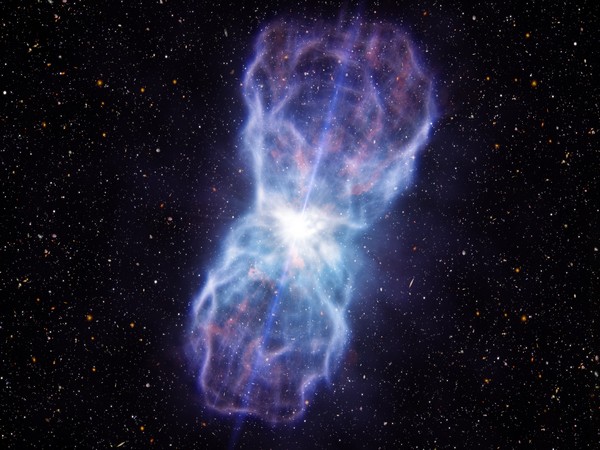

Washington D.C. [USA], April 15 (ANI): Researchers, led by Western University's Sarah Gallagher, using the Gemini North telescope on Hawai'i's Maunakea have detected the most energetic wind from any quasar ever measured. This outflow, which is travelling at nearly 13% of the speed of light, carries enough energy to dramatically impact star formation across an entire galaxy.
The extragalactic tempest lay hidden in plain sight for 15 years before being unveiled by innovative computer modelling and new data from the international Gemini Observatory.
This powerful outflow is moving into its host galaxy at almost 13% of the speed of light and stems from a quasar known as SDSS J135246.37+423923.5 which lies roughly 60 billion light-years from Earth.
"While high-velocity winds have previously been observed in quasars, these have been thin and wispy, carrying only a relatively small amount of mass," explains Gallagher, an astronomer at Western's Faculty of Science and Science Advisor to the President of the Canadian Space Agency. "The outflow from this quasar, in comparison, sweeps along a tremendous amount of mass at incredible speeds. This wind is crazy powerful, and we don't know how the quasar can launch something so substantial".
As well as measuring the outflow from SDSS J135246.37+423923.5, the team was also able to infer the mass of the supermassive black hole powering the quasar.
This monstrous object is 8.6 billion times as massive as the Sun - about 2000 times the mass of the black hole in the centre of our Milky Way and 50% more massive than the well-known black hole in the galaxy Messier 87.
This result is published in the Astrophysical Journal and the quasar studied here now holds the record for the most energetic quasar wind measured to date, with the wind more energetic than those recently reported in a study of 13 quasars.
Despite its mass and energetic outflow, the discovery of this powerhouse languished in a quasar survey for 15 years before the combination of Gemini data and the team's innovative computer modelling method allowed it to be studied in detail.
"We were shocked - this isn't a new quasar, but no one knew how amazing it was until the team got the Gemini spectra," explains Karen Leighly, an astronomer at the University of Oklahoma who was one of the scientific leads for this research. "These objects were too hard to study before our team developed our methodology and had the data we needed, and now it looks like they might be the most interesting kind of windy quasars to study."
Quasars - also known as quasi-stellar objects - are a type of extraordinarily luminous astrophysical object residing in the centres of massive galaxies. Consisting of a supermassive black hole surrounded by a glowing disk of gas, quasars can outshine all the stars in their host galaxy and can drive winds powerful enough to influence entire galaxies.
"Some quasar-driven winds have enough energy to sweep the material from a galaxy that is needed to form stars and thus quench star formation," explains Hyunseop (Joseph) Choi, a graduate student at the University of Oklahoma and the first author of the scientific paper on this discovery. "We studied a particularly windy quasar, SDSS J135246.37+423923.5, whose outflow is so thick that it's difficult to detect the signature of the quasar itself at visible wavelengths."
Despite the obstruction, the team was able to get a clear view of the quasar using the Gemini Near-Infrared Spectrograph (GNIRS) on Gemini North to observe at infrared wavelengths. Using a combination of high-quality spectra from Gemini and a pioneering computer modelling approach, the astronomers uncovered the nature of the outflow from the object -- which proved, remarkably, to be more energetic than any quasar outflow previously measured.
The team's discovery raises important questions, and also suggests there could be more of these quasars waiting to be found.
"We don't know how many more of these extraordinary objects are in our quasar catalogues that we just don't know about yet," concludes Choi "Since automated software generally identifies quasars by strong emission lines or blue colour -- two properties our object lacks -- there could be more of these quasars with tremendously powerful outflows hidden away in our surveys."
"This extraordinary discovery was made possible with the resources provided by the international Gemini Observatory; the discovery opens new windows and opportunities to explore the Universe further in the years to come," said Martin Still, an astronomy program director at the National Science Foundation, which funds Gemini Observatory from the U.S. as part of an international collaboration. "The Gemini Observatory continues to advance our knowledge of the Universe by providing the international science community with forefront access to telescope instrumentation and facilities." (ANI)




