

ADD ANI AS A TRUSTED SOURCE
googleads
ANI Logo
Menu
Science

Some corals can survive in acidified ocean conditions

Washington D.C. [USA], July 7 (ANI): Out of many corals which face survival risk because of rising acidity of the oceans, Caribbean coral species can survive and grow under the rising carbon dioxide levels, found researchers.

ANI Jul 07, 2019 19:17 IST googleads

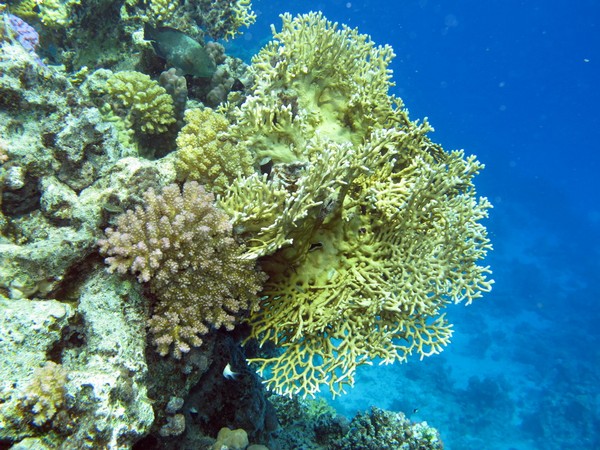
Representative image

Washington D.C. [USA], July 7 (ANI): Out of many corals which face survival risk because of rising acidity of the oceans, Caribbean coral species can survive and grow under the rising carbon dioxide levels, found researchers.
A new study published in the journal of Biological Sciences showed that at least three Caribbean coral species can survive and grow under conditions of ocean acidification more severe than those expected to occur during this century, although the density of their skeletons was lower than normal.
The study took advantage of the unusual seawater chemistry found naturally at sites along the Caribbean coastline of Mexico's Yucatan Peninsula, where water discharging from submarine springs has lower pH than the surrounding seawater, with reduced availability of the carbonate ions corals need to build their calcium carbonate skeletons.
In a two-year field experiment, the international team of researchers transplanted genetically identical fragments of three species of corals to a site affected by the springs and to a nearby control site not influenced by the springs, and then monitored the survival, growth rates, and other physiological traits of the transplants.
"The good news is the corals can survive and deposit calcium carbonate, but the density of their skeletons is reduced, which means the framework of the reef would be less robust and might be more susceptible to storm damage and bioerosion," said Adina Paytan, the author of the study.
Of the three species tested, the one that performed best in the low-pH conditions was Siderastrea siderea, commonly known as massive starlet coral, a slow-growing species that forms large dome-shaped structures. Another slow-growing dome-shaped species, Porites astreoides (mustard hill coral), did almost as well, although its survival rate was 20 percent lower. Both of these species outperformed the fast-growing branching coral Porites porites (finger coral).
"The slow-growing, dome-shaped corals tend to be more tolerant of extreme conditions, and they are important in building up the permanent structure of the reef. We found that they have the potential for persistence in acidified conditions," said co-author, Donald Potts.
Corals will have to cope with more than ocean acidification, however. The increasing carbon dioxide level in the atmosphere is also driving climate change, resulting in warmer ocean temperatures and rising sea levels. Unusually warm temperatures can disrupt the symbiosis between coral polyps and the algae that live in them, leading to coral bleaching. And rapidly rising sea levels could leave slow-growing corals at depths where they would die from insufficient sunlight.
Nevertheless, Potts noted that several species of Caribbean corals have long fossil records showing that they have persisted through major changes in Earth's history. (ANI)

Get the App

What to Read Next

Science

Discovering the genetics of climate adaptation 

Discovering the genetics of climate adaptation 

As climate change accelerates, plants are under increasing pressure to adapt to changing habitats and environmental conditions.

Read More
Science

Cancer drug may ease cognitive function for some with autism

Cancer drug may ease cognitive function for some with autism

According to recent research from the University of California San Diego, people with Rett syndrome, a rare disorder linked to autism, may find it easier to think when taking an experimental cancer treatment. This finding could lead to medicines for patients with other neurological conditions.

Read More
Science

Study finds new T cells, genes related to immune disorder

Study finds new T cells, genes related to immune disorder

A team of researchers has identified a number of uncommon helper T cell subtypes that are linked to immune conditions like asthma, rheumatoid arthritis, and multiple sclerosis.

Read More
Science

Children with hypertension at higher risk for heart conditions

Children with hypertension at higher risk for heart conditions

According to a recent study, young people with high blood pressure are almost four times more likely to be at long-term risk of developing major heart problems including stroke and heart attack.

Read More
Science

Study finds how mRNA used to target Alzheimer’s disease

Study finds how mRNA used to target Alzheimer’s disease

Researchers at The Florey have created a method using mRNA technology to specifically target the harmful protein tau, which accumulates in dementia patients suffering from Alzheimer's disease and other conditions.

Read More
Science

Daylight saving time has minimal effect on heart health: Study

Daylight saving time has minimal effect on heart health: Study

Researchers concentrated on the week immediately following the spring and autumn DST transitions when clocks are changed either an hour forward or backwards.

Read More
Science

Study gives insight into significance of genetic sequencing

Study gives insight into significance of genetic sequencing

Brazilian researchers described the case of a nine-year-old boy admitted to the hospital with multiple symptoms and overlapping conditions that made diagnosis difficult, including short stature, thin tooth enamel (dental enamel hypoplasia), moderate mental deficiency, speech delay, asthma, mildly altered blood sugar, and a history of recurring infections in infancy.

Read More
Science

Stress has tendency to increase inflammation in body

Stress has tendency to increase inflammation in body

Lifestyle and genetics, as well as a range of other factors both within and outside of our control, have all been connected to the development of metabolic syndrome, a set of conditions that increase the risk of serious health problems.

Read More
Science

Ice age may help predict oceans’ response to global warming

Ice age may help predict oceans’ response to global warming

A team of scientists led by a Tulane University oceanographer discovered that deposits deep beneath the ocean floor provide a means to estimate ocean oxygen levels and their relationship to carbon dioxide in the Earth's atmosphere during the last ice age, which ended more than 11,000 years ago.

Read More
Science

Butterflies might lose spots as climate warms: Research

Butterflies might lose spots as climate warms: Research

According to new research, female Meadow Brown butterflies have less spots when they grow up in warmer conditions, thus climate change may reduce their spottiness.

Read More
Home About Us Our Products Advertise Contact Us Terms & Condition Privacy Policy

Copyright © aninews.in | All Rights Reserved.




