

ADD ANI AS A TRUSTED SOURCE
googleads
ANI Logo
Menu
Science

Skills of underwater robots can be improved by studying fish sensory organs: Study

Scientists, led by the University of Bristol, have been studying a fish sensory organ to understand cues for collective behaviour which could be employed on underwater robots.

ANI Jan 25, 2023 16:29 IST googleads

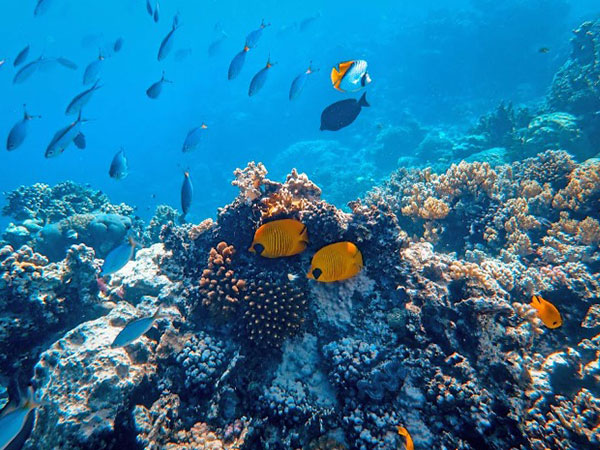
Representative Image

Washington [US], January 25 (ANI): Scientists, led by the University of Bristol, have been studying a fish sensory organ to understand cues for collective behaviour which could be employed on underwater robots.
This work was centred around the lateral line sensing organ in African cichlid fish but found in almost all fish species, which enables them to sense and interpret water pressures around them with enough acuity to detect external influences such as neighbouring fish, changes in water flow, predators and obstacles.
The lateral line system as a whole is distributed over the head, trunk and tail of the fish. It is comprised of mechanoreceptors (neuromasts) that are either within subdermal channels or on the surface of the skin.
Lead author Elliott Scott of the University of Bristol's Department of Engineering Mathematics explained: "We were attempting to find out if the different areas of the lateral line - the lateral line on the head versus the lateral line on the body, or the different types of lateral line sensory units such as those on the skin, versus those under it, play different roles in how the fish is able to sense its environment through environmental pressure readings.
"We did this in a novel way, by using hybrid fish, that allowed for the natural generation of variation."
They discovered the lateral line system around the head has the most important influence on how well fish are able to swim in a shoal, Meanwhile, the presence of more lateral line sensory units, neuromasts, that are found under the skin result in fish swimming closer together, while a greater presence of neuromasts on the skin tend to result in fish swimming further apart.
In simulation, the researchers were able to show how the mechanisms behind the lateral line work are applicable at not just the tiny scales found in actual fish, but at larger scales too. This could inspire a novel type of easily-manufactured pressure sensor for underwater robotics, particularly swarm robotics, where cost is a large factor.
Elliott said: "These findings provide a better understanding of how the lateral line informs shoaling behaviour in fish, while also contributing a novel design of inexpensive pressure sensor that could be useful on underwater robots that have to navigate in dark or murky environments."
The team now plan to develop the sensor further and integrate it into a robotic platform to help a robot navigate underwater and demonstrate its effectiveness. (ANI)


Get the App

What to Read Next

Science

Amphibians bounce-back from Earth’s greatest mass extinction

Amphibians bounce-back from Earth’s greatest mass extinction

Researchers at the University of Bristol discovered that ancient frog ancestors survived the biggest mass extinction of species by eating on freshwater prey that evaded terrestrial predators.

Read More
Science

New insights into how cancer evades the immune system: Study

New insights into how cancer evades the immune system: Study

Immunotherapy research primarily focuses on better recognition of cancer cells by the body's own immune system. Researchers at Amsterdam UMC and Moffitt Cancer Center have taken a different approach.

Read More
Science

Scientists use AI to better understand nanoparticles: Study

Scientists use AI to better understand nanoparticles: Study

A group of scientists has created a way to illuminate the dynamic behavior of nanoparticles, which are essential components in the production of pharmaceuticals, electronics, and industrial and energy-conversion materials.

Read More
Science

New device could allow you to taste cake in virtual reality

New device could allow you to taste cake in virtual reality

The 'e-Taste' interface employs sensors and wireless chemical dispensers to enable remote taste perception, often known as gestation. Field testing done by researchers at The Ohio State University confirmed the device's ability to digitally simulate a range of taste intensities, while still offering variety and safety for the user.

Read More
Science

Strand Life Sciences launches portal for rare disease diagnosis

Strand Life Sciences launches portal for rare disease diagnosis

Marking Rare Disease Day, Strand Life Sciences, a subsidiary of Reliance Industries and a leading genomics research company, has launched the StrandOmics Portal, an innovative digital platform designed to assist doctors in diagnosing rare diseases more efficiently.

Read More
Science

Study reveals impact of animals as architects of Earth

Study reveals impact of animals as architects of Earth

A new study led by Professor Gemma Harvey from Queen Mary University of London has revealed how hundreds of species shape the landscapes we depend on, from termite mounds visible from space to beavers creating wetlands and hippos carving drainage systems.

Read More
Science

Opposing arrows of time emerge from certain quantum systems

Opposing arrows of time emerge from certain quantum systems

Researchers at the University of Surrey made a thought-provoking discovery. A new study reveals that opposing arrows of time can theoretically emerge from certain quantum systems.

Read More
Science

Seals can essentially act as 'smart sensors': Study

Seals can essentially act as 'smart sensors': Study

A new study by marine biologists reports that seals can essentially act as 'smart sensors' for monitoring fish populations in the ocean's eerily dim 'twilight zone.'

Read More
Science

'Creation of black holes without singularities through gravity'

'Creation of black holes without singularities through gravity'

Traditional black holes, as predicted by Albert Einstein's theory of General Relativity, contain what are known as singularities, i.e. points where the laws of physics break down. Identifying how singularities are resolved in the context of quantum gravity is one of the fundamental problems in theoretical physics. Now, a team of experts has described the creation of regular black holes from gravitational effects without the need for the existence of exotic matter required by some previous models.

Read More
Science

New technology enhances gravitational-wave detection: Study

New technology enhances gravitational-wave detection: Study

A team of physicists led by Jonathan Richardson of the University of California, Riverside, demonstrated how new optical technology can extend the detection range of gravitational-wave observatories such as the Laser Interferometer Gravitational-Wave Observatory, or LIGO, and pave the way for future observatories.

Read More
Home About Us Our Products Advertise Contact Us Terms & Condition Privacy Policy

Copyright © aninews.in | All Rights Reserved.
