

ADD ANI AS A TRUSTED SOURCE
googleads
Menu
Science

Seating assignments on airplanes can reduce spread of COVID-19, finds research

Maryland [US], March 24 (ANI): COVID-19 has been shown to spread on aeroplanes by infected passengers, so minimising the risk of secondary infections aboard aircraft may save lives. New research uses two models to help solve the aeroplane seating assignment problem (ASAP).

ANI Mar 24, 2021 22:15 IST googleads

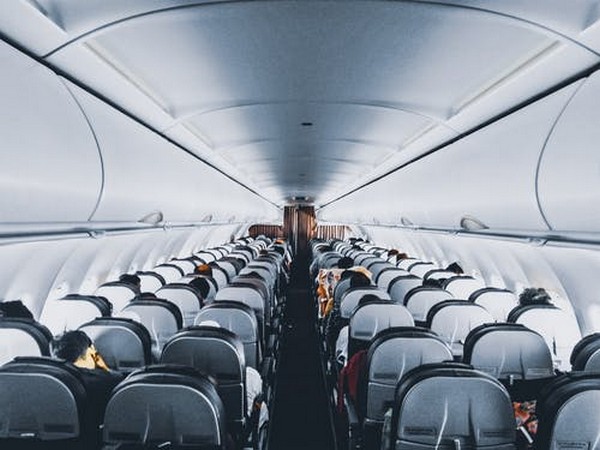
Representative image

Maryland [US], March 24 (ANI): COVID-19 has been shown to spread on aeroplanes by infected passengers, so minimising the risk of secondary infections aboard aircraft may save lives. New research uses two models to help solve the aeroplane seating assignment problem (ASAP).
The models can lower the transmission risk of COVID-19 more so than the strategy of blocking the middle seats, given the same number of passengers. The results of the study were published in the INFORMS journal Service Science.
"Blocking the middle seat on an aeroplane may provide limited benefit in reducing the risk of transmission of COVID-19. Rather, other health protocols are better supported at preventing the transmission of the virus," said Sheldon Jacobson, Founder Professor of computer science at the University of Illinois Urbana-Champaign.
The study, "Airplane Seating Assignment Problem," was conducted by Jacobson, John Pavlik and Ian Ludden, all from the University of Illinois Urbana-Champaign, alongside Edward Sewell from Southern Illinois University Edwardsville.
The researchers introduce two variations of a seating assignment model to optimize how each plane should seat passengers depending on the plane's size and how seats are distributed on the aircraft.
The two models are called vertex packing risk minimization (VPR) and risk-constrained vertex packing (RCV). To determine which to use to solve ASAP, you match the specific aeroplane being filled using the best-known disease transmission risks, then solve the instance to generate an optimal seating solution.
"Every seat on the aeroplane corresponds to a single vertex in the graph. Edges between vertices represent the risk of transmitting disease between each pair of seats. If either seat in a pair is empty, then there is no risk of transmitting disease, and hence VPR and RCV are closely related to the vertex packing problem," continued Jacobson.
"Given an undirected graph modelling an aeroplane seating assignment problem instance with appropriate risks on the edges, the solution to VPR is an optimal configuration of seats to minimize the risk of transmission for a fixed number of passengers on the airplane. Similarly, the solution to RCV is the maximum number of passengers and corresponding seat configuration given a maximum acceptable total risk of transmission." (ANI)


Get the App

What to Read Next

Science

New method guides magnetism without magnets

New method guides magnetism without magnets

Researchers at Paul Scherrer Institute PSI have demonstrated an innovative method to control magnetism in materials using an energy-efficient electric field.

Read More
Science

Amphibians bounce-back from Earth’s greatest mass extinction

Amphibians bounce-back from Earth’s greatest mass extinction

Researchers at the University of Bristol discovered that ancient frog ancestors survived the biggest mass extinction of species by eating on freshwater prey that evaded terrestrial predators.

Read More
Science

New insights into how cancer evades the immune system: Study

New insights into how cancer evades the immune system: Study

Immunotherapy research primarily focuses on better recognition of cancer cells by the body's own immune system. Researchers at Amsterdam UMC and Moffitt Cancer Center have taken a different approach.

Read More
Science

Scientists use AI to better understand nanoparticles: Study

Scientists use AI to better understand nanoparticles: Study

A group of scientists has created a way to illuminate the dynamic behavior of nanoparticles, which are essential components in the production of pharmaceuticals, electronics, and industrial and energy-conversion materials.

Read More
Science

New device could allow you to taste cake in virtual reality

New device could allow you to taste cake in virtual reality

The 'e-Taste' interface employs sensors and wireless chemical dispensers to enable remote taste perception, often known as gestation. Field testing done by researchers at The Ohio State University confirmed the device's ability to digitally simulate a range of taste intensities, while still offering variety and safety for the user.

Read More
Home About Us Our Products Advertise Contact Us Terms & Condition Privacy Policy

Copyright © aninews.in | All Rights Reserved.


