

ADD ANI AS A TRUSTED SOURCE
googleads
ANI Logo
Menu
Science

Scientists suggest that whales could be a valuable carbon sink

Nature-based solutions to fight climate change take a holistic approach that promotes biodiversity and ecosystem preservation. While many efforts have focused on planting trees or restoring wetlands, researchers publishing in Trends in Ecology and Evolution on December 15 advocate for the importance of understanding the carbon sequestration potential of the planet's largest animals whales.

ANI Dec 16, 2022 13:51 IST googleads

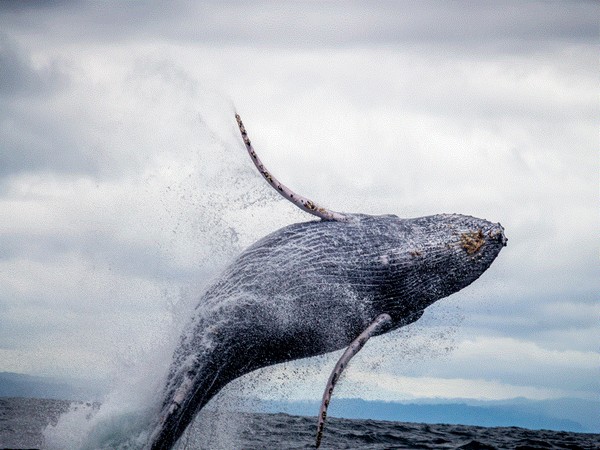
Representative Image

Washington [US], December 16 (ANI): Nature-based solutions to fight climate change take a holistic approach that promotes biodiversity and ecosystem preservation. While many efforts have focused on planting trees or restoring wetlands, researchers publishing in Trends in Ecology and Evolution on December 15 advocate for the importance of understanding the carbon sequestration potential of the planet's largest animals whales.
In their paper, the researchers explore how these marine giants can influence the amount of carbon in our air and waters and potentially contribute to the overall reduction of atmospheric carbon dioxide.
"Understanding the role of whales in the carbon cycle is a dynamic and emerging field that may benefit both marine conservation and climate-change strategies," write the authors, led by Heidi Pearson, a biologist from the University of Alaska Southeast. "This will require interdisciplinary collaboration between marine ecologists, oceanographers, biogeochemists, carbon-cycle modelers, and economists."
Whales can weigh up to 150 tons, live over 100 years, and be the size of large airplanes. Like all living things, their hefty biomass is composed largely of carbon and they make up one of the largest living carbon pools in the pelagic ocean, part of the marine system that is responsible for storing 22% of Earth's total carbon.
"Their size and longevity allow whales to exert strong effects on the carbon cycle by storing carbon more effectively than small animals, ingesting extreme quantities of prey, and producing large volumes of waste products," write the authors. "Considering that baleen whales have some of the longest migrations on the planet, they potentially influence nutrient dynamics and carbon cycling over ocean-basin scales."
Whales consume up to 4% of their massive body weight in krill and photosynthetic plankton every day. For the blue whale, this equates to nearly 8,000 pounds. When they finish digesting their food, their excrement is rich in important nutrients that help these krill and plankton flourish, aiding in increased photosynthesis and carbon storage from the atmosphere.
A blue whale can live up to 90 years. When they die and their bodies fall to the seafloor, the carbon they contain is transferred to the deep sea as they decay. This supplements the biological carbon pump, where nutrients and chemicals are exchanged between the ocean and the atmosphere through complex biogeochemical pathways. Commercial hunting, the largest source of population decline, has decreased whale populations by 81%, with unknown effects on biological carbon pump.
"Whale recovery has the potential for long-term self-sustained enhancement of the ocean carbon sink," the authors write. "The full carbon dioxide reduction role of great whales (and other organisms) will only be realized through robust conservation and management interventions that directly promote population increases." (ANI)


Get the App

What to Read Next

Science

Study reveals impact of animals as architects of Earth

Study reveals impact of animals as architects of Earth

A new study led by Professor Gemma Harvey from Queen Mary University of London has revealed how hundreds of species shape the landscapes we depend on, from termite mounds visible from space to beavers creating wetlands and hippos carving drainage systems.

Read More
Science

Microbes help detoxify our atmosphere, says study 

Microbes help detoxify our atmosphere, says study 

Melbourne researchers have uncovered important new information on how microbes absorb huge amounts of carbon monoxide (CO) and assist in reducing levels of this deadly gas.

Read More
Science

Astronomers find the smallest main-belt asteroids ever detected:

Astronomers find the smallest main-belt asteroids ever detected:

The majority of known asteroids orbit inside the main asteroid belt, which is positioned between Mars and Jupiter at an average distance of around 250 million km from Earth. Since the discovery of the first asteroid in 1801, about 750.000 asteroids have been identified, primarily in the last decade thanks to several optical surveys that examine the sky on clear nights.

Read More
Science

Tool for detecting problems during protein synthesis

Tool for detecting problems during protein synthesis

Protein synthesis in eukaryotic cells--found in plants, animals, and fungi--involves more than just the straightforward ribosome assembly of amino acids.

Read More
Science

Researchers shed light on possible endosymbiosis

Researchers shed light on possible endosymbiosis

Endosymbiosis is a remarkable biological phenomenon in which one creature resides within another. Such an unconventional partnership is usually advantageous to both parties. Even in human bodies, we find evidence of such cohabitation: mitochondria, the cells' powerhouses, originated from an ancient endosymbiosis. Bacteria long ago invaded and colonized other cells. This coexistence created the groundwork for mitochondria, which are found in the cells of plants, animals, and fungi.

Read More
Science

Fossil study finds how sea level changes shaped early life

Fossil study finds how sea level changes shaped early life

A newly developed timeline of early animal fossils suggests a relationship between sea level fluctuations, variations in marine oxygen, and the appearance of the earliest ancestors of present-day animals.

Read More
Science

Chemists design novel method for generating sustainable fuel

Chemists design novel method for generating sustainable fuel

Tuning this environment by controlling how the CoPc catalyst was distributed on the carbon nanotube surface allowed carbon dioxide to be as much as eight times more likely to produce methanol, a discovery that could increase the efficiency of other catalytic processes and have a widespread impact on other fields, said Robert Baker, co-author of the study and a professor in chemistry and biochemistry at The Ohio State University.

Read More
Science

Study finds biodiversity is key to better mental health

Study finds biodiversity is key to better mental health

A study by King's College London found that spaces with a variety of natural features are associated with better mental health than spaces with less natural diversity.

Read More
Science

Google marks total solar eclipse with special animation

Google marks total solar eclipse with special animation

A total solar eclipse is slated to take place today when the Moon will pass between the Sun and Earth, completely blocking out the Sun's light.

Read More
Science

Climate change disrupts vital ecosystems in Alps: Study

Climate change disrupts vital ecosystems in Alps: Study

Reduced snow cover and altering vegetation patterns in the Alps, both caused by climate change, are having significant combined effects on biodiversity and ecosystem functioning in the high mountains, according to a new study.

Read More
Home About Us Our Products Advertise Contact Us Terms & Condition Privacy Policy

Copyright © aninews.in | All Rights Reserved.


