 हिंदी खबर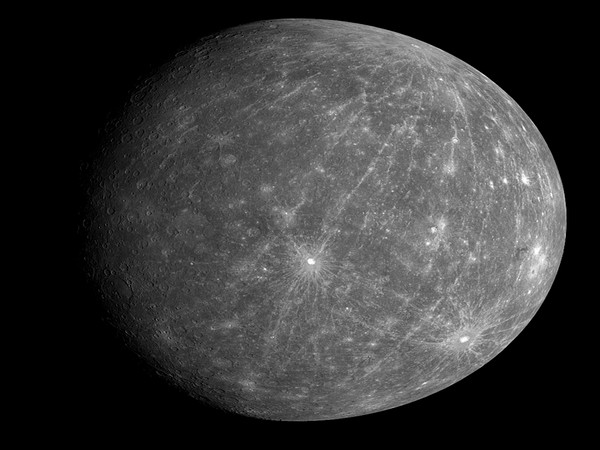

Anchorage (Alaska) [US], April 4 (ANI): A team of scientists has identified that Mercury, the solar system's smallest planet has geomagnetic storms similar to those on Earth.
The findings of the research were published in the journal, 'Nature Communications'.
The findings have answered whether other planets, including those outside our solar system, can have geomagnetic storms regardless of the size of their magnetosphere or whether they have an Earth-like ionosphere.
The study has proven that the planet has a ring current, a doughnut-shaped field of charged particles flowing laterally around the planet and excluding the poles. The second proves the existence of geomagnetic storms triggered by the ring current.
A geomagnetic storm is a major disturbance in a planet's magnetosphere caused by the transfer of energy from the solar wind. Such storms in Earth's magnetosphere produce the aurora and can disrupt radio communications.
"The processes are quite similar to here on Earth,' said Zhang on Mercury's magnetic storms, who is the co-author of the study.
"The main differences are the size of the planet and Mercury has a weak magnetic field and virtually no atmosphere," he added.
Confirmation about geomagnetic storms on Mercury results from research made possible by a fortuitous coincidence. A series of coronal mass ejections from the sun on April 8-18, 2015, and the end of NASA's Messenger space probe, which launched in 2004 and crashed into the planet's surface on April 30, 2015, at the expected end of its mission.
A coronal mass ejection, or CME, is an ejected cloud of the sun's plasma -- a gas made of charged particles. That cloud includes the plasma's embedded magnetic field.
The coronal mass ejection of April 14 proved to be the key for scientists. It compressed Mercury's ring current on the sun-facing side and increased the current's energy.
New analysis of data, which had dropped closer to the planet, showed "the presence of a ring current intensification that is essential for triggering magnetic storms.'
"The sudden intensification of a ring current causes the main phase of a magnetic storm," Zhang said.
But this doesn't mean Mercury has auroral displays like those on Earth.
On Earth, the storms produce aurora displays when solar wind particles interact with the particles of the atmosphere. On Mercury, however, solar wind particles don't encounter an atmosphere. Instead, they reach the surface unimpeded and may therefore be visible only through X-ray and gamma ray examination.
The results of the two papers show that magnetic storms are "potentially a common feature of magnetized planets," the analysis read.
"The results obtained from Messenger provide a further fascinating insight into Mercury's place in the evolution of the solar system following the discovery of its intrinsic planetary magnetic field," the analysis concluded. (ANI)




