

ADD ANI AS A TRUSTED SOURCE
googleads
ANI Logo
Menu
Science

Scientists predict efficiency of oxygen-evolving electrolysis on Moon and Mars in new study

Manchester [England], February 12 (ANI): Often the question has arisen of whether Earth is the only planet with living organisms or not and what would be the conditions suitable for the growth and survival of life? Scientists have now provided more insight into the possibility of establishing a pathway to generate oxygen for humans to potentially call the Moon or Mars 'home' for extended periods of time.

ANI Feb 12, 2022 12:34 IST googleads

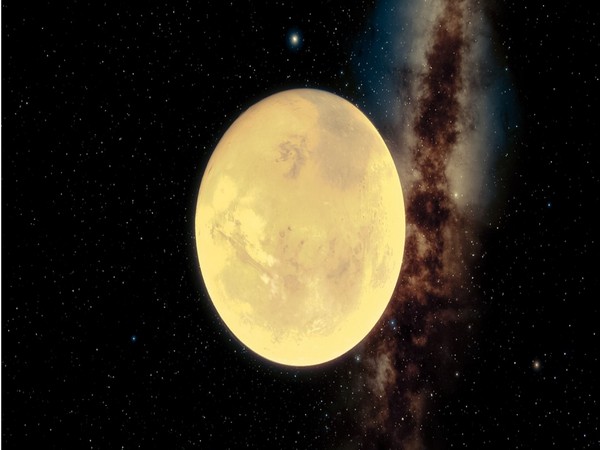
Representative image

Manchester [England], February 12 (ANI): Often the question has arisen of whether Earth is the only planet with living organisms or not and what would be the conditions suitable for the growth and survival of life? Scientists have now provided more insight into the possibility of establishing a pathway to generate oxygen for humans to potentially call the Moon or Mars 'home' for extended periods of time.
New research published in 'Nature Communications', demonstrated how a team of researchers from The University of Manchester and the University of Glasgow undertook experiments to determine how the potentially life-giving electrolysis method acted in reduced gravity conditions.
Creating a reliable source of oxygen could help humanity establish liveable habitats off-Earth in an era where space travel is more achievable than ever before. Electrolysis is a popular potential method which involves passing electricity through a chemical system to drive a reaction and can be used to extract oxygen out of lunar rocks or to split water into hydrogen and oxygen. This can be useful for both life support systems as well as for the in-situ production of rocket propellant.
Until now, however, how lower gravitational fields on the Moon (1/6th of Earth's gravity) and Mars (1/3rd of Earth's gravity) might affect gas-evolving electrolysis when compared to known conditions here on Earth had not been investigated in detail. Lower gravity can have a significant impact on electrolysis efficiency, as bubbles can remain stuck to electrode surfaces and create a resistive layer.
Lead engineer of the project, Gunter Just, said, "We designed and built a small centrifuge that could generate a range of gravity levels relevant to the Moon and Mars, and operated it during microgravity on a parabolic flight, to remove the influence of Earth's gravity."
"When doing an experiment in the lab, you cannot escape the gravity of Earth; in the almost zero-g background in the aircraft, however, our electrolysis cells were only influenced by the centrifugal force and so we could tune the gravity-level of each experiment by changing the rotation speed. The centrifuge had four 25 cm arms that each held an electrolysis cell equipped with a variety of sensors, so during each parabola of around 18 seconds we did four simultaneous experiments on the spinning system."
"We also operated the same experiments on the centrifuge between 1 and 8 g in the laboratory. In this configuration we had the arms swinging so that the downwards gravity was accounted for. It was found that the trend observed below 1 g was consistent with the trend above 1 g, which experimentally verified that high gravity platforms can be used to predict electrolysis behaviour in lunar gravity, removing the limitations of needing costly and complex microgravity conditions. In our system, we found that 11 per cent less oxygen was produced in lunar gravity, if the same operating parameters were used as on Earth."
The additional power requirement was more modest at around 1 per cent. These specific values are only relevant to the small test cell but demonstrate that the reduced efficiency in low gravity environments must be taken into account when planning power budgets or product output for a system operating on the Moon or Mars.
If the impact on power or product output was deemed too large for a system to function properly, some adaptations could be made that may reduce the effect of gravity, such as using a specially structured electrode surface or introducing flow or stirring. (ANI)


Get the App

What to Read Next

Science

Amphibians bounce-back from Earth’s greatest mass extinction

Amphibians bounce-back from Earth’s greatest mass extinction

Researchers at the University of Bristol discovered that ancient frog ancestors survived the biggest mass extinction of species by eating on freshwater prey that evaded terrestrial predators.

Read More
Science

New insights into how cancer evades the immune system: Study

New insights into how cancer evades the immune system: Study

Immunotherapy research primarily focuses on better recognition of cancer cells by the body's own immune system. Researchers at Amsterdam UMC and Moffitt Cancer Center have taken a different approach.

Read More
Science

Scientists use AI to better understand nanoparticles: Study

Scientists use AI to better understand nanoparticles: Study

A group of scientists has created a way to illuminate the dynamic behavior of nanoparticles, which are essential components in the production of pharmaceuticals, electronics, and industrial and energy-conversion materials.

Read More
Science

Strand Life Sciences launches portal for rare disease diagnosis

Strand Life Sciences launches portal for rare disease diagnosis

Marking Rare Disease Day, Strand Life Sciences, a subsidiary of Reliance Industries and a leading genomics research company, has launched the StrandOmics Portal, an innovative digital platform designed to assist doctors in diagnosing rare diseases more efficiently.

Read More
Science

Study reveals impact of animals as architects of Earth

Study reveals impact of animals as architects of Earth

A new study led by Professor Gemma Harvey from Queen Mary University of London has revealed how hundreds of species shape the landscapes we depend on, from termite mounds visible from space to beavers creating wetlands and hippos carving drainage systems.

Read More
Science

'Creation of black holes without singularities through gravity'

'Creation of black holes without singularities through gravity'

Traditional black holes, as predicted by Albert Einstein's theory of General Relativity, contain what are known as singularities, i.e. points where the laws of physics break down. Identifying how singularities are resolved in the context of quantum gravity is one of the fundamental problems in theoretical physics. Now, a team of experts has described the creation of regular black holes from gravitational effects without the need for the existence of exotic matter required by some previous models.

Read More
Science

New technology enhances gravitational-wave detection: Study

New technology enhances gravitational-wave detection: Study

A team of physicists led by Jonathan Richardson of the University of California, Riverside, demonstrated how new optical technology can extend the detection range of gravitational-wave observatories such as the Laser Interferometer Gravitational-Wave Observatory, or LIGO, and pave the way for future observatories.

Read More
Science

Microbes help detoxify our atmosphere, says study 

Microbes help detoxify our atmosphere, says study 

Melbourne researchers have uncovered important new information on how microbes absorb huge amounts of carbon monoxide (CO) and assist in reducing levels of this deadly gas.

Read More
Science

Weather change linked to heightened risk of Salmonella outbreaks

Weather change linked to heightened risk of Salmonella outbreaks

According to new research from the University of Surrey, climate change has an impact on Salmonella spread. This study builds on prior work by the researchers, which discovered that weather change is contributing to the spread of deadly diarrhoeal illnesses.

Read More
Science

AI can reveals hidden hazards of chemical mixtures in rivers

AI can reveals hidden hazards of chemical mixtures in rivers

Artificial intelligence can provide important insights into how complex chemical mixes in rivers affect aquatic life, paving the path for more effective environmental protection.

Read More
Home About Us Our Products Advertise Contact Us Terms & Condition Privacy Policy

Copyright © aninews.in | All Rights Reserved.


