

ADD ANI AS A TRUSTED SOURCE
googleads
ANI Logo
Menu
Science

Scientists find the factors influencing behaviour of whale shark

Washington [US], July 2 (ANI): A new research led by scientists from the Smithsonian Tropical Research Institute, the Anderson Cabot Center for Ocean Life and the University of Panama revealed that the globe-trotter is the largest fish in the ocean that can be found basking in the coastal waters of the Panamanian Pacific.

ANI Jul 02, 2022 15:53 IST googleads

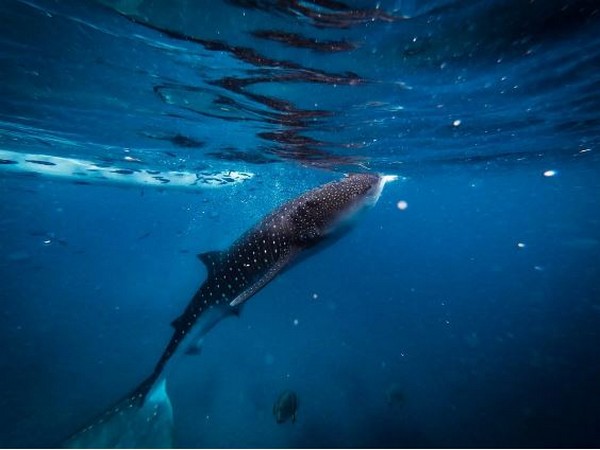
Representative image

Washington [US], July 2 (ANI): A new research led by scientists from the Smithsonian Tropical Research Institute, the Anderson Cabot Center for Ocean Life and the University of Panama revealed that the globe-trotter is the largest fish in the ocean that can be found basking in the coastal waters of the Panamanian Pacific.
There is more information known about the habits of whale shark Rhincodon typus. With the help of satellite tracking, a group of scientists found 30 of them in the region. The study also helps to discover the influencing factors that endangered change in species behaviour.
The findings of the study were published in the journal Frontiers in Marine Science.
The R. typus, like other large sharks, may take years or even decades to reach maturity and reproduce, making them vulnerable to population declines, especially when combined with human threats. For instance, they may be caught in fishing nets as bycatch or face the risk of vessel strikes when shipping lanes overlap with their feeding sites. Being able to understand and predict whale shark behavior is a necessary step for protecting the species.
The satellite monitoring of this species, led by STRI marine ecologist Hector Guzman, found that whale sharks feed mainly in coastal waters, seamounts and ridges of the Panamanian Pacific, where they can find an abundance of their favorite foods: small fish and plankton. They were also spotted swimming north and southbound along the coast, towards Mexico and Ecuador, and towards the open ocean to feed.
"This species requires clear regional planning," said Guzman. "Once the feeding and breeding aggregation areas are identified, some protection measures should be implemented. The newly announced marine protected area expansions across the region provide an interesting platform for large-scale conservation practices."
Although they used marine protected areas, the whale sharks also spent time in industrial fishing and vessel traffic zones, which could endanger them according to the new article published in Frontiers in Marine Science.
"The study shows how complex it is to protect whale sharks: tagged individuals visited 17 marine protected areas in 5 countries, but more than 77% of their time they were in areas without any protection," said Catalina Gomez, co-author of the study and marine ecologist at the University of Panama.
Thus, for highly migratory and endangered species such as the whale shark, conservation measures should go beyond the establishment of local marine protected areas.
Efforts should focus on protecting large oceanic areas and establishing marine corridors that transcend national borders, for example: the newly expanded Cordillera de Coiba Marine Protected Area in Panama or the Marine Conservation Corridor of the Eastern Tropical Pacific which connects Coiba with Costa Rica's Cocos Islands, the Galapagos in Ecuador and Colombia's Malpelo Island.
"A periodic tagging program should continue for two main reasons: first, we still don't know where the species reproduces and tracking may lead us in the right direction," said Guzman. "Second, we know that they are moving across extensive areas. We have identified potential corridors or seaways, as well as aggregation areas, that require management attention and clear protection rules. Tracking will allow us to better identify those regional routes."
The satellite tracking also revealed a whale shark migratory pattern that seems to be associated with circular ocean currents called eddies.
"Eddies are recognized as potential feeding areas for migratory species or food epicenters in the oceans, so they can swim in those areas for a long time while foraging and feeding," said Guzman. "However, eddies are dynamic systems and change constantly in speed or strength, size and location, even seasonally. These feeding areas are important for conservation, especially considering their dynamics and potential changes associated with climate change." (ANI)


Get the App

What to Read Next

Science

New method guides magnetism without magnets

New method guides magnetism without magnets

Researchers at Paul Scherrer Institute PSI have demonstrated an innovative method to control magnetism in materials using an energy-efficient electric field.

Read More
Science

Amphibians bounce-back from Earth’s greatest mass extinction

Amphibians bounce-back from Earth’s greatest mass extinction

Researchers at the University of Bristol discovered that ancient frog ancestors survived the biggest mass extinction of species by eating on freshwater prey that evaded terrestrial predators.

Read More
Science

New insights into how cancer evades the immune system: Study

New insights into how cancer evades the immune system: Study

Immunotherapy research primarily focuses on better recognition of cancer cells by the body's own immune system. Researchers at Amsterdam UMC and Moffitt Cancer Center have taken a different approach.

Read More
Science

Scientists use AI to better understand nanoparticles: Study

Scientists use AI to better understand nanoparticles: Study

A group of scientists has created a way to illuminate the dynamic behavior of nanoparticles, which are essential components in the production of pharmaceuticals, electronics, and industrial and energy-conversion materials.

Read More
Science

New device could allow you to taste cake in virtual reality

New device could allow you to taste cake in virtual reality

The 'e-Taste' interface employs sensors and wireless chemical dispensers to enable remote taste perception, often known as gestation. Field testing done by researchers at The Ohio State University confirmed the device's ability to digitally simulate a range of taste intensities, while still offering variety and safety for the user.

Read More
Science

Study reveals impact of animals as architects of Earth

Study reveals impact of animals as architects of Earth

A new study led by Professor Gemma Harvey from Queen Mary University of London has revealed how hundreds of species shape the landscapes we depend on, from termite mounds visible from space to beavers creating wetlands and hippos carving drainage systems.

Read More
Science

Opposing arrows of time emerge from certain quantum systems

Opposing arrows of time emerge from certain quantum systems

Researchers at the University of Surrey made a thought-provoking discovery. A new study reveals that opposing arrows of time can theoretically emerge from certain quantum systems.

Read More
Science

COVID-19 severity may be predicted by White Blood Cell Count

COVID-19 severity may be predicted by White Blood Cell Count

A COVID-19 diagnosis is no longer as frightening as it used to be, thanks to developments in treatment choices. However, a new study reveals that leukocyte (white blood cell) count may now be used to identify who is more likely to develop more significant disease symptoms.

Read More
Science

Seals can essentially act as 'smart sensors': Study

Seals can essentially act as 'smart sensors': Study

A new study by marine biologists reports that seals can essentially act as 'smart sensors' for monitoring fish populations in the ocean's eerily dim 'twilight zone.'

Read More
Science

New technology enhances gravitational-wave detection: Study

New technology enhances gravitational-wave detection: Study

A team of physicists led by Jonathan Richardson of the University of California, Riverside, demonstrated how new optical technology can extend the detection range of gravitational-wave observatories such as the Laser Interferometer Gravitational-Wave Observatory, or LIGO, and pave the way for future observatories.

Read More
Home About Us Our Products Advertise Contact Us Terms & Condition Privacy Policy

Copyright © aninews.in | All Rights Reserved.
