

ADD ANI AS A TRUSTED SOURCE
googleads
ANI Logo
Menu
Science

Scientists discover aggressive 'hot spots' inside breast cancer tumours

Quebec [Canada], October 31 (ANI): By using a novel technique, researchers have found tiny and previously undetectable 'hot spots' of extremely high stiffness inside breast cancer tumours. A team of McGill University researchers has found these 'hot spots' inside aggressive and invasive breast cancer tumours.

ANI Oct 31, 2020 14:44 IST googleads

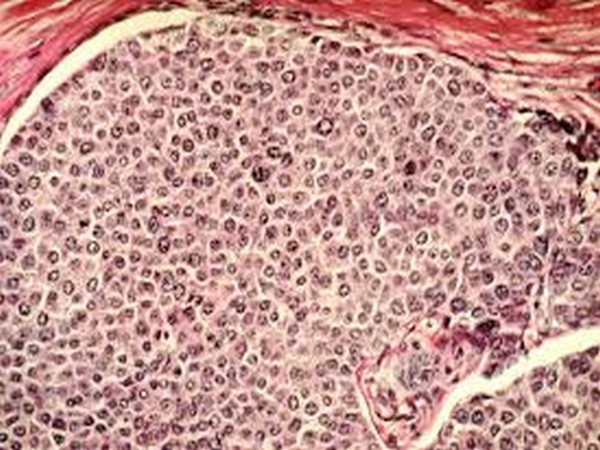
Representative image

Quebec [Canada], October 31 (ANI): By using a novel technique, researchers have found tiny and previously undetectable 'hot spots' of extremely high stiffness inside breast cancer tumours. A team of McGill University researchers has found these 'hot spots' inside aggressive and invasive breast cancer tumours.
Their findings suggest, for the first time, that only very tiny regions of a tumour need to stiffen for metastasis to take place. Though still in its infancy, the researchers believe that their technique may prove useful in detecting and mapping the progression of aggressive cancers.
"We are now able to see these features because our approach allows us to take measurements within living, intact, 3D tissues," said Chris Moraes, from the University's Department of Chemical Engineering, a Canada Research Chair and senior author on a recent research paper in Nature Communications. "When tissue samples are disrupted in any way, as is normally required with standard techniques, signs of these 'hot spots' are eliminated."
'Smart' hydrogels provide information about cancer progression
The researchers built tiny hydrogel sensors that can expand on demand, much like inflating balloons the size of individual cells and placed them inside 3D cultures and mouse models of breast cancer. When triggered, the expansion of the hydrogel can be used to measure very local stiffness inside the tumour.
This unusual technique, developed through a collaboration between McGill's Department of Chemical Engineering and the Rosalind and Morris Goodman Cancer Research Centre at McGill, allows the researchers to sense, from the perspective of a cancer cell, what is going on in their surrounding environment.
What cells sense drives their behaviour
"Human cells are not static. They grab and pull on the tissue around them, checking out how rigid or soft their surroundings are. What cells feel around them typically drives their behaviour: immune cells can activate, stem cells can become specialized, and cancer cells can become dangerously aggressive," explained Moraes. "Breast cancer cells usually feel surroundings that are quite soft. However, we found that cancer cells inside aggressive tumours experienced much harder surroundings than previously expected, as hard as really old and dried up gummy bears."
The researchers believe that their findings suggest new ways in which cell mechanics, even at the early stages of breast cancer, might affect disease progression.
"Developing methods to analyze the mechanical profiles in 3D tissues may better predict patient risk and outcome," said Stephanie Mok, the first author on the paper and a PhD candidate in the Department of Chemical Engineering. "Whether these 'hot spots' of stiffness are really causing cancer progression rather than simply being correlated with it remains an open, but critically important question to resolve." (ANI)


Get the App

What to Read Next

Science

New method guides magnetism without magnets

New method guides magnetism without magnets

Researchers at Paul Scherrer Institute PSI have demonstrated an innovative method to control magnetism in materials using an energy-efficient electric field.

Read More
Science

Amphibians bounce-back from Earth’s greatest mass extinction

Amphibians bounce-back from Earth’s greatest mass extinction

Researchers at the University of Bristol discovered that ancient frog ancestors survived the biggest mass extinction of species by eating on freshwater prey that evaded terrestrial predators.

Read More
Science

New insights into how cancer evades the immune system: Study

New insights into how cancer evades the immune system: Study

Immunotherapy research primarily focuses on better recognition of cancer cells by the body's own immune system. Researchers at Amsterdam UMC and Moffitt Cancer Center have taken a different approach.

Read More
Science

Scientists use AI to better understand nanoparticles: Study

Scientists use AI to better understand nanoparticles: Study

A group of scientists has created a way to illuminate the dynamic behavior of nanoparticles, which are essential components in the production of pharmaceuticals, electronics, and industrial and energy-conversion materials.

Read More
Science

New device could allow you to taste cake in virtual reality

New device could allow you to taste cake in virtual reality

The 'e-Taste' interface employs sensors and wireless chemical dispensers to enable remote taste perception, often known as gestation. Field testing done by researchers at The Ohio State University confirmed the device's ability to digitally simulate a range of taste intensities, while still offering variety and safety for the user.

Read More
Science

Study reveals impact of animals as architects of Earth

Study reveals impact of animals as architects of Earth

A new study led by Professor Gemma Harvey from Queen Mary University of London has revealed how hundreds of species shape the landscapes we depend on, from termite mounds visible from space to beavers creating wetlands and hippos carving drainage systems.

Read More
Science

Opposing arrows of time emerge from certain quantum systems

Opposing arrows of time emerge from certain quantum systems

Researchers at the University of Surrey made a thought-provoking discovery. A new study reveals that opposing arrows of time can theoretically emerge from certain quantum systems.

Read More
Science

COVID-19 severity may be predicted by White Blood Cell Count

COVID-19 severity may be predicted by White Blood Cell Count

A COVID-19 diagnosis is no longer as frightening as it used to be, thanks to developments in treatment choices. However, a new study reveals that leukocyte (white blood cell) count may now be used to identify who is more likely to develop more significant disease symptoms.

Read More
Science

Seals can essentially act as 'smart sensors': Study

Seals can essentially act as 'smart sensors': Study

A new study by marine biologists reports that seals can essentially act as 'smart sensors' for monitoring fish populations in the ocean's eerily dim 'twilight zone.'

Read More
Science

New technology enhances gravitational-wave detection: Study

New technology enhances gravitational-wave detection: Study

A team of physicists led by Jonathan Richardson of the University of California, Riverside, demonstrated how new optical technology can extend the detection range of gravitational-wave observatories such as the Laser Interferometer Gravitational-Wave Observatory, or LIGO, and pave the way for future observatories.

Read More
Home About Us Our Products Advertise Contact Us Terms & Condition Privacy Policy

Copyright © aninews.in | All Rights Reserved.


