

ADD ANI AS A TRUSTED SOURCE
googleads
ANI Logo
Menu
Science

Scientists date merger of Milky Way with dwarf galaxy

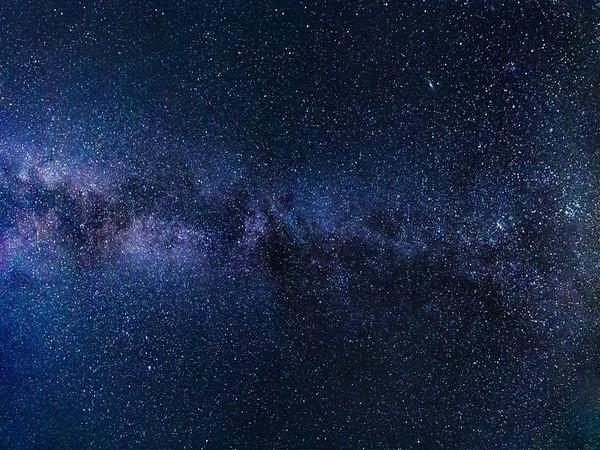
Washington D.C. [USA], Jan 14 (ANI): The dwarf galaxy Gaia-Enceladus collided with the Milky Way probably approximately 11.5 billion years ago. The Milky Way has encountered several other galaxies in its 13.5 billion-year history. One of them is the dwarf galaxy Gaia-Enceladus. To understand how this event affected our galaxy and changed it permanently, it is important to reliably date the collision.

ANI Jan 14, 2020 14:09 IST googleads

The Milky Way has encountered several other galaxies in its 13.5 billion-year history.

Washington D.C. [USA], Jan 14 (ANI): The dwarf galaxy Gaia-Enceladus collided with the Milky Way probably approximately 11.5 billion years ago. The Milky Way has encountered several other galaxies in its 13.5 billion-year history. One of them is the dwarf galaxy Gaia-Enceladus. To understand how this event affected our galaxy and changed it permanently, it is important to reliably date the collision.
A team of researchers including scientists from the Max Planck Institute for Solar System Research (MPS) in Germany for the first time used a single star affected by the collision as a clue for dating.
Using observational data from ground-based observatories and space telescopes, the scientists led by the University of Birmingham were able to determine the age of the star and the role it played in the collision. The research group describes its results in the issue of Nature Astronomy.
The researchers led by Prof. Dr. Bill Chaplin of the University of Birmingham turned their attention to a single star: nu Indi is found in the constellation Indus; with an apparent brightness comparable to that of Uranus, it is visible even to the naked eye and can be easily studied in detail.
"The space telescope TESS collected data from nu Indi already in its first month of scientific operation," says Dr Saskia Hekker, head of the research group "Stellar Ages and Galactic Evolution (SAGE)" at MPS and co-author of the new study.
The space telescope was launched in 2018 to perform a full-sky survey and characterise as many stars as possible. "The data from TESS allow us to determine the age of the star very accurately," Hekker adds.
Moreover, nu Indi provided clues on the history of the collision with the dwarf galaxy Gaia-Enceladus. To reconstruct its role in the collision, the research group evaluated numerous data sets on nu Indi obtained with the help of the spectrographs HARPS (High Accuracy Radial velocity Planet Searcher) and FEROS (Fiber-fed Extended Range Optical Spectrograph) of the European Southern Observatory, the Galaxy Evolution Experiment of the Apache Point Observatory in New Mexico, and ESA's Gaia Space Telescope. This allowed them to specify both the chemical composition of the star and its movement within the galaxy with great precision.
The cosmic detective work produced a clear picture: nu Indi has been part of the halo, the outer region of the Milky Way, and the collision changed its trajectory. "Since the motion of nu Indi was affected by the collision, it must have taken place when the star was already formed," Chaplin explains the line of argument. The age of the star, therefore, puts a constraint on the time of the collision.
To determine the age of a star, researchers use its natural oscillations, which can be observed as brightness fluctuations. "Similar to the way seismic waves on Earth allow conclusions about the interior of our planet, stellar oscillations help us to reveal the internal structure and composition of the star and thus its age," explains MPS scientist and co-author Dr Nathalie Themessl.
The calculations carried out by MPS researchers and other research groups showed that with a probability of 95 percent the galaxy merger must have occurred 13.2 billion years ago. With a probability of 68 percent, the collision took place approximately 11.5 billion years ago. "This chronological classification not only helps us to understand how the collision changed our galaxy," says Hekker. "It also gives us a sense, of how collisions and mergers impacted other galaxies and influenced their evolution." (ANI)

Get the App

What to Read Next

Science

New method guides magnetism without magnets

New method guides magnetism without magnets

Researchers at Paul Scherrer Institute PSI have demonstrated an innovative method to control magnetism in materials using an energy-efficient electric field.

Read More
Science

Amphibians bounce-back from Earth’s greatest mass extinction

Amphibians bounce-back from Earth’s greatest mass extinction

Researchers at the University of Bristol discovered that ancient frog ancestors survived the biggest mass extinction of species by eating on freshwater prey that evaded terrestrial predators.

Read More
Science

New insights into how cancer evades the immune system: Study

New insights into how cancer evades the immune system: Study

Immunotherapy research primarily focuses on better recognition of cancer cells by the body's own immune system. Researchers at Amsterdam UMC and Moffitt Cancer Center have taken a different approach.

Read More
Science

Scientists use AI to better understand nanoparticles: Study

Scientists use AI to better understand nanoparticles: Study

A group of scientists has created a way to illuminate the dynamic behavior of nanoparticles, which are essential components in the production of pharmaceuticals, electronics, and industrial and energy-conversion materials.

Read More
Science

New device could allow you to taste cake in virtual reality

New device could allow you to taste cake in virtual reality

The 'e-Taste' interface employs sensors and wireless chemical dispensers to enable remote taste perception, often known as gestation. Field testing done by researchers at The Ohio State University confirmed the device's ability to digitally simulate a range of taste intensities, while still offering variety and safety for the user.

Read More
Science

Study reveals impact of animals as architects of Earth

Study reveals impact of animals as architects of Earth

A new study led by Professor Gemma Harvey from Queen Mary University of London has revealed how hundreds of species shape the landscapes we depend on, from termite mounds visible from space to beavers creating wetlands and hippos carving drainage systems.

Read More
Science

Opposing arrows of time emerge from certain quantum systems

Opposing arrows of time emerge from certain quantum systems

Researchers at the University of Surrey made a thought-provoking discovery. A new study reveals that opposing arrows of time can theoretically emerge from certain quantum systems.

Read More
Science

COVID-19 severity may be predicted by White Blood Cell Count

COVID-19 severity may be predicted by White Blood Cell Count

A COVID-19 diagnosis is no longer as frightening as it used to be, thanks to developments in treatment choices. However, a new study reveals that leukocyte (white blood cell) count may now be used to identify who is more likely to develop more significant disease symptoms.

Read More
Science

Seals can essentially act as 'smart sensors': Study

Seals can essentially act as 'smart sensors': Study

A new study by marine biologists reports that seals can essentially act as 'smart sensors' for monitoring fish populations in the ocean's eerily dim 'twilight zone.'

Read More
Science

New technology enhances gravitational-wave detection: Study

New technology enhances gravitational-wave detection: Study

A team of physicists led by Jonathan Richardson of the University of California, Riverside, demonstrated how new optical technology can extend the detection range of gravitational-wave observatories such as the Laser Interferometer Gravitational-Wave Observatory, or LIGO, and pave the way for future observatories.

Read More
Home About Us Our Products Advertise Contact Us Terms & Condition Privacy Policy

Copyright © aninews.in | All Rights Reserved.




