

ADD ANI AS A TRUSTED SOURCE
googleads
Menu
Science

Scientists attempt to measure temperature of dark matter

California [USA], Jan 16 (ANI): We know that it exists and makes up about a quarter of our universe, but we have yet to see a particle of the elusive dark matter.

ANI Jan 16, 2020 17:08 IST googleads

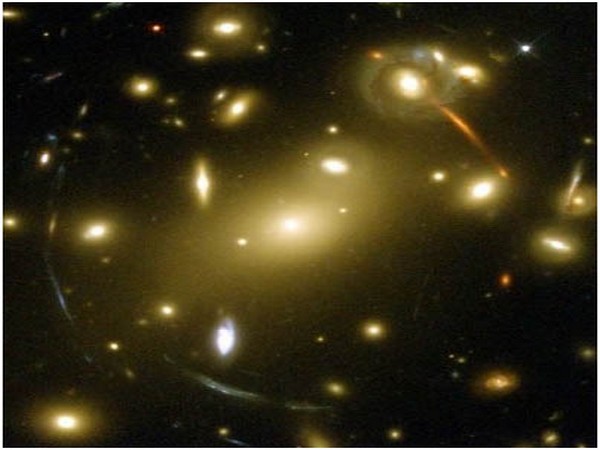
Gravity of clumps of dark matter can distort light from distant objects (Picture Courtesy: JPL-NASA)

California [USA], Jan 16 (ANI): We know that it exists and makes up about a quarter of our universe, but we are yet to see a particle of the elusive dark matter.
Although our current knowledge of this mysterious substance is highly limited, it can be said with a certain degree of surety that the gravity of clumps of dark matter can distort light from distant objects.
Chris Fassnacht, a physics professor at the University of California, Davis and his colleagues are using this distortion, called gravitational lensing, to measure the temperature of dark matter.
The standard model for dark matter is that it is 'cold,' meaning that the particles move slowly compared to the speed of light, Fassnacht said.
This is also tied to the mass of dark matter particles. The lower the mass of the particle, the 'warmer' it is and the faster it will move.
The model of cold (more massive) dark matter holds at very large scales, Fassnacht said, but doesn't work so well on the scale of individual galaxies.
That's led to other models including 'warm' dark matter with lighter, faster-moving particles. 'Hot' dark matter with particles moving close to the speed of light has been ruled out by observations.
Former UC Davis graduate student Jen-Wei Hsueh, Fassnacht, and colleagues used gravitational lensing to put a limit on the warmth and therefore the mass of dark matter.
They measured the brightness of seven distant gravitationally lensed quasars to look for changes caused by additional intervening blobs of dark matter and used these results to measure the size of these dark matter lenses.
If dark matter particles are lighter, warmer and more rapidly-moving, then they will not form structures below a certain size, Fassnacht said.
"Below a certain size, they would just get smeared out," he said.
The results put a lower limit on the mass of a potential dark matter particle while not ruling out cold dark matter, he said.
The team's results represent a major improvement over a previous analysis, from 2002, and are comparable to recent results from a team at UCLA.
Fassnacht hopes to continue adding lensed objects to the survey to improve the statistical accuracy.
"We need to look at about 50 objects to get a good constraint on how warm dark matter can be," he said. (ANI)

Get the App

What to Read Next

Science

New insights into how cancer evades the immune system: Study

New insights into how cancer evades the immune system: Study

Immunotherapy research primarily focuses on better recognition of cancer cells by the body's own immune system. Researchers at Amsterdam UMC and Moffitt Cancer Center have taken a different approach.

Read More
Science

Strand Life Sciences launches portal for rare disease diagnosis

Strand Life Sciences launches portal for rare disease diagnosis

Marking Rare Disease Day, Strand Life Sciences, a subsidiary of Reliance Industries and a leading genomics research company, has launched the StrandOmics Portal, an innovative digital platform designed to assist doctors in diagnosing rare diseases more efficiently.

Read More
Science

'Creation of black holes without singularities through gravity'

'Creation of black holes without singularities through gravity'

Traditional black holes, as predicted by Albert Einstein's theory of General Relativity, contain what are known as singularities, i.e. points where the laws of physics break down. Identifying how singularities are resolved in the context of quantum gravity is one of the fundamental problems in theoretical physics. Now, a team of experts has described the creation of regular black holes from gravitational effects without the need for the existence of exotic matter required by some previous models.

Read More
Science

Discovery of unexpected collagen structure to influence research

Discovery of unexpected collagen structure to influence research

Collagen, the body's most abundant protein, has long been considered a predictable structural component of tissues.

Read More
Science

Shubhanshu Shukla: IAF officer becomes first Indian astronaut for

Shubhanshu Shukla: IAF officer becomes first Indian astronaut for

Shubhanshu Shukla, Indian Air Force (IAF) officer and one of four astronauts for Indian Space Research Organisation's (ISRO) Gaganyaan mission, has been sele Shubhanshu Shukla, Indian Air Force (IAF) officer and one of four astronauts for Indian Space Research Organisation's (ISRO) Gaganyaan mission, has been selected as the pilot for Axiom Mission 4, scheduled for Spring 2025.cted as the pilot for Axiom Mission 4, scheduled for Spring 2025.

Read More
Home About Us Our Products Advertise Contact Us Terms & Condition Privacy Policy

Copyright © aninews.in | All Rights Reserved.


