

ADD ANI AS A TRUSTED SOURCE
googleads
ANI Logo
Menu
Science

School-bus-size asteroid to safely zoom past Earth

Washington [US], September 23 (ANI): A small near-Earth asteroid (or NEA) will briefly visit Earth's neighbourhood on Thursday, September 24, zooming past at a distance of about 13,000 miles (21,000 kilometres) above our planet's surface.

ANI Sep 23, 2020 17:59 IST googleads

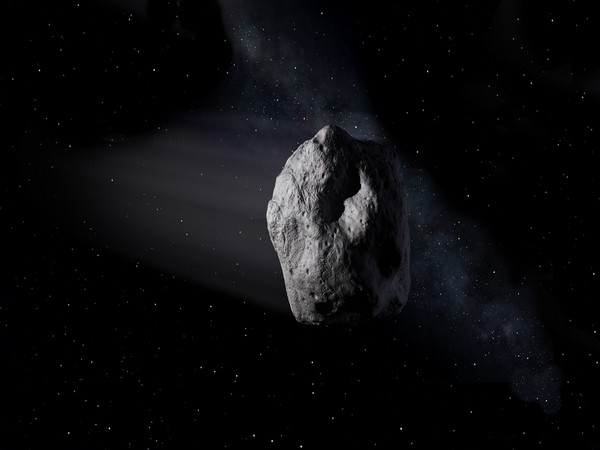
This illustration shows a near-Earth asteroid like asteroid 2020 SW traveling through space. (Image credit: NASA/JPL-Caltech)

Washington [US], September 23 (ANI): A small near-Earth asteroid (or NEA) will briefly visit Earth's neighbourhood on Thursday, September 24, zooming past at a distance of about 13,000 miles (21,000 kilometres) above our planet's surface.
The asteroid will make its close approach below the ring of geostationary satellites orbiting about 22,000 miles (36,000 km) away from Earth.
Scientists estimate that 2020 SW is roughly 15-30 feet (5-10 meters) in size, based on its brightness -- or about the size of a small school bus. Although it's not on an impact trajectory with Earth, if it were, the space rock would almost certainly break up high in the atmosphere, becoming a bright meteor known as a fireball.
"There are a large number of tiny asteroids like this one, and several of them approach our planet as close as this several times every year," said Paul Chodas, director of the Center for Near-Earth Object Studies (CNEOS) at NASA's Jet Propulsion Laboratory in Southern California. "In fact, asteroids of this size impact our atmosphere at an average rate of about once every year or two."
After asteroid 2020 SW was discovered on September 18 by the NASA-funded Catalina Sky Survey in Arizona, follow-up observations confirmed its orbital trajectory to high precision, ruling out any chance of impact. CNEOS scientists determined that it will make its closest approach at 4:12 am. PDT (7:12 am EDT [11:12 UTC]) on September 24 over the Southeastern Pacific Ocean. After Thursday's close approach, the asteroid will continue its journey around the Sun, not returning to Earth's vicinity until 2041, when it will make a much more distant flyby.
In 2005, Congress assigned NASA the goal of finding 90 per cent of the near-Earth asteroids that are about 460 feet (140 meters) or larger in size. These larger asteroids pose a much greater threat if they were to impact, and they can be detected much farther away from Earth because they're simply much brighter than the small ones. It is thought that there are over 100 million small asteroids like 2020 SW, but they are very hard to discover unless they get very close to Earth.
"The detection capabilities of NASA's asteroid surveys are continually improving, and we should now expect to find asteroids of this size a couple of days before they come near our planet," added Chodas. (ANI)


Get the App

What to Read Next

Science

New method guides magnetism without magnets

New method guides magnetism without magnets

Researchers at Paul Scherrer Institute PSI have demonstrated an innovative method to control magnetism in materials using an energy-efficient electric field.

Read More
Science

Amphibians bounce-back from Earth’s greatest mass extinction

Amphibians bounce-back from Earth’s greatest mass extinction

Researchers at the University of Bristol discovered that ancient frog ancestors survived the biggest mass extinction of species by eating on freshwater prey that evaded terrestrial predators.

Read More
Science

New insights into how cancer evades the immune system: Study

New insights into how cancer evades the immune system: Study

Immunotherapy research primarily focuses on better recognition of cancer cells by the body's own immune system. Researchers at Amsterdam UMC and Moffitt Cancer Center have taken a different approach.

Read More
Science

Scientists use AI to better understand nanoparticles: Study

Scientists use AI to better understand nanoparticles: Study

A group of scientists has created a way to illuminate the dynamic behavior of nanoparticles, which are essential components in the production of pharmaceuticals, electronics, and industrial and energy-conversion materials.

Read More
Science

New device could allow you to taste cake in virtual reality

New device could allow you to taste cake in virtual reality

The 'e-Taste' interface employs sensors and wireless chemical dispensers to enable remote taste perception, often known as gestation. Field testing done by researchers at The Ohio State University confirmed the device's ability to digitally simulate a range of taste intensities, while still offering variety and safety for the user.

Read More
Science

Strand Life Sciences launches portal for rare disease diagnosis

Strand Life Sciences launches portal for rare disease diagnosis

Marking Rare Disease Day, Strand Life Sciences, a subsidiary of Reliance Industries and a leading genomics research company, has launched the StrandOmics Portal, an innovative digital platform designed to assist doctors in diagnosing rare diseases more efficiently.

Read More
Science

Study reveals impact of animals as architects of Earth

Study reveals impact of animals as architects of Earth

A new study led by Professor Gemma Harvey from Queen Mary University of London has revealed how hundreds of species shape the landscapes we depend on, from termite mounds visible from space to beavers creating wetlands and hippos carving drainage systems.

Read More
Science

Opposing arrows of time emerge from certain quantum systems

Opposing arrows of time emerge from certain quantum systems

Researchers at the University of Surrey made a thought-provoking discovery. A new study reveals that opposing arrows of time can theoretically emerge from certain quantum systems.

Read More
Science

COVID-19 severity may be predicted by White Blood Cell Count

COVID-19 severity may be predicted by White Blood Cell Count

A COVID-19 diagnosis is no longer as frightening as it used to be, thanks to developments in treatment choices. However, a new study reveals that leukocyte (white blood cell) count may now be used to identify who is more likely to develop more significant disease symptoms.

Read More
Science

Seals can essentially act as 'smart sensors': Study

Seals can essentially act as 'smart sensors': Study

A new study by marine biologists reports that seals can essentially act as 'smart sensors' for monitoring fish populations in the ocean's eerily dim 'twilight zone.'

Read More
Home About Us Our Products Advertise Contact Us Terms & Condition Privacy Policy

Copyright © aninews.in | All Rights Reserved.


