

ADD ANI AS A TRUSTED SOURCE
googleads
ANI Logo
Menu
Science

Scanty rain: Amazon even more vulnerable than previously thought

Washington [US], August 3 (ANI): Researchers have now used network analysis to understand the complex workings of one of Earth's most valuable and biodiverse carbon sinks.

ANI Aug 03, 2022 20:49 IST googleads

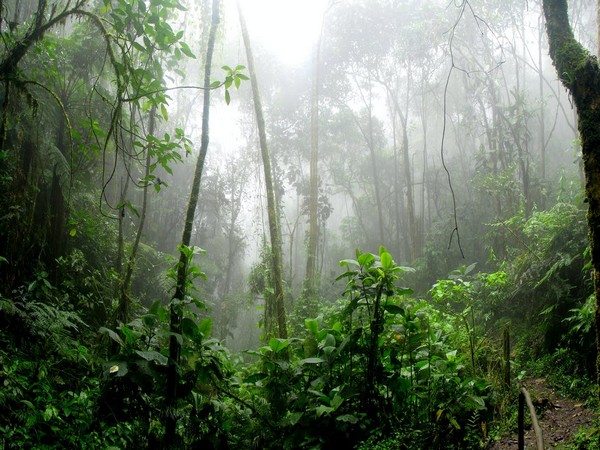
Representative Image

Washington [US], August 3 (ANI): Researchers have now used network analysis to understand the complex workings of one of Earth's most valuable and biodiverse carbon sinks.
The study is published in the journal 'Proceedings of the National Academy of Sciences (PNAS) on August 2.
The regions most at risk of turning into savannah are located on the forest's Southern fringes, where continuous clearing for pasture or soy has already been weakening the forest's resilience for years.
The rainforest in South America may be losing rain and with it, its moisture supply as climate change sends more frequent and more severe drought spells to the Amazon Basin. That lack of rain is life-threatening to the forest because it breathes water: Once rained down, the soil takes it up as much as the plants, and both release a great amount again through evaporation and transpiration. In this atmospheric moisture recycling, the forest creates much of its own weather, generating up to half of the rainfall over the Amazon Basin. And while it is highly efficient, the moisture recycling system ultimately relies on how much water is initially put into the system.
Scientists have now found that even if a dry spell affects only one specific region of the forest, its harm stretches beyond that region by a factor of 1.3: As lack of rain strongly decreases the water recycling volume, there will also be less rainfall in neighbouring regions, hence putting even more parts of the forest under significant stress. "More intensive droughts put parts of the Amazon rainforest at risk of drying off. Subsequently, due to the network effect, less forest cover leads to less water in the system overall, and hence disproportionally more harm. And while we've investigated the impact of drought, that rule also holds for deforestation. It means essentially when you chop down one acre of forest, what you actually are destroying is 1.3 acres," Nico Wunderling, author and researcher at the Potsdam Institute for Climate Impact Research, explains.
Climate science predicts that what used to be extraordinarily dry years in the Amazon region, like 2005 and 2010, may well become the new normal from 2050 onwards, with centennial droughts occurring in up to nine out of ten years by 2060. But droughts have different effects on forest systems within the Amazon. "In the Amazon, trees and forest systems are differently adapted to water availability, as some regions commonly exhibit a distinct dry season while others have rain all year round. We specifically acknowledge these local adaptations as they can be a blessing or curse under climate change," Boris Sakschewski, co-author of the study and also at the Potsdam Institute, remarks. "So we find that even the dry season adapted parts of the Amazon forest won't necessarily survive a new climate normal and the risk of tipping into savannah or no trees at all is high. The consequences for biodiversity would be disastrous, but the same goes for the local, regional and global climate."
"Yet not all is lost," says Ricarda Winkelmann, co-author of the study and leader of tipping elements research at the Potsdam Institute. "Our simulations do not show an endless downward slope. That is because a good part of the forest is still in relatively stable conditions. The network effects of dry spells are likely limited to certain areas in the forest's southeast and southwest - which happen to be those where the forest has been suffering from the human hand already, in clearing forest for pasture or soy. So there is still a lot we can do to try and stabilize the Amazon, as preserving it and its ecological services is of utmost importance for local, regional and global climate stability. And we know how we can do that: by protecting the rainforest from logging, and by rapidly reducing greenhouse gas emissions to limit further global warming." (ANI)


Get the App

What to Read Next

Science

New method guides magnetism without magnets

New method guides magnetism without magnets

Researchers at Paul Scherrer Institute PSI have demonstrated an innovative method to control magnetism in materials using an energy-efficient electric field.

Read More
Science

Amphibians bounce-back from Earth’s greatest mass extinction

Amphibians bounce-back from Earth’s greatest mass extinction

Researchers at the University of Bristol discovered that ancient frog ancestors survived the biggest mass extinction of species by eating on freshwater prey that evaded terrestrial predators.

Read More
Science

New insights into how cancer evades the immune system: Study

New insights into how cancer evades the immune system: Study

Immunotherapy research primarily focuses on better recognition of cancer cells by the body's own immune system. Researchers at Amsterdam UMC and Moffitt Cancer Center have taken a different approach.

Read More
Science

Scientists use AI to better understand nanoparticles: Study

Scientists use AI to better understand nanoparticles: Study

A group of scientists has created a way to illuminate the dynamic behavior of nanoparticles, which are essential components in the production of pharmaceuticals, electronics, and industrial and energy-conversion materials.

Read More
Science

New device could allow you to taste cake in virtual reality

New device could allow you to taste cake in virtual reality

The 'e-Taste' interface employs sensors and wireless chemical dispensers to enable remote taste perception, often known as gestation. Field testing done by researchers at The Ohio State University confirmed the device's ability to digitally simulate a range of taste intensities, while still offering variety and safety for the user.

Read More
Science

Strand Life Sciences launches portal for rare disease diagnosis

Strand Life Sciences launches portal for rare disease diagnosis

Marking Rare Disease Day, Strand Life Sciences, a subsidiary of Reliance Industries and a leading genomics research company, has launched the StrandOmics Portal, an innovative digital platform designed to assist doctors in diagnosing rare diseases more efficiently.

Read More
Science

Study reveals impact of animals as architects of Earth

Study reveals impact of animals as architects of Earth

A new study led by Professor Gemma Harvey from Queen Mary University of London has revealed how hundreds of species shape the landscapes we depend on, from termite mounds visible from space to beavers creating wetlands and hippos carving drainage systems.

Read More
Science

Opposing arrows of time emerge from certain quantum systems

Opposing arrows of time emerge from certain quantum systems

Researchers at the University of Surrey made a thought-provoking discovery. A new study reveals that opposing arrows of time can theoretically emerge from certain quantum systems.

Read More
Science

COVID-19 severity may be predicted by White Blood Cell Count

COVID-19 severity may be predicted by White Blood Cell Count

A COVID-19 diagnosis is no longer as frightening as it used to be, thanks to developments in treatment choices. However, a new study reveals that leukocyte (white blood cell) count may now be used to identify who is more likely to develop more significant disease symptoms.

Read More
Science

Seals can essentially act as 'smart sensors': Study

Seals can essentially act as 'smart sensors': Study

A new study by marine biologists reports that seals can essentially act as 'smart sensors' for monitoring fish populations in the ocean's eerily dim 'twilight zone.'

Read More


