

ADD ANI AS A TRUSTED SOURCE
googleads
Menu
Science

Researchers use silkworm silk hoping for better treatment of muscle atrophy

Washington [US], March 11 (ANI): Researchers at the Utah State University recently used the silk from silkworm to grow skeletal muscle cells, improving on traditional methods of cell culture and hopefully leading to better treatments for muscle atrophy.

ANI Mar 11, 2021 00:06 IST googleads

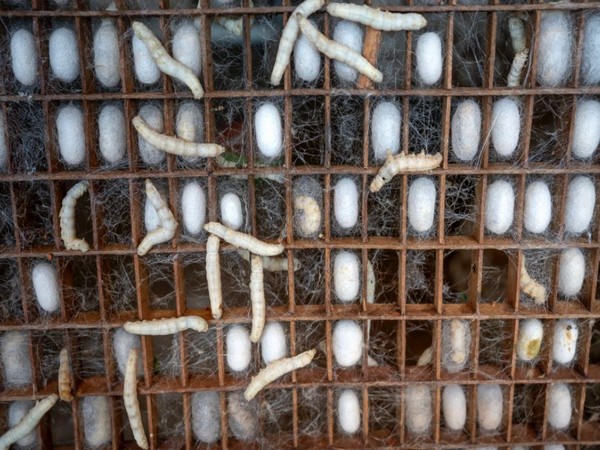
Representative Image

Washington [US], March 11 (ANI): Researchers at the Utah State University recently used the silk from silkworm to grow skeletal muscle cells, improving on traditional methods of cell culture and hopefully leading to better treatments for muscle atrophy.
When scientists are trying to understand the disease and test treatments, they generally grow model cells on a flat plastic surface (think petri dish). But growing cells on a two-dimensional surface has its limitations, primarily because muscle tissue is three-dimensional.
Thus, USU researchers developed a three-dimensional cell culture surface by growing cells on silk fibers that are wrapped around an acrylic chassis. The team used both native and transgenic silkworm silk, the latter produced by silkworms modified with spider silk genes.
Native silkworm silks have been used previously as three-dimensional cell culture models, but this is the first time that transgenic silkworm silk has been used for skeletal muscle modeling. Elizabeth Vargis, Matthew Clegg, and Jacob Barney of the Biological Engineering Department, and Justin Jones, Thomas Harris, and Xiaoli Zhang of the Biology Department published their findings in ACS Biomaterials Science and Engineering.
Cells grown on silkworm silk proved to more closely mimic human skeletal muscle than those grown on the usual plastic surface. These cells showed increased mechanical flexibility and increased expression of genes required for muscle contraction. Silkworm silk also encouraged proper muscle fiber alignment, a necessary element for robust muscle modeling.
Skeletal muscle is responsible for moving the skeleton, stabilizing joints, and protecting internal organs. The deterioration of these muscles can happen for myriad reasons, and it can happen swiftly. For example, after only two weeks of immobilization, a person can lose almost a quarter of their quadricep muscle strength. Understanding how muscles can atrophy so quickly must begin at a cellular level, with cells grown to better represent reality.
"The overarching goal of my research is to build better in vitro models," said Elizabeth Vargis, associate professor of biological engineering at USU. "Researchers grow cells on these 2D platforms, which aren't super realistic, but give us a lot of information. Based on those results, they usually transition into an animal model, then they move onto clinical trials, where a vast majority of them fail. I'm trying to add to that first step by developing more realistic in vitro models of normal and diseased tissue." (ANI)


Get the App

What to Read Next

Science

Amphibians bounce-back from Earth’s greatest mass extinction

Amphibians bounce-back from Earth’s greatest mass extinction

Researchers at the University of Bristol discovered that ancient frog ancestors survived the biggest mass extinction of species by eating on freshwater prey that evaded terrestrial predators.

Read More
Science

Scientists use AI to better understand nanoparticles: Study

Scientists use AI to better understand nanoparticles: Study

A group of scientists has created a way to illuminate the dynamic behavior of nanoparticles, which are essential components in the production of pharmaceuticals, electronics, and industrial and energy-conversion materials.

Read More
Science

New technology enhances gravitational-wave detection: Study

New technology enhances gravitational-wave detection: Study

A team of physicists led by Jonathan Richardson of the University of California, Riverside, demonstrated how new optical technology can extend the detection range of gravitational-wave observatories such as the Laser Interferometer Gravitational-Wave Observatory, or LIGO, and pave the way for future observatories.

Read More
Science

Astronomers find the smallest main-belt asteroids ever detected:

Astronomers find the smallest main-belt asteroids ever detected:

The majority of known asteroids orbit inside the main asteroid belt, which is positioned between Mars and Jupiter at an average distance of around 250 million km from Earth. Since the discovery of the first asteroid in 1801, about 750.000 asteroids have been identified, primarily in the last decade thanks to several optical surveys that examine the sky on clear nights.

Read More
Science

Study finds connection between quantum theory, information theory

Study finds connection between quantum theory, information theory

"Our results have no clear or direct application right now. It's basic research that lays the foundation for future technologies in quantum information and quantum computers. There's enormous potential for complete discoveries in many different research fields," said Guilherme B Xavier, a researcher in quantum communication at Linkoping University, Sweden.

Read More
Home About Us Our Products Advertise Contact Us Terms & Condition Privacy Policy

Copyright © aninews.in | All Rights Reserved.
